
11 Dutch startups that raised money in June
Every month, we list the investments that caught our attention the most.
Published on July 9, 2026
© Nearfield Instruments

Team IO+ selects and features the most important news stories on innovation and technology, carefully curated by our editors.
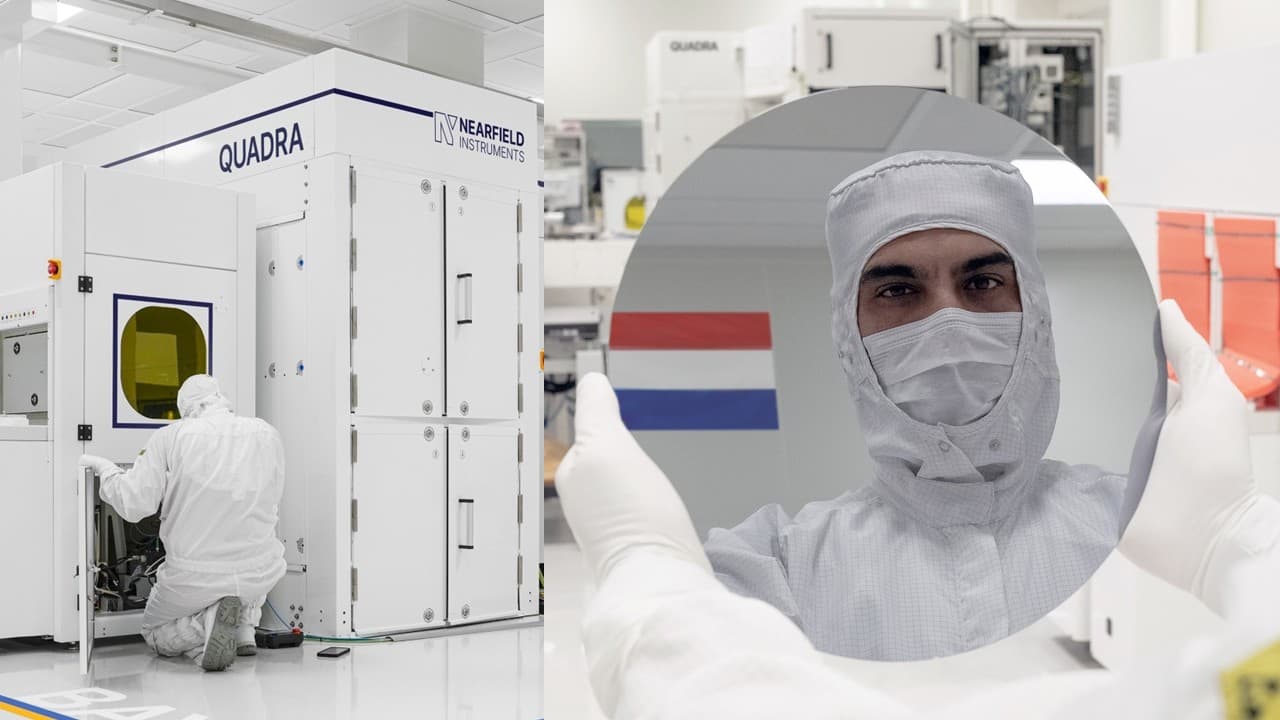
Nearfield Instruments raised €330 million
Nearfield Instruments raised a record €330 million, the largest ever deep tech investment in a Dutch company. The company develops measurement and inspection systems used in chip production. Its technology enables monitoring of tiny, complex chip structures during manufacturing. As the demand for more powerful, energy-efficient chips grows — which require increasingly complex architectures — tools like those of Nearfield are key to sustaining chip technology development. Thanks to this funding round, the company has become a unicorn, meaning it has reached a $1 billion valuation.
General Intuition landed $320 million
General Intuition received $320 in fresh funding from a diverse cohort of investors, including Jeff Bezos. The company trains AI models on around 2 billion video clips per year from 10 million gamers, using first-person, interactive gameplay footage to teach AI physics, space, and time. Its world models predict environment changes, while action models generate optimal actions — aiming to bring AI reasoning into physical-world tasks. If world models break through the way language models did, the consequences for the labor market could be significant — not just in white-collar services, but potentially enabling AI to perform physical work such as truck driving, plumbing, or care work.
Cybersecurity company Eye Security received €60 million
Eye Security, a The Hague-based cybersecurity company, raised €60 million. According to the company, this is the largest investment in a Dutch cybersecurity company. Eye Security offers small and medium-sized companies enterprise-level cybersecurity protection. Smaller companies lack the budget to have a dedicated security team. Eye Security helps them by providing threat detection and response, monitoring company software, and reacting to potential breaches.
Leyden Labs raised €40m for its spray against respiratory viruses
Leyden Labs, a Dutch biotechnology company developing a new class of nasal sprays to protect against respiratory viruses, has closed a €40 million funding round. Most vaccines and antibodies — often administered via injection — can indeed generate systemic immune responses. However, airborne viruses enter the body through the mouth or nose, so Leyden Labs is developing nasal sprays to intercept them at the point of entry before an infection can take hold.
€38 million for Volta Energy to replace diesel generators
Volta Energy, a company developing hybrid mobile energy systems, secured €38 million in funding. The scaleup develops and leases systems that combine solar energy, battery storage, and a biofuel generator. These systems provide temporary power in locations without a permanent connection, such as construction sites, telecom sites, and security projects. A Volta system can use up to 90% less diesel than a conventional generator.
Chip manufacturer XIVER secured €25 million
XIVER, an Eindhoven-based semiconductor company specializing in micro- and nanotechnology, has raised €25 million in growth capital. With this money, the company will expand its production capacity for advanced chips. XIVER is one of the few European companies that not only develop advanced micro- and nanosystems, but also scale them up to industrial production. The organization supports customers in transitioning from prototype to scalable chip production, a bottleneck that stifles many European companies.
ASML spin-off raised €20 million for chip inspection
Invisix, a spin-off of ASML, has raised €20 million for a new technology that allows chips to be inspected with much greater precision. The company aims to address a growing problem in the chip industry: minuscule defects that are barely detectable with current measurement equipment. Investors include imec.expand and Hitachi Ventures. Samsung has reportedly indicated interest in Invisix's technology for its 2-nanometer chips.
Vertoro secured €17 million to scale renewable oil
Dutch renewable oil developer Vertoro closed a €17 million funding round. The company developed a technology to transform plant-based residues and agricultural waste into a highly flexible, low-carbon crude oil alternative. This platform bridges the gap between raw biomass and existing industrial infrastructure, offering a practical pathway to phase out fossil resources. Vertoro's system operates at low temperatures and low pressures without requiring expensive catalysts. The output of this process is a highly stable, liquid, renewable oil that can be used as a drop-in replacement in existing refinery infrastructure.
Droppie raised €4.2 million to expand its recycling stores
Amsterdam-based Droppie, a startup operating a network of recycling stores, landed €4.2 million in new funding. The company operates one-stop recycling points where users can turn in items such as plastic packaging, small electronics, and textiles, and receive a reward. The Dropbot machine, active in its stores, recognizes the material, weighs it, and automatically issues a reward through the Droppie app.
Tap Electric landed €4 million to make EV charging cheaper
Tap Electric, a company developing electric vehicle (EV) charging software, has raised €4 million. Tap's charging app and management platform use electricity price fluctuations to make charging cheaper. With AI built directly into the driver experience, the app guides private and business drivers towards the cheapest moments and places to charge. This funding will support Tap's expansion in the Netherlands, Belgium, the United Kingdom, and Ireland.
OurMind received €2.1 million to reduce burnout in healthcare
OurMind, a startup based in Amsterdam that developed a platform to embed AI in healthcare professionals' workflows, raised €2.1 million. The platform helps practitioners save time on administrative work so they can focus more on patients. The AI software can convert medical consultations into medical documentation. Today, more than 300 general practices and 14 hospitals in the Netherlands use the platform.