

Mauro swapped Sardinia for Eindhoven and has been an IO+ editor for 3 years. As a GREEN+ expert, he covers the energy transition with data-driven stories.
This week’s news of EUCLYD’s funding round worth over €200 million is yet another bet on AI and the infrastructure around it. Of the five largest funding rounds in Dutch tech companies in 2026 so far, four of the best-funded companies are building AI-related technology. They are designing better chips, improving manufacturing processes, and teaching AI about the real world.
The four startups building the next AI wave
- EUCLYD (more than €200 million). Headquartered in Eindhoven’s High Tech Campus (HTC), the company is building fundamentally different chips designed for the AI era. EUCLYD targets one of the AI bottlenecks: the speed and efficiency with which compute and memory talk to each other. The solution, per the startup, lies in developing a combination of proprietary chips, memory architecture and data center systems. Deploying these components together would result in faster, more energy-efficient AI.
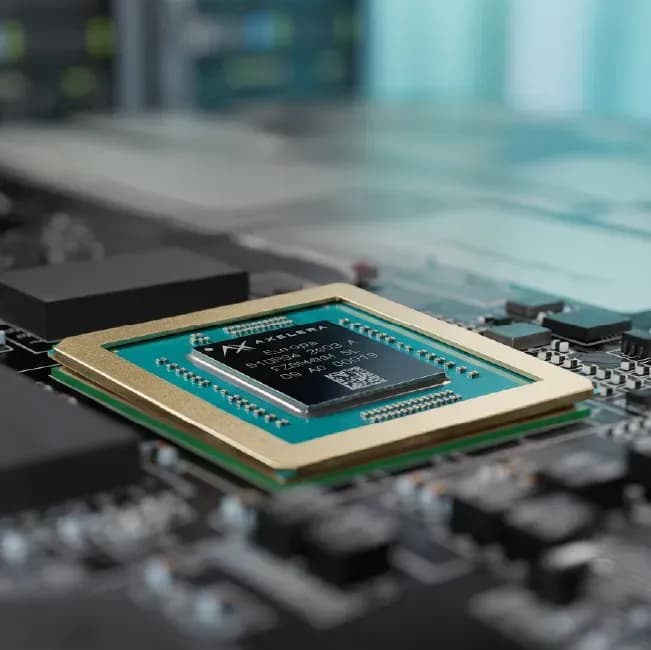
- Axelera AI (more than $250 million). Axelera AI is also developing AI chips. Specifically, the company, also located in Eindhoven, is building chips designed to run AI. When a company uses AI to, let’s say, identify an object, that computation happens in a far-away data center — this often means a slow connection and entails lots of energy to run that computation. Axelera AI chips let AI run inside the device itself, right where the data is being collected, thus using much less power.
- Nearfield Instruments (€330 million). Chips are only one piece of the jigsaw puzzle behind AI developments; machinery to print them — such as ASML’s — is needed, along with precise inspection systems. Nearfield Instruments does exactly that. The company develops advanced measurement and inspection systems for chip production. Their technology enables monitoring of small, complex chip structures during manufacturing. This is key to ensuring that chips, with ever-increasing architectural complexity, can be efficiently produced.
- General Intuition ($320 million). Physical AI is an emerging trend in the space. In other words, AI is moving into the real world, powering robots and devices of all kinds. General Intuition is teaching AI the common sense humans use to understand physics and space. The company does so by training models on millions of hours of video game footage, including Fortnite, from the player’s point of view. Why is this relevant for AI? Because a player is constantly moving, making decisions and seeing the consequences, the footage teaches AI cause-and-effect and spatial awareness effectively.
A $300 million boost to embed AI in hospitality software
Although Mews isn't strictly an AI company — or one building AI's physical or structural layers — a portion of the money it raised is also going toward AI. The firm develops hospitality software and raised $300 million in January, also making it into the top five investments of 2026 so far. This money is helping the company push agent-driven AI deeper into hotel operations by automating complex workflows, reducing staff cognitive load, and improving the guest experience.
The money is funding AI infrastructure
Interestingly, three of the five rounds — Axelera AI, EUCLYD, and Nearfield — aren’t simply betting on smarter models. Instead, they are targeting what they see as AI's current constraints: the plumbing around it. Faster chips and manufacturing tools that can help build the semiconductors of tomorrow.
This trend is far from random and ties directly to the Dutch semiconductor industry. The expertise and the ecosystem developed around ASML and imec favors the development of such technologies. This week’s €50 million investment in Fortaegis — a company developing chip-based security tech — and the €20 million raised by ASML’s spin-off Inivisix, which is working on a new technology to inspect chips, further strengthen the case.
EUCLYD's €200 million round may be this week's headline, but it's really just the latest data point in a pattern that's been building all year: in the Netherlands, the smartest AI bets aren't on the models — they're on the chips, machines, and security layers that let those models run at all.