
5 years of LEVEL UP: from startup skills to European growth power
LEVEL UP began by asking how a founder can build a better company. Five years later, a much bigger question is on the table.
Published on September 23, 2026
Bart, co-founder of Media52 and Professor of Journalism oversees IO+, events, and Laio. A journalist at heart, he keeps writing as many stories as possible.
What began in 2022 as a Brabant meeting place for founders has grown into an international startup event. LEVEL UP's evolution also tells a bigger story: there is no shortage of good ideas, but they can only grow into world-class companies with capital, customers, talent, and a strong ecosystem.
Looking back at the stories from five years of LEVEL UP reveals more than an event that grew bigger every year. It also shows how the conversation about startups has matured. The early editions focused primarily on entrepreneurs themselves: how do you create a business plan, when should you pivot, how do you build a network, and what can you learn from failure? Gradually, attention shifted to a more complex question: what does a promising startup need to scale successfully, and what must investors, companies, governments, and knowledge institutions jointly organise to make that possible?
This evolution is the common thread leading up to the fifth edition of LEVEL UP, which will take place at the Evoluon in Eindhoven on September 28. What began as a stage for entrepreneurship has increasingly become a workshop for the entire innovation ecosystem. The ambition is no longer merely to help founders take the next step, but to create the conditions for technology companies from the Netherlands and the Benelux to grow into global players. “Europe has the knowledge, talent and technology required to produce global leaders,” says Brigit van Dijk - Van de Reijt, managing director of the Brabant Development Agency (BOM), which organises LEVEL UP together with The Gate. “The challenge lies in mobilising sufficient capital and organising an ecosystem that continues to support companies beyond their initial growth phase. LEVEL UP brings together founders, investors, corporates and public partners to enable that next step.”
The founder comes first
The inaugural edition in 2022 centred on a fundamental lesson that returned every subsequent year: a startup does not grow on brilliant technology alone. A strong network, a convincing business plan, market knowledge and the ability to change direction at the right time are at least as important.
From the outset, LEVEL UP created room for the unpolished side of entrepreneurship. Founders spoke about their mistakes, pitches that led nowhere and technologies for which the market was not yet ready. Experts explained how and when a deeptech company should pivot and why entrepreneurs should not spend forever building the perfect product, but instead take action in the present while working toward their larger vision.
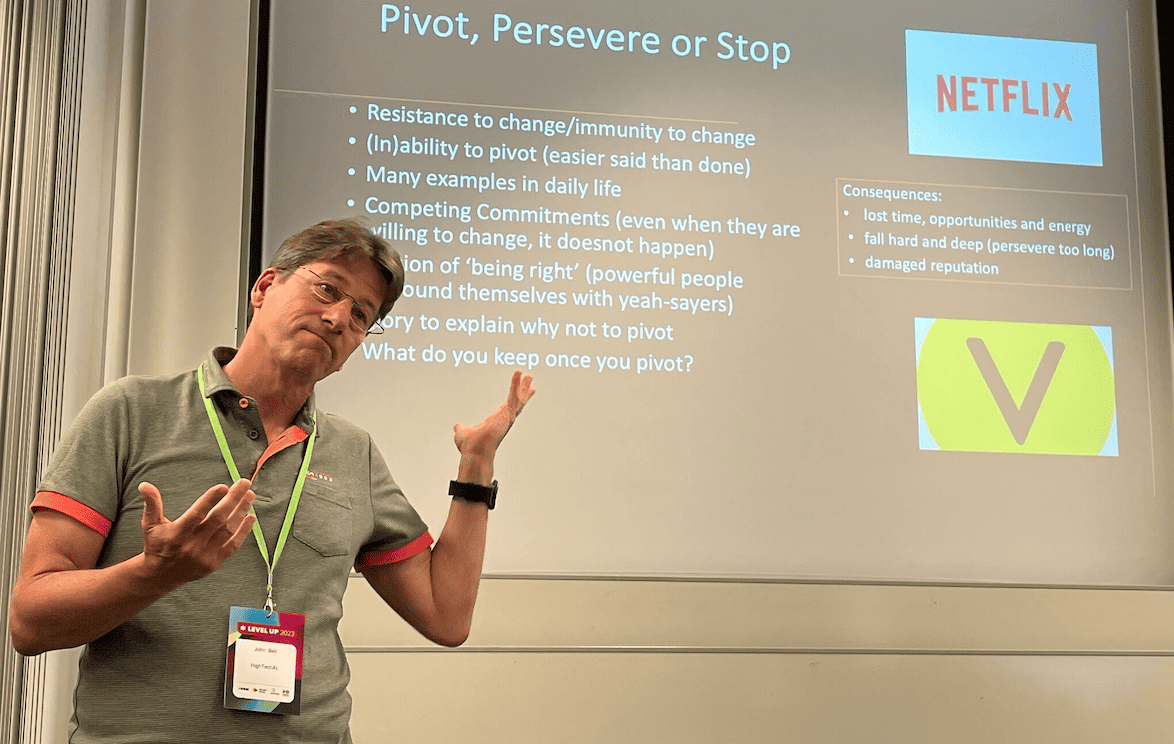
Human nature vs. the need to pivot: why changing course is so difficult for start-ups
While pivoting can be necessary, human nature means people often resist change, afraid of losing their livelihood and status, HighTechXL’s John Bell explained.
That may sound elementary, but it goes to the heart of innovation. The technical solution is rarely the only problem. Carbyon founder Hans de Neve put it succinctly during an early edition: the challenge lies not only in the technology, but also in the business, the market and attracting finance. LEVEL UP therefore positioned itself not as a showcase for success, but as a place where entrepreneurs could discuss the difficult reality behind that success.
From promise to proof
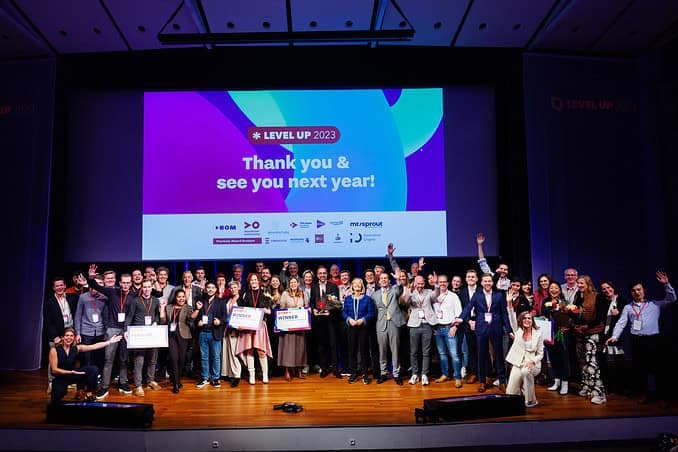
In 2023, this idea took visible shape with the first Brabant40 Award, the predecessor of today’s LEVEL UP Awards. The prize was intended for startups that not only had an innovative idea, but could also demonstrate progress in terms of customers, team, business model, product and financing. Relement won the inaugural award with its renewable aromatics for applications including coatings and materials.
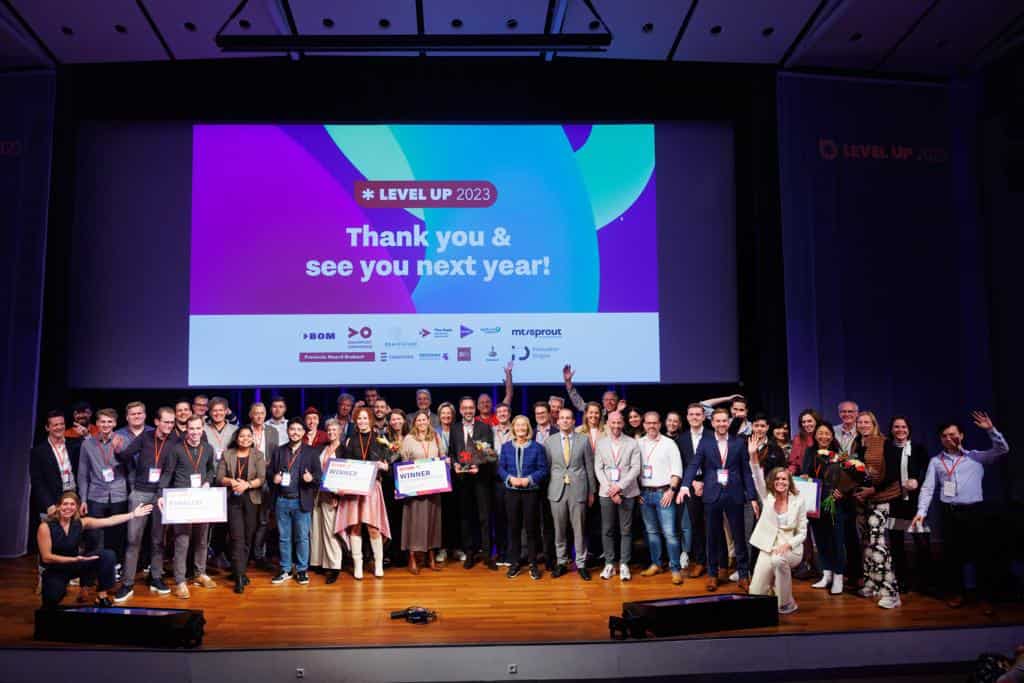
Relement wins the first Brabant40 Award
Runners-up for this year’s Brabant40 were AgroExact and VivArt-X. Scy Dye won the audience award, getting the most votes out of almost 3,000 participants.
Relement, in particular, illustrates what LEVEL UP means by growth. After receiving the award, the company moved from the laboratory to the market, scaled production to the tonne level, and worked with industrial partners on paint containing a high proportion of renewable raw materials. Recognition on stage was not the finishing line but an accelerator: it helped generate visibility, credibility and new business connections.
The 2023 edition also made clear that impact and shareholder value are not automatically compatible. In a widely discussed conversation, Protix founder Kees Aarts and impact investor Warner Philips warned about a poor match between founder and financier. Their message was that entrepreneurs do not simply need money; they need investors who understand how value is created in a complex technology company. Trust, patience and substantive engagement are just as important as the spreadsheet.
The leap to scale
LEVEL UP grew in 2024, attracting more than a thousand visitors to the Evoluon. At the same time, the programme became more international and placed even greater emphasis on the leap from startup to scale-up. AI entrepreneurs and investors discussed market validation, company culture, and when venture capital is not a sensible choice. Meatable founder Krijn de Nood explained that a startup begins with a grand vision, but rarely has a roadmap for the steps that follow. The art is to divide that vision into concrete milestones without losing sight of the ultimate goal.
That year’s LEVEL UP Award went to ANTENNEX, which develops testing technology for wireless devices. Once again, the award only acquired real meaning through what happened afterwards. ANTENNEX raised new capital, signed a distribution agreement for North America and began working with international technology partners. According to CEO Anouk Hubrechsen, the trip to CES included with the award opened doors to new markets.
In two entirely different sectors, Relement and ANTENNEX made the same transition: from technological promise to industrial application, and from regional visibility to international market access. This also brought LEVEL UP’s broader function into sharper focus. An event cannot scale a company, but it can create the moment when trust emerges among customers, investors, partners and new talent.
The system surrounding the entrepreneur
At the fourth edition in 2025, attended by more than 1,550 participants, the discussion moved up another level. The individual founder remained important, but Europe’s innovation system shortcomings came fully into view.
Lex Hoefsloot drew a tough lesson from the Lightyear adventure: deeptech founders must start working backwards from day one, based on the enormous sums they will need later. Anyone who will ultimately need to raise a billion euros must understand early on which international investors can handle such a round and which intermediate steps are required to get there. Meanwhile, Jelle Prins of Cradle described entrepreneurship in the Netherlands as “running through mud”: the individual obstacles may seem small, but together they impede talent, financing and growth.
LEVEL UP thus shifted from startup advice towards a critique of the system. Europe does not lack knowledge or ideas, but it suffers from a shortage of late-stage capital, major first customers, accessible infrastructure, and a coherent route to growth. The 2025 financing debate therefore brought together venture builders, companies, venture capital firms and public-sector investors. The implicit conclusion was that none of these parties can overcome the scaling barrier alone.
The discussions with pension funds also reflected this development. Work around LEVEL UP focused on a fund-of-funds structure intended to make institutional capital more accessible to innovative companies. That is precisely the kind of bridge Europe needs: public funding to reduce risk, private capital to impose scaling discipline, and large companies that not only invest but also serve as first customers or industrial partners.
The 2025 winner, Salvia BioElectronics, put a human face on the discussion. The company is developing an ultra-thin implant for people suffering from severe migraines. The award not only attracted attention to the technology, but also generated recognition among patients and confidence among potential employees. Finalists EviSafe and GoDutch likewise found that the nomination opened doors. EviSafe entered into new discussions with municipalities and financiers; GoDutch used the opportunity to build valuable contacts in the southern Netherlands, beyond its largely Amsterdam-based network, and subsequently grew rapidly. The award proved to be fertile ground for trust and growth, even for those who did not win.
The fifth edition: less generic, more focused
These developments will converge on September 28. LEVEL UP now addresses both the national and international startup communities, while retaining Eindhoven as its permanent home. The first three editions were primarily national in scope; since 2025, the event has placed greater emphasis on Belgium, Luxembourg and the rest of Europe.
The format of the fifth edition shows that the event is also entering its next substantive phase. In sector-specific tracks, founders, investors and experts will examine the forces that determine success or failure in a particular market. The Academy will address practical obstacles relating to financing, taxation, law, technology and team development. The Investor Café will bring entrepreneurs and financiers together for conversations intended to go beyond a fleeting pitch. Meet Your Co-Founder XL will focus on what may be the scarcest growth factor of all: the right people. And during F*CK UP NIGHT on September 27, the vulnerable side of entrepreneurship will continue to receive explicit attention.
With speakers including Carbon Equity CEO Jacqueline van den Ende, former ASML CEO Peter Wennink and Nearfield Instruments CEO Hamed Sadeghian, the programme connects different phases and perspectives: capital for the transition, experience in building a European global leader and the day-to-day reality of a rapidly growing high-tech company.
This fits the ambitions of organisers The Gate and BOM. LEVEL UP no longer wants to offer founders generic startup wisdom, but to connect them with the specific knowledge, people, customers, and financiers that can enable their next phase of growth. The awards follow the same approach: candidates must have moved beyond the experimental phase, demonstrate market validation, and have a team capable of making the transition to scale.
From annual event to ongoing mission
After five years, LEVEL UP has also become a barometer of the innovation climate. The recurring themes - a lack of growth capital, difficult market access, teams that must grow alongside their companies, and European technology looking to the United States for its breakthrough - remain unresolved. The event’s growth therefore does more than demonstrate its success; it also underlines the continuing need for connection.
LEVEL UP’s next step must consequently extend beyond that single day at the Evoluon. Its true value emerges when a conversation in the Investor Café leads to an investment, when a corporate gives a startup its first major order, when a founder finds a complementary co-founder or when public and private financiers work together to guide a capital-intensive technology through its most difficult phase.
The central lesson from five editions is ultimately a simple one. Startups need courage, but courage alone does not build a global company. That also requires customers, capital, talent, infrastructure and an ecosystem that does not walk away after the first funding round. LEVEL UP began by asking how a founder can build a better company. Five years later, a bigger question is on the table: how can we create an environment where that company can grow from Europe into a global leader?