
691 chats with AI Vincent: what Van Gogh tells about innovation
The creators describe the app as a new “interface” for Van Gogh’s letters: a way to engage associatively with his ideas and thoughts.
Published on August 22, 2026

Bart, co-founder of Media52 and Professor of Journalism oversees IO+, events, and Laio. A journalist at heart, he keeps writing as many stories as possible.
The Nuenen-based AI app Vincent. All Ears, launched in October 2024, is now being used worldwide. An analysis of 691 conversations shows that visitors ask about much more than his paintings. They also talk to the virtual Van Gogh about travel, family and emotions.
IO+ asked Vincent about a subject that was very much in motion during his lifetime: innovation and technology. Some of his answers can be traced back to his letters with remarkable accuracy – but they also show where historical sources and artificial intelligence begin to diverge.
.png&w=2048&q=75)
What was the most important innovation of your time?
It is not exactly the first question you would expect someone to ask Vincent van Gogh. Yet the digital Vincent has an answer ready immediately.
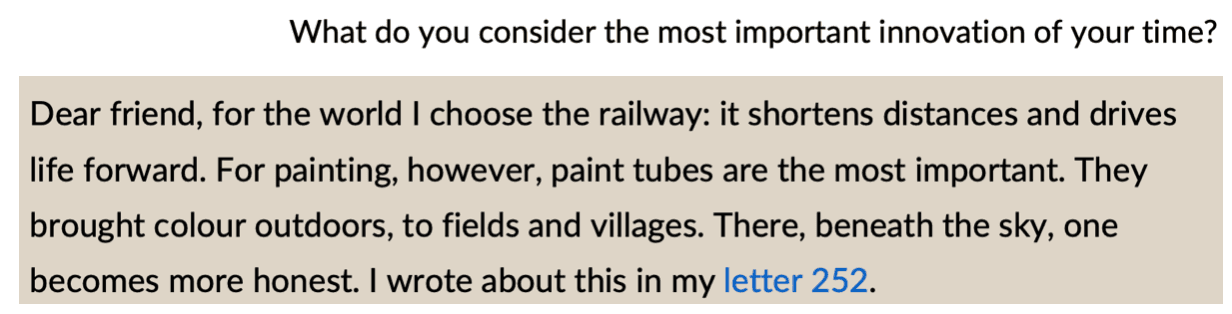
“Dear friend, for the world I choose the railway: it shortens distances and drives life forward. For painting, however, paint tubes are the most important.” Thanks to those tubes, he continues, colour could be taken outdoors, into the fields and villages.
That sounds pretty convincing for someone who died in 1890.
Except this Vincent is artificial intelligence.
From 820 letters to a conversation
The app Vincent. All Ears was launched at the end of October 2024 during the CONNected Festival in Nuenen. Coöperatie OnsNet Nuenen provided financial support for the further technological development. The AI model draws on studies about Van Gogh and his 820 surviving personal letters.
The initiative comes from a team including Rob Mulder, Tomas Snels, Bas Brinkman and Silviya Velkova. Their ambition is explicitly not to pretend that Van Gogh has been brought back from the dead. They describe the project as an exploration of how far AI can realistically and vividly recreate a historical figure in virtual form. The application is still under development.
Since June this year, visitors to Van Gogh Village Nuenen have also been able to talk to the digital Vincent. In the museum’s coffee corner, they can scan a QR code and immediately start a conversation about something they have just seen – or ask a question they have always wanted to put to the painter.
According to OnsNet Nuenen, the app is now used worldwide. The developers have analysed 691 anonymised conversations in more detail. The result offers an intriguing glimpse of what happens when an artist who has been dead for 136 years suddenly becomes someone you can talk to.
Sunflowers wins, but it is not all about art
Almost a third of the 691 conversations – 224, to be precise – are primarily about art or an image-related request. In 156 of those conversations, the user mainly wants to learn something about Van Gogh’s art; 68 are more focused on requesting or discussing an artwork or image.
But something quite different quickly follows. 168 conversations, more than 24 percent, mainly consist of small talk with Vincent. Biography, places and travel, and emotions or personal reflection each account for 74 conversations, or 10.7 percent.
That last category may be the most striking result. OnsNet sees users not only asking how Van Gogh felt, but also bringing up their own emotions and then asking how he dealt with similar feelings. The digital painter thus becomes not only a museum guide, but also a kind of conversation partner.
Those who do talk about art tend to return to the same icons. Sunflowers is mentioned in 137 of the 691 conversations, The Starry Night in 112 and The Potato Eaters in 106. After that, the number of mentions drops sharply: Irises follows with only 21 conversations.
The people around Van Gogh also feature prominently. His brother Theo is mentioned in 188 conversations, Paul Gauguin in 81. Of all the places, Auvers-sur-Oise is the most popular with 154 mentions, followed by Arles with 141. Nuenen ranks third with 114 conversations – ahead of Paris and Saint-Rémy-de-Provence.
Not bad for an AI experiment that began in the Brabant village where Van Gogh lived and worked between 1883 and 1885.
The train to the stars
But how does such a virtual Van Gogh respond when you ask him not about sunflowers or his brother Theo, but about innovation?
Asked whether he often travelled by train himself, AI Vincent talks about journeys between cities such as The Hague, Paris and Arles. Then he makes an unusual leap. Travelling by train, he says, could almost feel “like a journey to a star”. As his source, he cites letter 638.
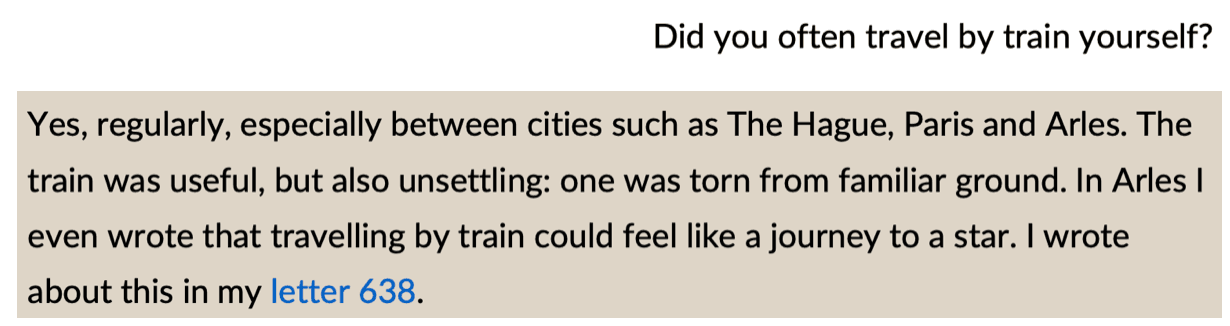
This is precisely where the strength of the concept becomes apparent. Because that reference is correct.
In July 1888, writing to Theo from Arles, Van Gogh described his fascination with the stars. He wondered why the points of light in the sky should be any less accessible than the black place names on a map. Then came one of the most remarkable sentences in the letter: “Just as we take the train to go to Tarascon or Rouen, we take death to go to a star.” He then concluded: “What’s certainly true in this argument is that while alive, we cannot go to a star, any more than once dead we’d be able to take the train.”
The chatbot translates that existential comparison back into a conversation about technology. When I ask which star he would like to travel to, the digital Vincent replies that he does not mean any particular star, but “a luminous distance” where the mystery of life and death becomes calmer.
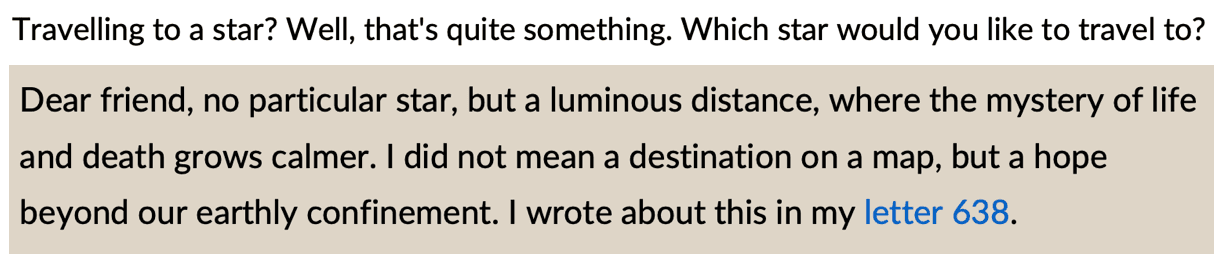
It is not a quotation from Van Gogh. But it comes remarkably close to what he was trying to express in that letter.
Photography? The soul cannot simply be replaced
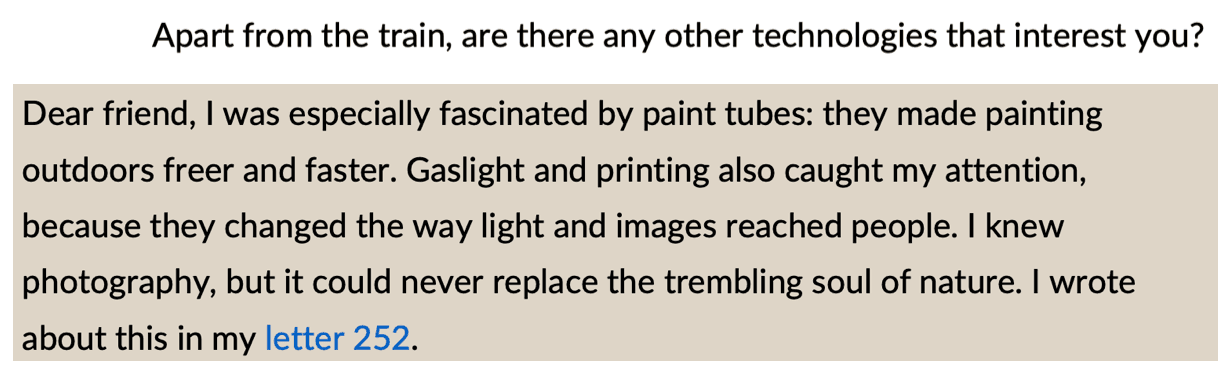
Other nineteenth-century innovations also come up in the conversation. AI Vincent mentions gaslight, printing and photography. The latter in particular elicits a characteristically Van Gogh-like response: he knew photography, he says, but it could “never replace the trembling soul of nature”.
Then the great industrial transformation comes up. How did Van Gogh view the steam engine and the rise of mass production?
The virtual painter admires the power of the machine, but distrusts a society in which profit “crushes the human being”. He refers to his experiences with miners and ends with an almost contemporary statement: “No factory should be more important than their dignity.” As his source, he gives letter 151.
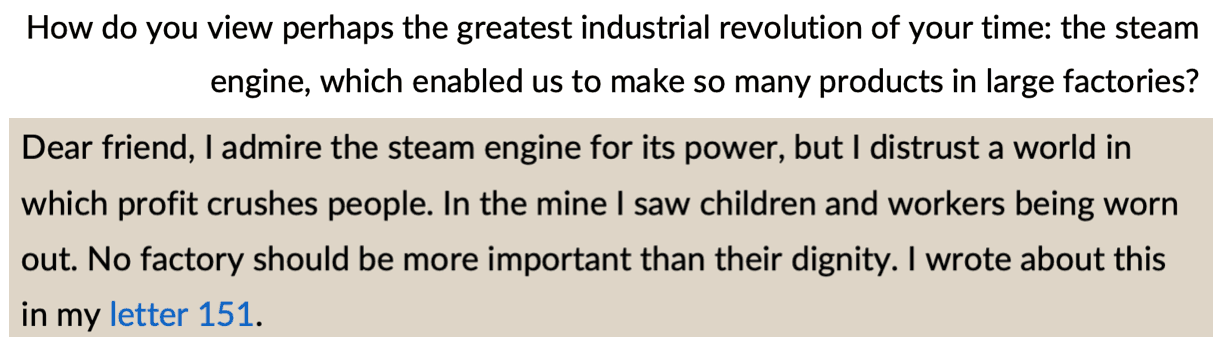
Here too, there is a genuine historical core beneath the AI-generated answer. In that letter, written in April 1879, Van Gogh describes spending six hours in the notorious Marcasse mine in the Borinage. He saw the dangers under which miners lived and wrote that it was mainly children – boys as well as girls – who loaded the loosened coal into small wagons.
But the wording about profit crushing people and human dignity taking precedence over factories does not literally appear in the letter. This is where the AI makes an interpretative leap: from Van Gogh’s documented experiences and social concern, it constructs an answer to a question Van Gogh himself was never asked in this way.
That distinction matters.
An AI that sometimes simply says ‘I don’t know’
Interestingly, the app is also willing to admit that at times.
When I ask whether Van Gogh’s own clothes came from industrial factories, he answers that he cannot say with certainty. His clothes were bought or repaired; he generally did not know exactly where they had been produced.
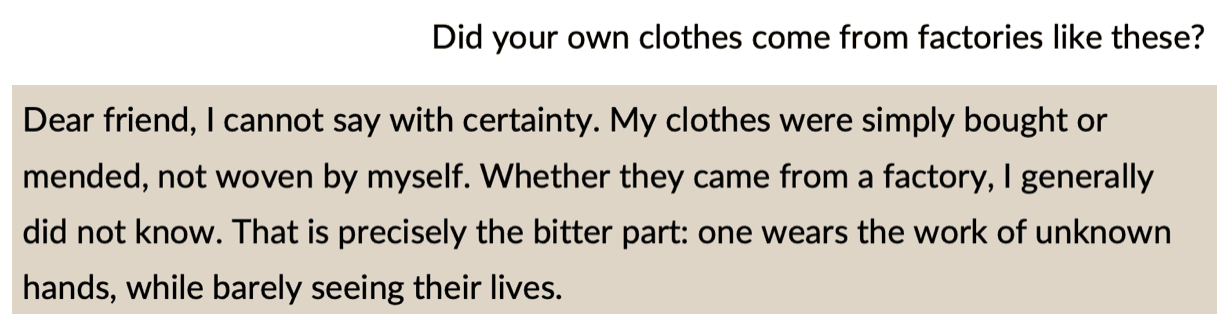
The AI then turns this into another typically Vincentian thought: “one wears the work of unknown hands, while scarcely seeing their lives.”
That sentence does not come from a letter. But as a conversational interface, it works: the technology uses historical knowledge not only to retrieve facts, but also to draw a plausible line between Van Gogh’s world and a contemporary topic such as supply chains.
That is precisely where both the appeal and the risk of applications like this lie.
Not every source reference is equally precise
The answer about paint tubes illustrates this too. AI Vincent immediately names them as perhaps the most important innovation for painting and refers to letter 252.
In that letter, Van Gogh does indeed write extensively about paint, colour theory, working from nature and making studies outdoors. But he does not say that the invention of the paint tube made outdoor painting possible.
Other letters do show how practically important tubes were to him. A month later, for example, he describes painting outdoors, using large quantities of paint and having to work quickly because the effect of the light was already disappearing. He explicitly mentions the tubes from which he used his paint.
The chatbot’s conclusion is therefore historically plausible, but the source it provides is less precise than the answer suggests.
That is not a minor detail. Precisely because the application provides links to the original letters, users gain a strong impression of reliability. But a source reference does not automatically turn an AI-generated answer into a quotation.
‘The machine was background to me, never master’
My final question to Vincent is therefore almost inevitable: would he have preferred to live in a time without all those modern technologies?
“No, not entirely,” he replies. New art and new colours had awakened him, but at the same time he longed for nature, silence and simplicity. His summary: “Progress is good, as long as it does not suffocate the human being.”
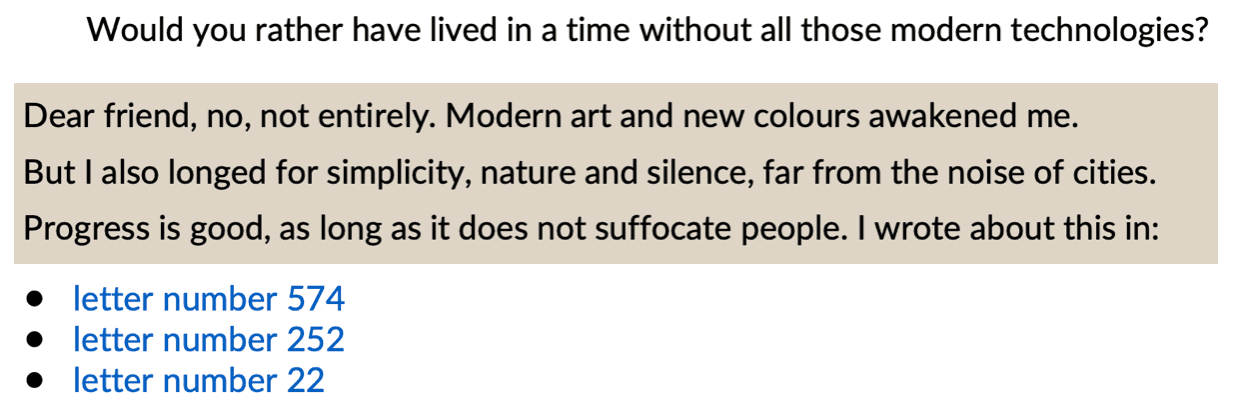
Here too, that final sentence was created by the AI. But the underlying attitude is not invented out of thin air. In a letter from 1887 to his sister Willemien, Van Gogh emphasised just how much the art of his own time needed to be lively, intense and strong in colour. He was certainly not an artist who only looked to the past.
That makes Vincent. All Ears more interesting than a digital gimmick in which a historical celebrity simply recites a few pre-programmed answers. The 691 analysed conversations show that users make use of the space that emerges when an archive is no longer merely searchable, but can talk back.
The makers themselves describe it as a new “interface” for Van Gogh’s letters: a way to engage associatively with his ideas and thoughts. That also seems the best way to approach the app. Not as a spiritualist séance in which Vincent finally tells us what he really thought, but as an AI layer on top of an exceptionally rich historical archive.
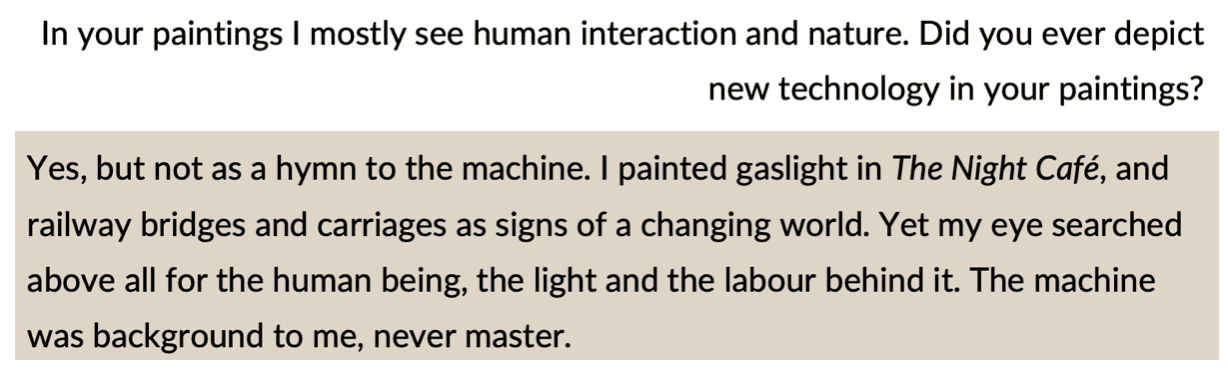
And perhaps the virtual Vincent himself offers the best formulation. When I ask whether he ever depicted technology in his paintings, he replies that railway bridges, carriages and gaslight did indeed appear in his world.
“The machine was background to me, never master.”
It is not a genuine Van Gogh quote.
But as a design principle for AI, he could have done worse.
