
A headstrong little boy from Overijssel became a wind pioneer
In the three-part series The Early Years of an Inventor, we explore what inventors' childhoods were like and what experiences shaped them.
Published on August 31, 2026


Our DATA+ expert and Editor-in-Chief, Elcke Vels, explores AI, cyber security, and Dutch innovation. Her "What if..." column imagines bold scenarios beyond the norm.
A wind turbine that’s cheaper and more efficient than existing models: that’s the disruptive idea behind the Dutch company TouchWind. The man behind it is inventor Rikus van de Klippe, a seemingly “ordinary” guy from Heino in the province of Overijssel. In this small village, nestled in the heart of a farming community, he discovered early on that he wasn’t a follower. “I didn’t really belong there.”
Old childhood photos have something special about them. You flip through them and suddenly see details you never noticed before. Van de Klippe pulls out an old school photo. Something catches his eye in the snapshot from eighth grade. The whole class was standing together during a field trip to Schiphol. One little boy was standing half a meter to the side. “That little boy is me,” he says. “As a child, I wasn’t the one standing in the middle of the group. Not because the others excluded me, but because I always took a stance of: I don’t quite belong.”
.png&w=2048&q=75)
In hindsight, he sees this as a trait that shaped his later career as an inventor: a deep-seated aversion to conformity. “If something was expected of me just because everyone else was doing it, then I certainly wouldn’t do it.”
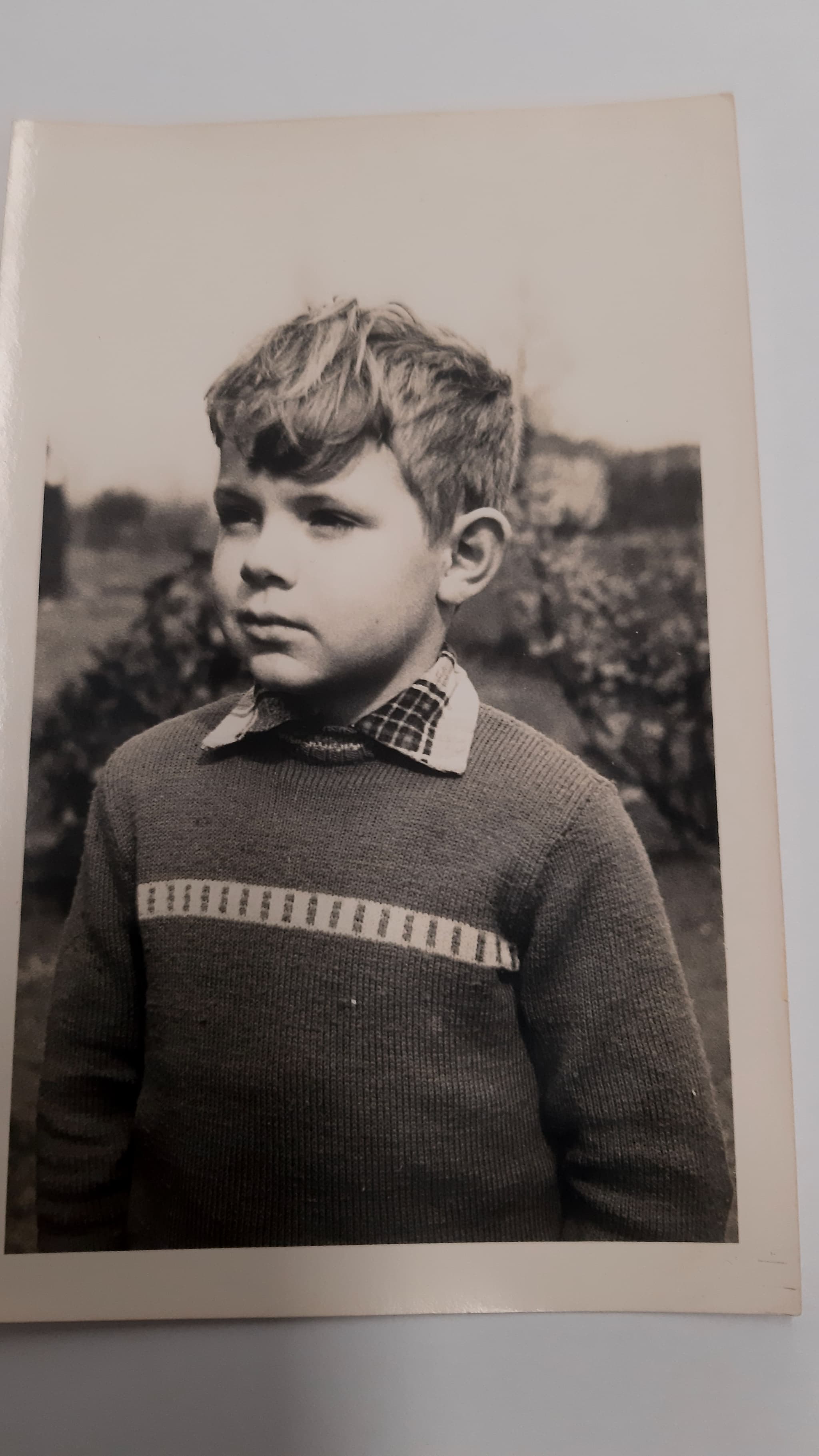
Photo: Rikus
Taking bikes apart
He did his own thing, but he did have a few friends. They played outside together and were often busy making things. Van de Klippe recalls that one of his friends had a shed full of old bikes at his house. “Together, we turned them into the craziest creations. We’d mount two bikes on top of each other—that kind of crazy stuff.” Sometimes there were as many as ten bikes taken apart in the shed.
A life-changing event
Has the inventor always done things his own way? “As far back as I can remember.” Around the time he was three, the family went through a life-changing event that contributed to this. Van de Klippe was the first child. He knew a little brother or sister was on the way, but it turned out to be two. “My mother’s labor was very difficult. In fact, she had a near-death experience.”
For Van de Klippe, nearly losing his mother was a traumatic experience. Looking back, the entrepreneur sees this event as a pivotal moment in the development of his independence. “I realized that you can never really trust the situation. Because one day or another, everything can change.”
Hanging on to something
Standing on one’s own two feet, tinkering with projects in the garage: these are traits that fit the image of an inventor. Yet the boy from Heino didn’t dream of becoming one at a young age.
That wasn’t on his mind in high school either. Van de Klippe got good grades. “Just good, but not outstanding,” he says himself. During that time, however, he did discover an important trait that would later become a hallmark of his career as an inventor: when something truly interested him, he could throw himself into it completely. He noticed this, for example, in fourth grade, when he took stereometry, a course centered on spatial awareness and three-dimensional thinking. “I suddenly found it really fun, and then I started getting A’s and B’s.”
Dream of becoming a pilot
While his dream of becoming an inventor was still a long way off, Van de Klippe threw himself into something else in the meantime: flying. “As a child, I dreamed of becoming a pilot. I wanted that for a very long time. That dream even came close to coming true: I went through several rounds of selection for KLM.” Ultimately, things went wrong during the final test. There, they assessed not only his technical skills but also how he presented himself. “You had to show up in a suit; they wanted to see if you looked presentable. And Rikus just doesn’t fit into a uniform,” he says with a laugh. Once again, it became clear: conforming just wasn’t an option.
Aerodynamics, forces, and motion
Knowing he wouldn’t become a pilot, the budding inventor switched to aeronautical engineering in Delft. “I learned everything about aerodynamics, forces, and motion.” Years later, that knowledge would form a strong foundation for his work in wind technology.
Many graduates found their way into military technology. Courses such as supersonic aerodynamics tied in well with that field. At first, Van de Klippe wasn’t very interested in the subject, but when he took the course again, the underlying theory began to fascinate him. He delved deeper into it and ultimately earned the highest grade in the class.
Still, he didn’t see himself working in the military sector. “My pacifist convictions stood in the way of a career in that direction.” Gradually, his focus shifted to the question of how technology could contribute to the future of society in other ways.
Car-free sundays
One Sunday in 1973 marked a pivotal moment in Van der Klippe’s development as an inventor. The Netherlands was in the midst of the oil crisis. A conflict between Israel and several Arab countries had caused a global oil shortage. In the Netherlands, this led to the introduction of car-free Sundays: on certain Sundays, people were not allowed to use their cars in order to conserve fuel.
For many Dutch people, it was a unique experience. Streets and highways, normally filled with traffic, suddenly became quiet places where people could walk and ride bicycles. Van der Klippe, too, took to his bicycle on those Sundays.
That sight got him thinking. The crisis made it clear just how dependent society was on fossil fuels. With his background in aeronautical engineering and aerodynamics, he saw a possible solution. “I thought: I studied aeronautical engineering, I understand aerodynamics, so I’m going to do something with wind turbines.”
Three wind startups
And so it came to pass. The inventor founded his first startup, ZonneWind (1984), followed by a second, Aerolift (2001). Both companies centered on a key question: how can wind energy be generated more intelligently and efficiently? Ultimately, everything came together in TouchWind, the company with which he has been working since 2018 on a wind turbine featuring a unique tilting rotor design. A total of ten patents have been filed for TouchWind.
A new chapter
After years of inventing, testing, and overcoming technical challenges, a new chapter is now beginning for TouchWind. The company is in the process of scaling up and commercializing its technology. It’s a great milestone, but for Van de Klippe, it’s a logical moment to take a step back. “So that my schedule has more room for what I’m good at: working on technology.”
One thing is clear: the journey of invention is far from over.