
A new Parkinson’s treatment: a brain making its own dopamine
Conventional Parkinson’s treatment effects fade away with time. A group of scientists is opting to let the brain heal the damage.
Published on November 4, 2026
© BUDDHI Kumar SHRESTHA - Unsplash
Mauro swapped Sardinia for Eindhoven and has been an IO+ editor for 3 years. As a GREEN+ expert, he covers the energy transition with data-driven stories.
Parkinson’s affects millions worldwide, but still has no effective cure, as standard medication effects vanish over time. Scientists at the University of Amsterdam (UvA) are studying how to make remaining neurons produce more dopamine by designing new molecules that trigger them.
The tremors, the stiffness, and the behavioral impairments caused by Parkinson’s are a direct effect of a sharp drop in dopamine production. This neurotransmitter, often called the feel-good chemical, is also central to movement and memory.
The researchers are focusing on activating a receptor, known as Gucy2c, that switches on the enzyme that limits how fast a cell can make dopamine. American scientists have shown in mice that the absence of this receptor makes neurons more vulnerable to stress — activating it might mean better protecting them from stress.
“It would be a two-hit mechanism: you produce more dopamine, which relieves the symptoms, and you also protect neurons from dying,” explains Lars van der Heide, Associate Professor of Molecular Neuroscience at the Swammerdam Institute for Life Sciences. He leads the study with Ioana Ilie, Assistant Professor of Computational Chemistry at the Van 't Hoff Institute for Molecular Sciences, and postdoctoral researcher Niki Paspali.
Triggering the brain to produce more dopamine
The standard way to treat Parkinson’s is by giving patients levodopa. In the brain, this substance is converted into dopamine and can cross the blood-brain barrier — a filter that shields the brain from most substances circulating in the blood — to enter the nervous system. Giving patients plain dopamine doesn’t work because it can’t cross the barrier. Levodopa alleviates symptoms, yet its effect diminishes over time.
Levodopa is normally produced in neurons. “The difference is that it comes from outside the brain, it crosses the blood-brain barrier and then is everywhere in the brain, not only in the neurons that need it. If you use this receptor, you really produce dopamine in the neurons that need it. That’s the big difference,” clarifies Van der Heide.
Parkinson’s symptoms typically become apparent only when a person has lost 80% of their dopamine production. The brain's synthesis of the neurotransmitter is thus central to treating the disease. UvA scientists aim to stimulate what remains.
Finding the right fit — with the help of AI
Finding the right molecule is a lengthy, complex process. It starts with Ilie’s work, which involves designing candidate molecules that could be a good fit. However, no one has ever determined the structure of the Gucy2c receptor, so scientists use AI models to generate potential molecule structures.
The design phase runs in stages, narrowing hundreds of thousands of candidates down to a few dozen. Scientists then simulate the survivors alongside the receptor to see whether the pairing physically holds together. Often it doesn’t. “In certain cases the dimer falls apart, or the molecules fly away, which is a direct measure that it’s not a good binder, even though the AI suggested it,” says Ilie. She explains that the models don’t fully capture how molecules move and interact.
The designs that make the final cut enter Van der Heide’s lab, where they are tested on cells. Results feed back into the next design round, creating a feedback loop that drives development. Both researchers underline how it will take some iterations before finding the right molecule.
"Some of these things not working will probably teach us more than the ones which are successful," says Van der Heide, "because they will give such important hints to how this system works and how to improve it."
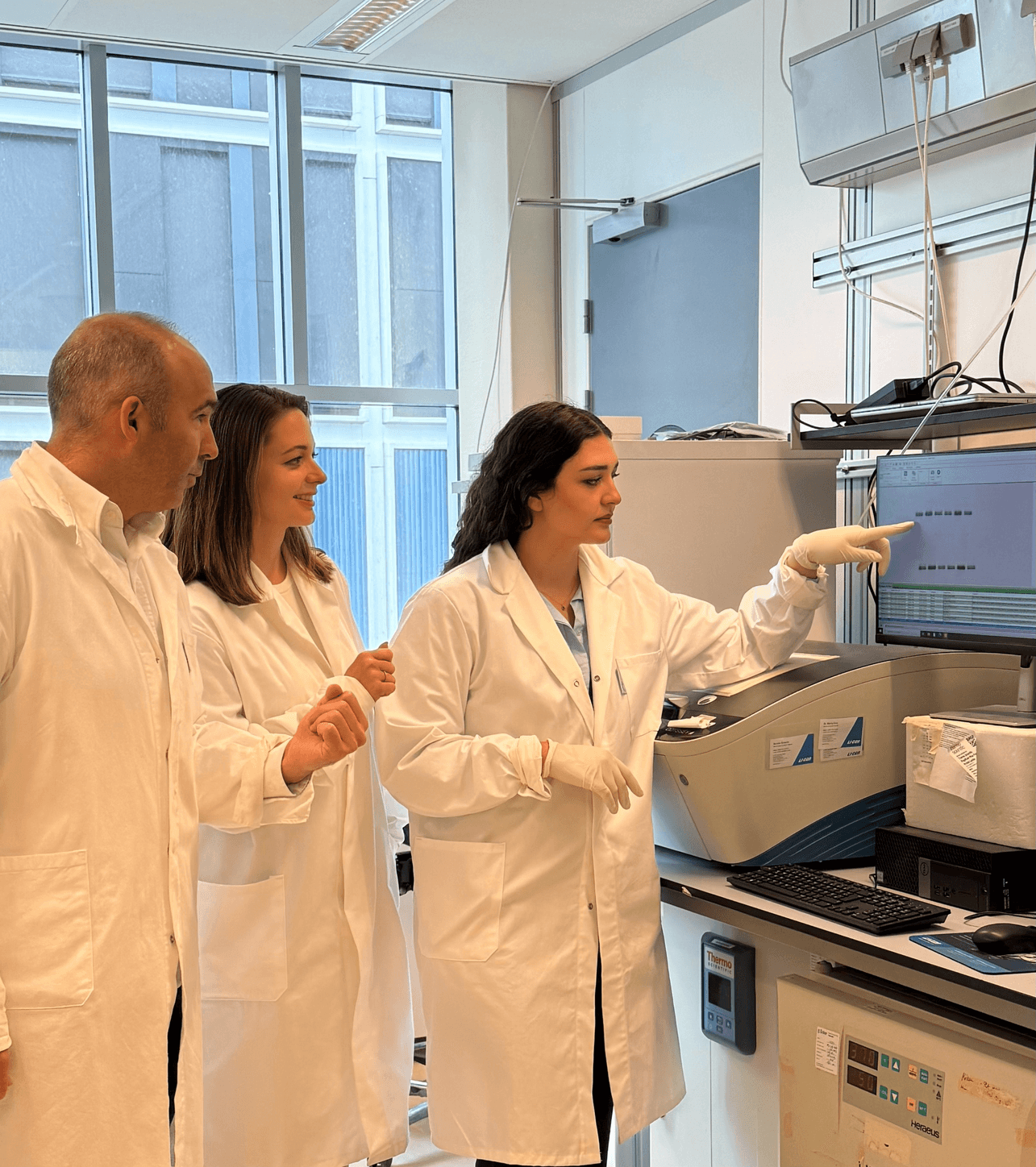
Van der Heide, Ilie, and Paspali working in the lab. - © UvA
Parkinson’s: an ever-emerging health condition
How helpful is AI?
How valuable can AI models be in drug discovery? “AI doesn’t do magic,” Ilie says. The academic notes that these models can help researchers understand the system, even when they fail, because researchers can learn where the bottlenecks and limitations are.
“They should be taken with a grain of salt, and you should do the necessary validation to make sure they actually mean something,” she adds.
Working the survivors harder
UvA researchers argue for doing more with the few brain cells left. But is making the remaining neurons work harder a good idea? Van der Heide notes that scientific literature has shown increased dopamine in cells can lead to toxicity.
“But the advantage is that activating this receptor possibly also activates survival pathways that counteract that toxicity. That would be a way of keeping neurons intact,” he says. The professor also explains that dopamine neurons start dying one to two decades before the first clinical symptoms appear. With a reliable biomarker, treatment could start during that silent period, meaning patients would likely need less medication to prevent the disease.
Amsterdam’s scientists have already activated the receptor in a mouse model of Parkinson’s, comparing it against levodopa. Within two weeks, the animals’ motor symptoms improved as much as with the standard drug, and the effect lasted through three weeks. The compound had to be delivered straight into the brain, and cannot be given to patients — which is why the team is looking for better candidates.
The power of multidisciplinarity
A usable molecule is years away — Ilie points out there is a reason drug discovery takes decades. A multidisciplinary collaboration like the one between the two departments is instrumental to the process.
"At the beginning it felt like we were not speaking the same language," says Ilie. That has changed, and both see the model as portable — to Alzheimer's, or any disease where a molecule has to be designed.
"The AI revolution is making this type of collaboration more common," says Van der Heide. "But in my view, it should happen even more frequently."