
A solar panel you can take apart and reuse
Researchers are working on a concept for a fully recyclable solar panel.
Published on June 17, 2026
© TU Delft

Mauro swapped Sardinia for Eindhoven and has been an IO+ editor for 3 years. As a GREEN+ expert, he covers the energy transition with data-driven stories.
Solar power is the main driver of the energy transition and the cheapest form of electricity. With billions of solar panels now connected to the grid, what will happen to them at the end of their life? “The total weight of the entire human population is around 600 megatons. End-of-life solar panels waste could reach around 200 megatons by 2050,” explains Urvashi Bothra, a postdoc at the Delft University of Technology.
Currently, solar panels are shredded when discarded. This is because solar cells are coated in a layer of EVA — ethylene-vinyl acetate, a glue that binds them to the glass. As much as this coating keeps the different components together, protects them from moisture, and provides stability, it also makes it hard to disassemble solar panels at the end of their life – usually after 25 to 30 years.
.png&w=2048&q=75)
From copper to silicon, solar panels contain a wealth of valuable materials. Moreover, following refurbishment, the same silicon cells can be reused. Bothra’s work focuses on designing solar panels that use circularity as their guiding principle.
The researcher is part of the Photovoltaic Materials and Devices (PVMD) group at TU Delft. The group focuses on the full solar energy chain, working on new materials, innovative solar panels, and battery solutions.
A different design approach
The postdoctoral researcher’s work starts from the assumption that current EVA-coated solar panels are too hard to recycle. Therefore, the solution to the problem lies in designing solar panels that achieve performance comparable to what is available on the market, are easy to disassemble, and enable the smooth recovery of materials.
A concept she has been working on is a liquid-filled module. Instead of EVA, silicone oil is chosen for its optical properties that match well with glass. “As a result, we achieved a solar module with an efficiency of 21.4% in the lab,” underlines Bothra. “This is essentially the same as the conventional solar modules that use EVA.”
The efficiency is the amount of sunlight a solar panel can convert into electricity. Solar panels on the market range from 22% to 26%. The choice of silicone oil aligns precisely with this direction while offering an easier path to recycling.
The liquid-filled module concept is inspired by a previous solar module concept: the air gap module, which uses air to encapsulate cells. However, given the different refractive indices of glass and air, a fraction of the light is reflected rather than transmitted. As a result, the solar panels were less efficient.
Full material recovery
Disassembling is straightforward. “You take out the liquid, you cut the edge sealant, and you have the solar cell — from which you can recover high-grade silicon and silver," explains the postdoc. In this way, every single gram of the used material can have a second life. At the same time, the silicone oil showed potential for full reusability. Being a non-toxic product, there is no disposal issue.
For comparison, once solar panels are dismissed, they are treated as follows. The aluminum frame and the junction box — where cables connect to get electricity – are removed. Everything else, from glass to cells, goes into a shredder and is then used as filler material for road making.
The development of these modules passes through proving tests. In the climate chamber, an isolated device, looking a bit like a fridge, solar panels are thoroughly tested for wear and weather resistance.
Modules are tested for sun exposure, simulating years' worth of exposure in a matter of weeks. For instance, conventional solar panels turn yellow, gradually reducing the light reaching the cells and degrading performance over time. Liquid-filled modules, Bothra notes, could be promising and not show this effect. The tests are underway.
“We test temperature, humidity, and their interaction,” underlines Bothra. It is painstaking work, but it is what stands between a promising prototype on a lab bench and a product that can be trusted on a roof.
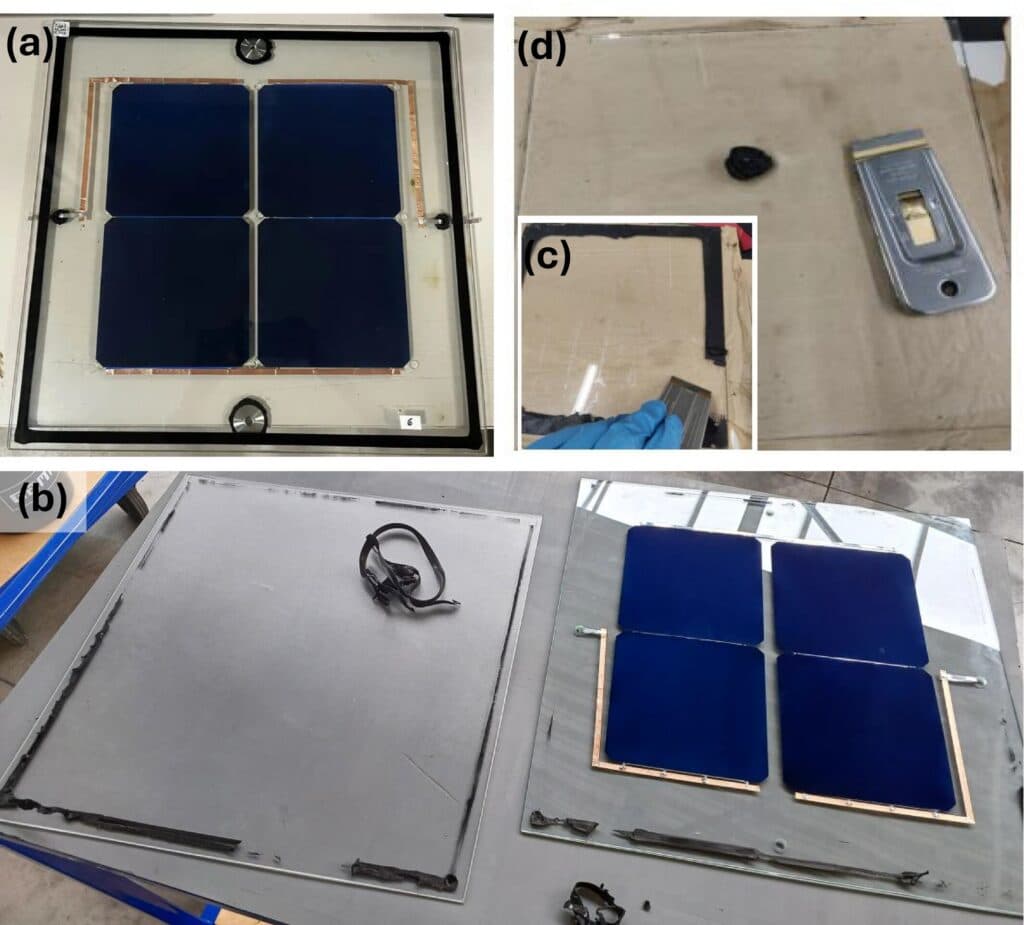
A snapshot of the liquid-filled module assembled and disassembled. - © TU Delft
Scaling up
To make an impact, the innovative solar cells need to get out of the lab. To do so, the researchers are working on scaling the design. One issue the group has identified is hydrostatic pressure: in a full-size module, the weight of liquid creates pressure that can cause the glass to bow. That is an engineering problem being actively worked on.
A more encouraging finding on the manufacturing side: the lamination equipment used to make conventional modules requires only one additional step — the liquid-filling — to produce the new design. TU Delft is already working with a Dutch manufacturer, Biosphere Solar, on this transition within the FAIR-PV project.
Full-size prototypes are not just sitting in the lab. Liquid-filled and air-gap modules have been installed at the Innovation Pavilion, Marineterrein, Amsterdam and are being monitored for outdoor performance alongside commercial panels.
Much of the solar industry's success has been grounded in cost per watt — circularity has never been part of the equation. Bothra's work is a bet that it will have to — that as deployment scales into the terawatt range and the first wave of panels begins reaching end of life, the industry will need a way to close the loop.