
About Iran and why energy independence is a dire necessity
The blockade of the world's most important oil route is pushing prices to record highs. It shows how vulnerable our economy is.
Published on March 2, 2026
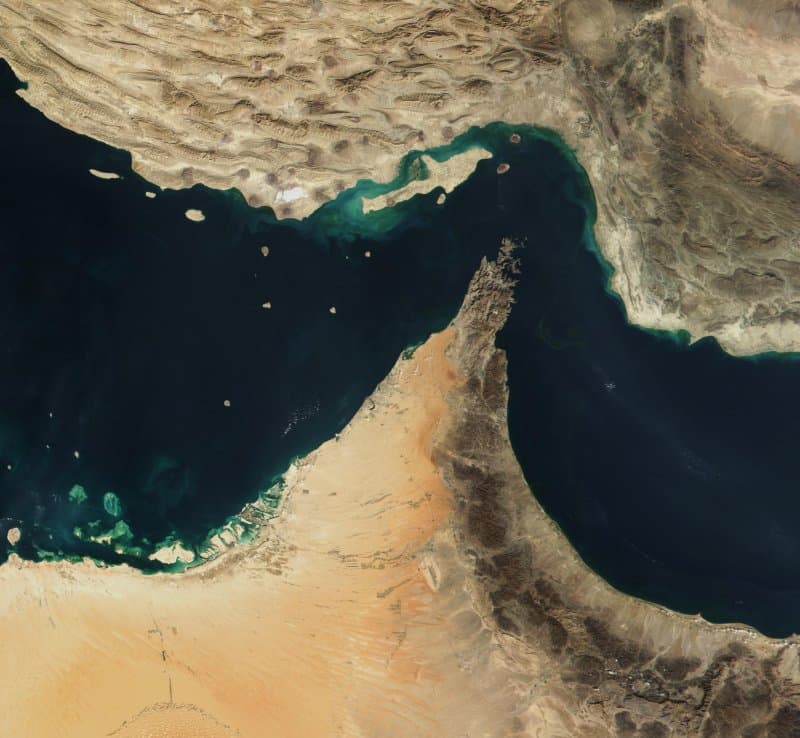
The Strait of Hormuz

Team IO+ selects and features the most important news stories on innovation and technology, carefully curated by our editors.
The Strait of Hormuz is locked down. Since Sunday, hundreds of tankers have been anchored or turning back. The Iranian Revolutionary Guard has put its words into action after heavy American and Israeli attacks. The immediate consequences are being felt at the pump and on energy bills. But this conflict exposes a deeper problem. Our addiction to fossil fuels from unstable regions makes us vulnerable to blackmail. The current crisis proves that the energy transition is not a left-wing hobby, but a hard security policy; we must get rid of gas and oil as quickly as possible.
The figures are staggering. Normally, 20 percent of global oil consumption passes through the narrow strait between Oman and Iran every day. That amounts to around 20 million barrels per day. In addition, one-fifth of all liquefied natural gas (LNG) finds its way to the world market here.
Since Sunday, February 28, this crucial artery has been blocked. The blockade follows ‘Operation Epic Fury’, a large-scale air strike by the United States and Israel on Iranian targets. Iran responded immediately. The Revolutionary Guard is denying ships access. Shipping companies no longer dare to take the risk. Commercial shipping traffic fell by 70 percent within a few hours. At least 150 ships are currently anchored, out of work.
The market is reacting with panic. At the beginning of January, a barrel of Brent oil still cost $60. On Friday, the stock markets closed at $73. Analysts at ING and Rabobank now expect an immediate jump to $80 or $90. In the event of a prolonged blockade, prices of $100 or even $140 per barrel are not an unthinkable scenario.
Europe is in the danger zone
For Europe, this blow comes at an extremely unfortunate moment. In recent years, we have worked hard to free ourselves from Russian gas. The strategy was simple: from now on, we will get our gas from somewhere else. Much of that ‘somewhere else’ now turns out to be Qatar. Qatar is one of the largest LNG exporters in the world. However, their tankers have to pass through the same Strait of Hormuz. Now that the route is blocked, that gas is stuck. European gas reserves were already lower in June 2025 than the year before. The buffers are tight. An interruption in supplies from Qatar will affect us directly. Gas prices are skyrocketing. This immediately translates into higher energy bills for households and businesses.
The illusion of alternative routes
Alternative routes are often mentioned. Saudi Arabia and the United Arab Emirates have pipelines that bypass the Strait of Hormuz. There is a pipeline to Fujairah and one to Yanbu on the Red Sea [5]. On paper, this sounds like a solution. In practice, it is a drop in the ocean. The capacity of these pipelines is nowhere near sufficient to compensate for the loss of the shipping route.
Autonomy through transition
The answer to this crisis does not lie in the Middle East. It lies on our own rooftops and in our own North Sea. The only way to become immune to the whims of the ayatollahs is to stop using their product. We must no longer view the energy transition as an expense. It is an investment in our national security. Sun, wind, and geothermal energy are local resources. No one can block the sun. No regime can shut down the wind. A wind farm in the North Sea does not need protection from an American aircraft carrier. Electric cars do not run on oil from Hormuz. Heat pumps do not need Qatari gas.
The EU is already aiming to be completely independent of Russian gas after 2027. That ambition must now be broadened. We must accelerate our transition away from all fossil fuel imports from unstable regions.