
AI’s real labor impact: The hiring chill hits young people
Anthropic’s new 'observed exposure' metric reveals a hiring slowdown for young workers despite low overall displacement.
Published on March 9, 2026

Bart, co-founder of Media52 and Professor of Journalism oversees IO+, events, and Laio. A journalist at heart, he keeps writing as many stories as possible.
The narrative of artificial intelligence triggering immediate, mass unemployment has dominated economic forecasting since the release of ChatGPT. However, new data released by Anthropic challenges this catastrophic view while highlighting a quieter, more insidious trend. The introduction of a novel metric, "observed exposure," reveals that while established professionals remain secure, the labor market is contracting for new entrants. The immediate threat to global competitiveness is not the replacement of the current workforce, but the invisible barrier rising against the next generation of talent. For policymakers and industry leaders, the focus must shift from preventing layoffs to unlocking entry-level pathways.
The gap between theory and reality
For years, economists relied on theoretical models to predict which jobs AI would automate. These models often assumed that if a task *could* be automated, it *would* be. Anthropic’s new research dismantles this assumption by introducing "observed exposure." This metric contrasts the theoretical capabilities of Large Language Models (LLMs) with their actual deployment in professional settings. The findings expose a massive utilization gap. For example, while Computer and Mathematical occupations exhibit a 94% theoretical capability for automation, their observed exposure stands at only 33%. Similarly, while 68% of observed AI usage targets fully automatable tasks, the overall penetration of AI into the workforce remains a fraction of its potential.
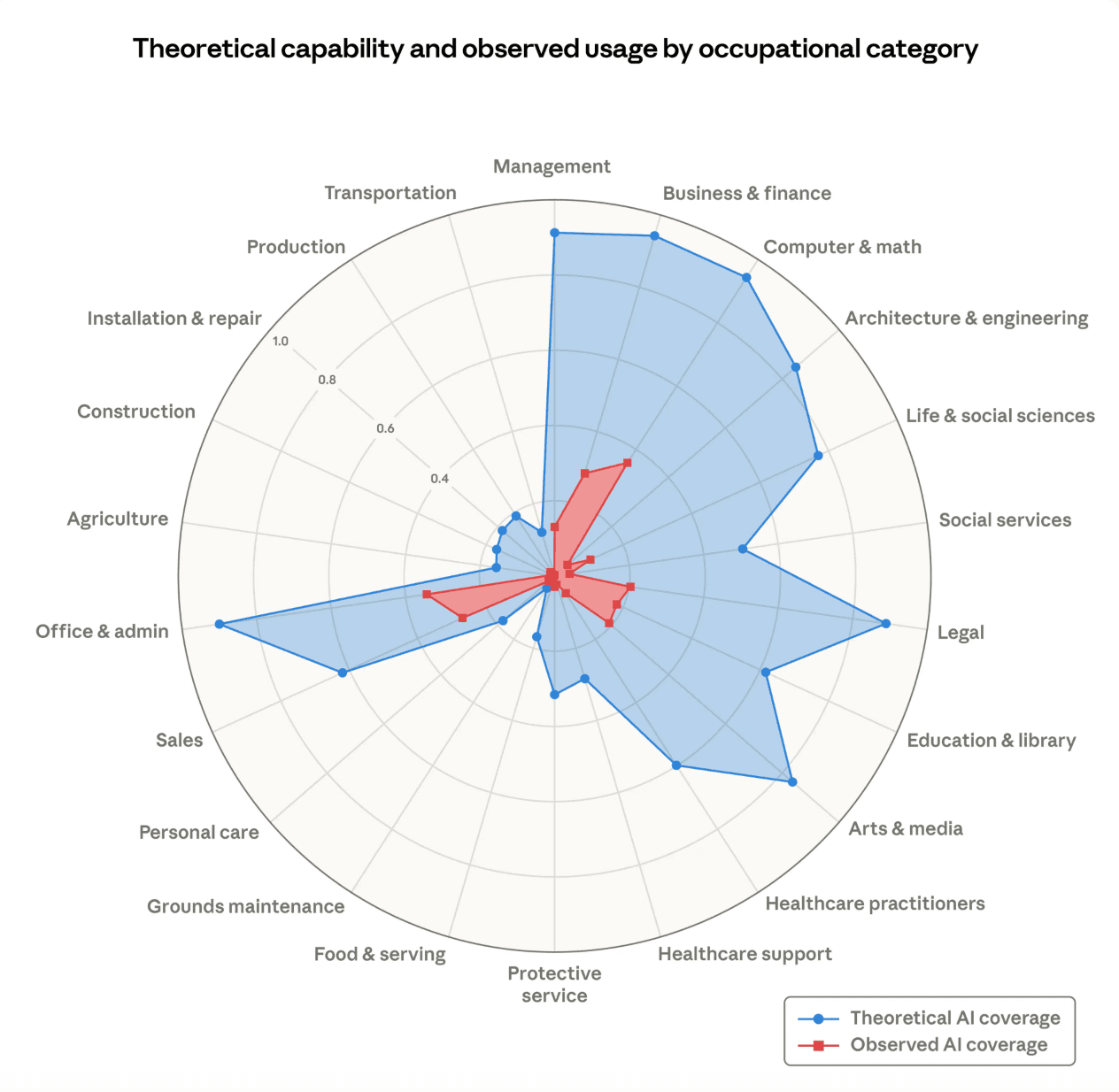
© Anthropic - Theoretical capability and observed exposure by occupational category: Share of job tasks that LLMs could theoretically perform (blue area) and our own job coverage measure derived from usage data (red area).
This discrepancy matters because it signals that technological feasibility does not guarantee economic adoption. The data show that 30% of workers, including those in manual roles such as cooks and mechanics, have zero observed coverage. Even in high-risk sectors, the transition is slower than anticipated. This lag provides a crucial window for strategic adjustment. However, it also suggests that current productivity gains are unevenly distributed. The study indicates that for every 10 percentage point increase in observed exposure, projected job growth through 2034 decreases by 0.6 percentage points. This confirms that while AI is not liquidating jobs overnight, it is actively suppressing future headcount growth in specific, knowledge-intensive sectors.
The silent slowdown for young talent
The most alarming finding in the 2026 data is not who is leaving the workforce, but who is failing to enter it. There has been no systematic increase in unemployment rates for highly exposed workers since late 2022. Instead, the impact is concentrated on the front end of the talent pipeline. The research identifies a suggestive slowdown in hiring for workers aged 22 to 25 in occupations with high AI exposure. Specifically, the job-finding rate for this demographic has dropped by roughly 14% post-ChatGPT compared with unexposed sectors. This creates a "pulling up the ladder" effect. Senior employees, who tend to be older, higher-paid, and more educated, use AI to augment their productivity. Meanwhile, entry-level roles, often defined by the routine tasks AI solves best, are evaporating.
Demographic data reinforce this divide. Workers in the most exposed quartile are 16 percentage points more likely to be female, disproportionately Asian, and earn 47% more on average than unexposed peers. They also hold significantly more advanced degrees. The insulation of these experienced workers contrasts sharply with the vulnerability of recent graduates. If this trend solidifies, companies risk hollowing out their talent pipelines. Without entry-level positions to train the next generation of senior engineers and analysts, organizations may face a critical skills shortage in the coming decade. The breakdown of the apprenticeship model in white-collar work represents a long-term strategic risk that automation alone cannot solve.
Top ten most exposed occupations using our task coverage measure. © Anthropic
Technical and legal firewalls
The chasm between AI’s theoretical power and its workplace footprint is maintained by significant technical and legal barriers. In high-stakes professions like law, the "context window" (the amount of information an AI can process at once) remains a limiting factor. Legal documents often require cross-referencing thousands of pages, a task where current context windows struggle to maintain accuracy. Furthermore, the necessity for human verification prevents full automation. AI "hallucinations," or plausible but false outputs, demand that a human expert review every output, reducing the efficiency gains that pure automation would promise.
Beyond software limitations, regulatory and liability concerns act as a brake on adoption. In the legal sector, for instance, relying on AI for case citations without human oversight has already led to professional misconduct sanctions. Corporations are wary of integrating AI into workflows where data privacy or intellectual property could be compromised. This hesitation is particularly acute in Europe, where the AI Act and GDPR create a more rigorous compliance environment than in the United States. These friction points suggest that for the medium term, AI will remain a tool for augmentation rather than a standalone replacement. The technology must overcome these "last mile" problems before observed exposure aligns with theoretical capability.
Productivity gains and the wage premium
Despite the hiring freeze for juniors, the economic argument for AI adoption at the senior level remains compelling. Global data indicate that sectors most exposed to AI are experiencing labor productivity growth nearly five times higher than non-exposed sectors. This productivity boost is translating into tangible economic rewards for those with the right skills. Job postings requiring specialized AI competencies are growing 3.5 times faster than overall recruitment, and these roles command a significant wage premium, up to 25% in major markets like the US and the UK.
This bifurcated market rewards adaptability. In financial services and information communication, the demand for AI-literate professionals has surged. The wage advantage for financial analysts with AI skills, for example, can reach 33%. This suggests a shift from labor displacement to labor polarization. The market is placing a premium on workers who can leverage AI to accelerate output, while devaluing roles that compete directly with algorithms. For European competitiveness, this underscores the urgency of upskilling. Productivity gains of 4% observed in early-adopter firms demonstrate that the technology is a multiplier for mature economies, provided the workforce is trained to wield it effectively.
Strategic implications for Europe
The translation of these US-centric findings to the European market requires a nuanced strategic response. Europe’s distinct labor laws and the recently implemented AI Act may blunt the speed of displacement, but they cannot halt the underlying economic shifts. The "hiring chill" for young workers poses a specific threat to European social stability, given the region's existing challenges with youth unemployment. To maintain strategic autonomy, European nations must proactively manage this transition rather than react to lagging indicators such as unemployment rates.
Policy interventions must move beyond simple regulation. There is a critical need for "flexicurity", systems that protect workers while allowing labor market flexibility. This includes expanding sector-specific transition funds and modernizing youth employment programs to focus on "AI-proof" skills: complex problem-solving, emotional intelligence, and high-level strategy. If European firms fail to integrate young workers into AI-augmented workflows, the continent risks a demographic skills gap that will hamper innovation for decades. The goal is not to preserve obsolete jobs but to ensure the next generation can navigate a hybrid labor market. Monitoring the "observed exposure" metric will be vital for Brussels to identify vulnerable sectors before systemic damage occurs.