
ASML breaks ground on a 20,000-worker Eindhoven campus
ASML begins construction of a 350,000 m² campus in Eindhoven, targeting 20,000 jobs to meet surging AI-driven chip demand.
Published on September 9, 2026
© ASML

Team IO+ selects and features the most important news stories on innovation and technology, carefully curated by our editors.
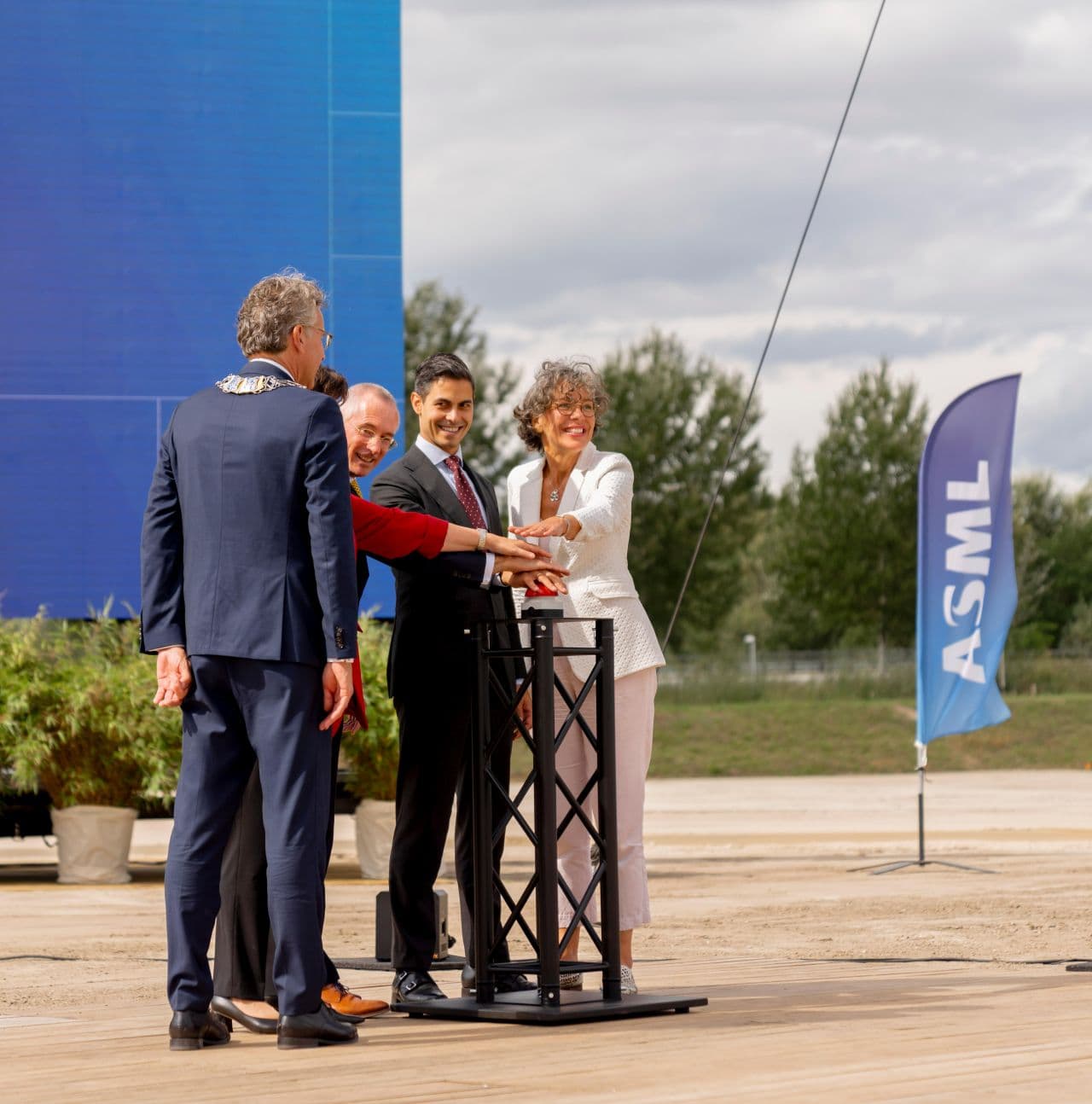
ASML officially broke ground on a new industrial campus in Eindhoven, launching a multi-phase project to accommodate up to 20,000 workers. The Brainport Industries Campus (BIC) North will integrate production, logistics, and office activities to meet global demand for advanced semiconductor equipment. Dutch Prime Minister Rob Jetten and ASML CEO Christophe Fouquet attended yesterday's ceremony, underscoring the project’s national and strategic significance.
The new campus is ASML’s second major industrial site in the Brainport region, complementing existing facilities in Veldhoven. It will host ASML’s next-generation 'flow factory' manufacturing model for TWINSCAN systems, designed to improve productivity and scalability. The first phase, targeting completion by 2029, will house at least 3,000 employees, with initial staff expected to arrive by early 2028. The expansion aligns with ASML’s role as the sole provider of advanced extreme ultraviolet (EUV) lithography systems, which are critical for producing the smallest transistors used in AI-driven chips.
The Dutch government has allocated €2.5 billion under 'Project Beethoven' to support regional infrastructure, housing, and electrical grid upgrades for ASML’s expansion. The project received rare nitrogen permit approval from the Province of Noord-Brabant in March 2026, justified by ASML’s global strategic importance. Eindhoven’s city council also approved zoning plans and local permits, enabling preparatory groundwork to begin in mid-2026. TenneT will extend a high-voltage station near Best to meet the campus’s electricity needs, addressing critical bottlenecks in the region’s power supply.
Regulatory and land acquisition hurdles
ASML faced regulatory challenges, including four objections filed with the Dutch Council of State regarding municipal and provincial decisions. Land acquisition proved complex, with six of nine landowners accepting the municipality’s offer, while the remaining properties faced forced expropriation. The city of Eindhoven purchased a detached home for €1 million, which will be demolished to clear space for the campus. The nitrogen permit was granted on the condition that ASML offset environmental damage by improving woodland in the Kempen region.
Economic and geopolitical implications
The campus reinforces the Brainport Eindhoven region’s position as a global semiconductor hub, supporting Europe’s push for strategic autonomy. ASML’s revenue is heavily concentrated in Asia (79.6%), with minimal contributions from the Netherlands (0.1%), highlighting the need for expanded domestic capacity. The project addresses surging demand for EUV lithography systems, with major clients like TSMC, Samsung, and Intel expanding their own production to meet AI computing needs. Nearly all of ASML’s EUV tool capacity is booked through 2027, underscoring the urgency of scaling operations.
Construction and supply chain integration
Construction will proceed in phases, with the first buildings—including a factory with cleanrooms and an office complex—expected to be operational by 2028. The campus will ultimately span 350,000 m², integrating advanced manufacturing, R&D, and logistics to support ASML’s long-term growth. The project reflects close collaboration between ASML, governments, knowledge institutions, and regional partners, with public-private partnerships investing in talent development, affordable housing, and equal opportunity to ensure sustainable growth.
The expansion will create tens of thousands of additional jobs at suppliers, further boosting regional employment. ASML’s new flow factory model, adapted from automotive and aerospace industries, will streamline material and work flows to enhance productivity. The campus will also strengthen the Brainport ecosystem’s supply chain resilience, supporting Europe’s broader semiconductor strategy. French President Emmanuel Macron’s August 2026 visit to the region highlighted the project’s role in European chip supply chains and AI collaboration.