
Battery recycling patents surge sevenfold, study shows
A joint EPO-IEA study reveals a massive spike in battery reuse innovations, driven by Asian tech giants and EV demand.
Published on May 8, 2026

Team IO+ selects and features the most important news stories on innovation and technology, carefully curated by our editors.
The global energy transition depends heavily on the availability of battery materials. As electric vehicle adoption accelerates, the industry is shifting its focus from raw material extraction to a circular economy. A landmark joint study by the European Patent Office (EPO) and the International Energy Agency (IEA) reveals that inventions related to battery reuse and recycling have increased sevenfold over the last decade.
This surge in innovation signals a critical pivot in how the world manages the lifecycle of energy storage systems. By prioritizing circularity, manufacturers aim to reduce environmental impact and secure supply chains against volatile commodity markets. This report highlights the technical and geopolitical shifts currently reshaping the global energy landscape.
The global surge in battery innovation
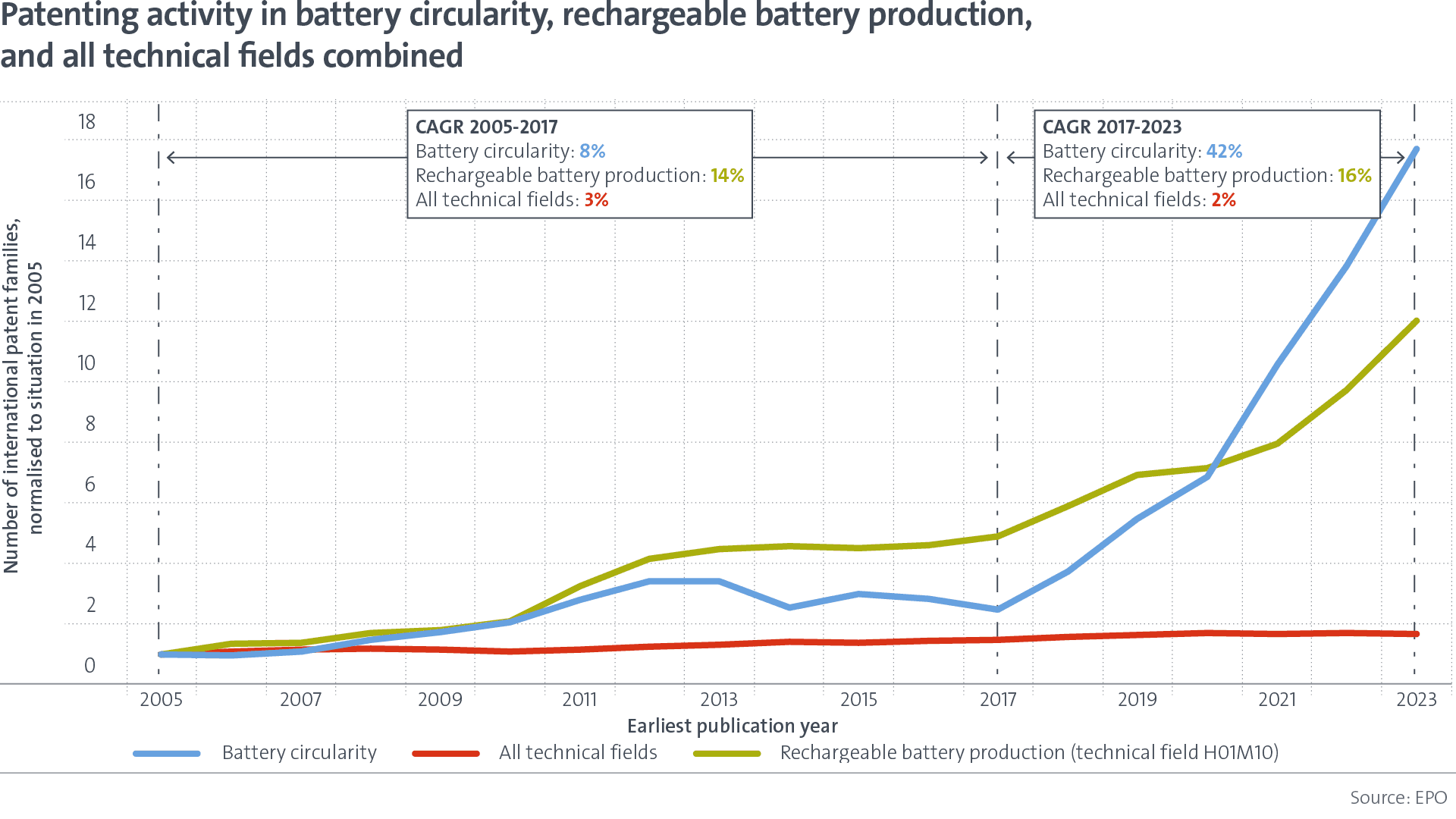
The pace of innovation in battery circularity has reached an unprecedented level. According to the joint report published by the EPO and IEA on April 29, 2026, the number of international patent families (IPF) for battery recycling and reuse has grown by 700% in just ten years. This acceleration began in earnest around 2017, the same year global electric vehicle sales first surpassed the one-million-unit milestone. High-value inventions are typically protected by IPFs, which represent patent applications filed in at least two different patent offices globally.
The data suggests that companies are no longer just looking to build better batteries; they are investing heavily in the infrastructure needed to reclaim them. This trend reflects a maturing industry that recognizes the limitations of finite lithium, cobalt, and nickel supplies. As the first generation of mass-market electric vehicle batteries nears the end of its useful life, the technology to process these units has moved from niche research to a primary industrial focus. The scale of this growth underscores a fundamental shift in the global manufacturing strategy, moving toward a closed-loop system that minimizes waste and maximizes resource efficiency.
Asian dominance and the competitive landscape
The patent landscape for battery circularity is currently dominated by Asian corporations, which held 63% of all international patent families in this sector by 2023. This concentration of intellectual property highlights a significant competitive gap between regions. Leading the charge is the Chinese battery recycler Brunp, identified as a top owner of recycling-related patents. Other major players include Japanese and South Korean giants such as Toyota, LG, and Sumitomo.
These companies are not merely battery manufacturers; they are becoming vertically integrated stewards of the entire battery lifecycle. Their dominance is the result of early and sustained investment in chemical processing and material science. While European and American firms are increasing their efforts, they are currently playing catch-up to an established Asian ecosystem that controls both the production and the recovery of essential battery components. This concentration of expertise has significant implications for global trade, as the regions that control recycling technology will effectively control the secondary market for battery-grade minerals. For Western companies, closing this patent gap is not just a matter of innovation but a requirement for maintaining long-term industrial relevance in the automotive and energy sectors.
Redefining the battery lifecycle
Modern battery circularity encompasses a broad range of technologies beyond simple shredding and melting. The patent data focuses on three primary pillars: collection, recycling processes, and repurposing. Collection technologies involve the logistics and safety protocols required to transport large volumes of spent lithium-ion cells. Recycling processes are becoming increasingly sophisticated, moving toward hydrometallurgical and pyrometallurgical methods that can recover high-purity minerals with lower energy inputs. Perhaps most significant is the growth in repurposing, or 'second-life' applications.
These inventions allow batteries that are no longer fit for the high-performance demands of electric vehicles to be repurposed for stationary energy storage in homes or on the electrical grid. This approach extends the battery's economic value and delays the need for intensive recycling. By focusing on the entire lifecycle, the industry is creating a more resilient framework for energy storage. These technological advancements are essential for making the circular economy a practical reality rather than a theoretical goal. The ability to efficiently disassemble, test, and reintegrate battery components will determine the cost-effectiveness of future energy systems.
Strategic autonomy and resource security
The surge in recycling patents is driven by more than environmental concerns; it is a matter of strategic autonomy. For regions like Europe, which lack significant domestic deposits of lithium and cobalt, recycling is a vital tool for reducing reliance on imported raw materials. The ability to recover these materials locally provides a buffer against geopolitical instability and supply chain disruptions. As the demand for batteries grows, the competition for raw materials will only intensify. By mastering recycling technology, nations can create a 'virtual mine' within their own borders, extracting valuable minerals from old products rather than relying on foreign extraction.
This shift is critical for maintaining industrial sovereignty in an era where energy storage is a national security priority. The EPO report highlights that the strategic importance of these technologies cannot be overstated. Governments are increasingly linking patent incentives to domestic manufacturing goals, recognizing that intellectual property in recycling is the key to a stable and sustainable industrial base. Without these innovations, the transition to renewable energy would remain vulnerable to the same supply chain bottlenecks that have historically plagued the fossil fuel industry.
Scaling for a decarbonized future
While the seven-fold increase in patents is a promising indicator of progress, the industry now faces the challenge of scaling these laboratory-proven technologies to an industrial level. The transition from a patent filing to a functioning, profitable recycling facility requires significant capital investment and regulatory support. The data from the EPO and IEA suggests that the foundational science is already in place, with clear leaders emerging in the private sector.
The next phase will involve harmonizing international standards for battery health monitoring and material labeling to facilitate easier recycling across borders. As the volume of spent batteries increases, the efficiency of these patented processes will be tested by the sheer scale of the waste stream. The forward-looking perspective for the industry is one of rapid industrialization. Companies that successfully implement these patented innovations will gain a significant first-mover advantage in a market that is expected to grow exponentially over the next two decades. The goal is a decarbonized economy where the materials used to power our vehicles and homes never leave the value chain, ensuring that the green revolution is truly sustainable from start to finish.