
Blue light therapy, VR, and music: healthcare innovation booms
The 17th edition of the Health Valley Event in Nijmegen shows how healthcare benefits from automation and AI.
Published on March 23, 2026
Masterstudente journalistiek aan de RUG, stagiair bij IO+, schrijft graag over de integratie van AI in het dagelijks leven
Last week marked the 17th edition of the Health Valley Event in Nijmegen, and IO+ attended. One theme stood central throughout the event: the future of healthcare is technological. Various exhibitions offered visitors insight into innovations, including robots delivering medication, apps and AI aimed at improving efficiency in healthcare, and a new way of treating cataracts.
Such technological support is much needed, as healthcare professionals experience a high workload and often take on roles beyond their medical duties, such as providing emotional support or guidance. The event demonstrated how technology can help ease this pressure.
Opening sets the tone for collaboration
Dolf Jansen opened the event and invited Egbert-Jan Bögels, director of Health Valley, onto the stage. Bögels emphasised the events’ shared goal: “Together, we make a difference in bringing healthcare to a sustainable level.”
A notable part of the opening was the interactive session by The Smartphone Orchestra. This activity highlighted the paradox of technology: it connects people, yet can also create distance. By linking phones together, an orchestra was formed, with each device acting as an instrument. What began with some scepticism gradually turned into enthusiasm.
Afterwards, eight finalists of the National Healthcare Innovation Award 2026—Bratelle, Ditto Care, Ambyon, Phlecs, Clef’r, SGMA, Incision Assist and Peyeoneer—were given the opportunity to present their innovations, showcasing the sector’s diversity.
Examples of this diversity include Bratelle and Clef’r. Bratelle produces bras for women who have had breast cancer. After treatment, the lymphatic system often functions less effectively, leading to fluid build-up. The ribbed design of the bra, combined with the natural movement of the ribcage during breathing, helps massage the lymph nodes and reduce swelling.
Music can evoke memories, but dementia makes it more difficult to operate devices such as radios. For this reason, Rik Wesselink developed Clef’r: a simple radio that encourages users to listen to music and adapts to their daily rhythm.
The opening concluded with guest speaker and author Gijs van Wulfen, who shared a clear message with innovators: perseverance is essential, even when ideas are repeatedly rejected.
Learning and living with VR
Virtual reality (VR) featured prominently on the exhibition floor. For example, VR-Bieb offers interactive training for novice healthcare professionals. Developed with experts by experience and actors, the material enables users to practise realistic scenarios in a safe environment.
“Prepare, perform, reflect,” says Inge Bergsma, nurse and presenter for VR-Bieb. “It is a safe and accessible way of learning.”
In addition to professional training, VR applications are also being developed for older adults. Elders VR, for instance, enables virtual travel for people with physical limitations.
Apps bring clarity to complex care
A recurring issue in healthcare is the fragmentation of patient data. Information is often stored across multiple systems, increasing the risk of missing important details.
Innovations such as the MS Sherpa app aim to address this. The application is designed for people with multiple sclerosis (MS), allowing patients to complete short daily tests, with results immediately available to their doctor.
“The app is currently intended only for people with MS,” says Sonja Cloosterman, Chief Clinical Officer at Sherpa. In the future, the team aims to develop additional apps for people with other conditions, such as dementia.
“Doctors often have only ten minutes per patient; there is hardly any time to study a full medical record,” Cloosterman explains. The app ensures everything is quickly and clearly accessible. “The holy grail is integration into the electronic patient records of all hospitals.”
Hands-on with new technology
Visitors were also able to explore other notable machines. InBody presented equipment that accurately measures body composition. “Its accuracy is 99% comparable to a DEXA scan,” says sales manager Natasha Liarte van Ekeren.
A less obvious innovation was Nater’s water mist fire extinguisher, specifically developed for care institutions where evacuation can be difficult. “Unlike sprinkler systems that use 80 litres per minute, the Hydramist uses just 8 litres per minute,” explains Mark Nater.
Finalist Phlecs also drew attention with a device that uses blue light therapy to treat eczema and other skin conditions. “Phlecs is specifically for patients with eczema or inflammatory skin conditions,” says David Aubert.
Technology enhances independence
Patient independence is a key theme in healthcare, as reflected at the event. Innovations such as Dosell’s medication dispenser support this goal. The dispenser works with pre-packaged medication rolls and ensures medicines are provided on time and easy to access. If a dose is missed, healthcare professionals are automatically notified.
AI as a silent force
Artificial intelligence is playing an increasingly important role in supporting healthcare processes. Ditto Care, for example, is developing technology that automatically translates medical jargon into plain language.
Smart camera systems, such as those by InexCloud, also aim to improve efficiency. These systems can detect incidents such as falls and only forward relevant alerts. “Only relevant notifications are sent; a flapping duvet, for instance, is ignored,” explains Gerjanne Tolner-Visser, account manager at Van Breda.
Another innovation is Exolumen, which uses AI during operations by projecting medical scans onto the patient’s body. CEO Ernst Elmhorst also sees applications beyond hospitals: “A specialist can remotely observe and draw on the projected image, enabling a less specialised doctor in the field to carry out the correct procedures.”
More comfort for patients
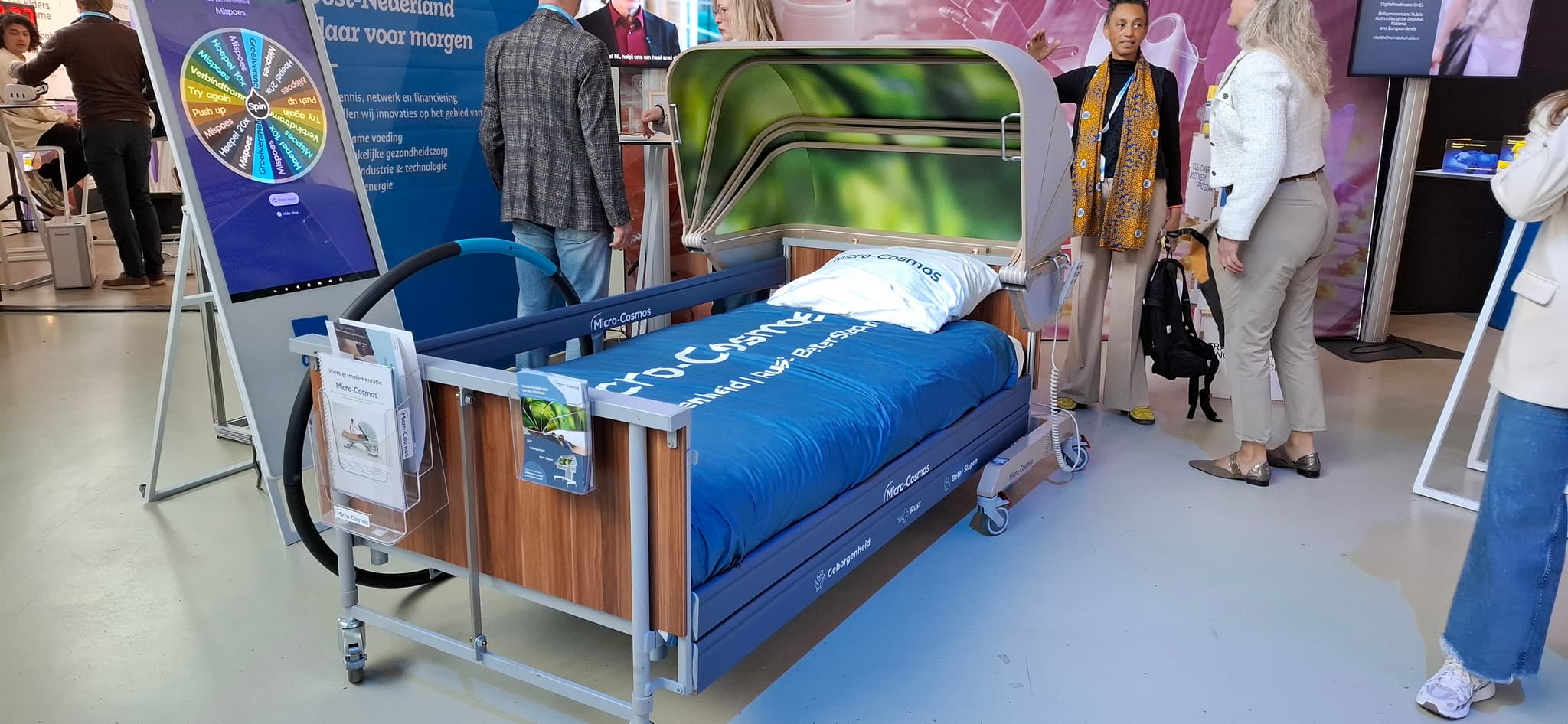
Some innovations focus on comfort and tranquillity. Micro Cosmos, for example, has developed a mobile canopy that can be placed over a hospital bed to reduce sensory stimuli. The canopy regulates light and sound, creating a calmer environment.
“At present, it is mainly intended for elderly care and people with dementia, who often experience restless sleep and sensitivity to stimuli,” says inventor Eef Lammers.
Conclusion
The Health Valley Event 2026 demonstrated the breadth and versatility of technological innovation in healthcare. From AI and VR to smart devices and data solutions, technology offers practical tools to make care more efficient and patient-centred.
At the same time, one principle remains unchanged: technology supports, but humans remain in control. As aptly summarised: “The final step, such as assessing an alert, is always carried out by a human,” says Tolner-Visser.