
Brainport needs engineers, Match Your Engineer finds them early
Match Your Engineer connects technical talent with companies, giving students the opportunity to gain work experience while still studying.
Published on November 19, 2026
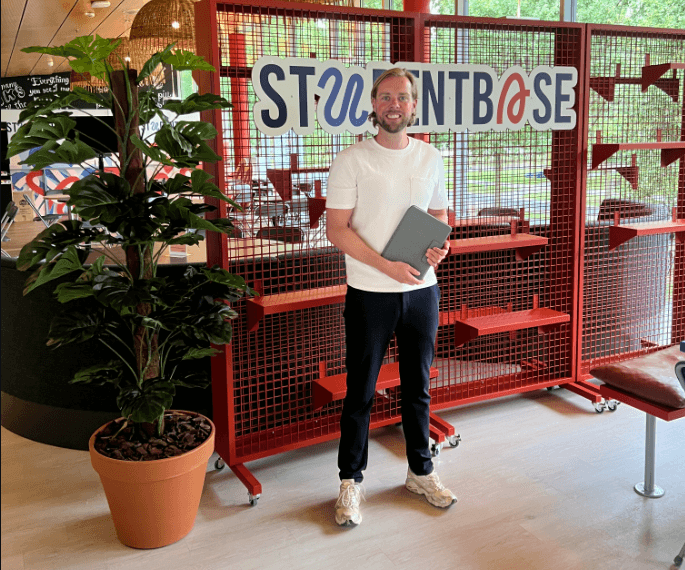
The Brainport region needs technical talent. At the same time, students often struggle to find a job after graduating because they lack relevant work experience. Match Your Engineer aims to bridge that gap. The initiative works together with Student Base at the High Tech Campus.
Kevin Engels launched Match Your Engineer about a month ago. Before that, he worked at EuFlex for two and a half years, helping students find part-time jobs and entry-level positions. When that department closed, he wanted to prevent the connections built between students and companies from being lost.
“What I have noticed is that many students want the opportunity to do something for companies while they are still studying. You learn things at a company that you simply cannot learn in a classroom. For a university student, that is a real step forward in terms of entering the job market. Once you graduate, you can say: I worked at that company and did this. That is worth a lot,” Engels explains.
From lecture hall to workplace
The idea behind Match Your Engineer is that students can already offer companies a great deal during their studies. This could include developing a dashboard, building prototypes or helping to develop an AI agent. At the same time, students get the opportunity to put the knowledge they acquire during their studies into practice.
According to Engels, a working student position is often the quickest way to make a match. For example, a company looking for someone to build a dashboard can submit an assignment. Engels then posts the vacancy on Eindhoven University of Technology's internal job platform. Interested students are invited for an interview, after which he introduces suitable candidates to the company.
The process can move quickly. Engels recently helped an Eindhoven-based cybersecurity company looking for a front-end developer. “He told me it would probably take two to three weeks to find someone he could hire. In the end, I had eight suitable candidates for him to choose from within just a few days. That was great, of course. He eventually hired two of them.”
Companies are not yet seeing the opportunities
Although companies are responding positively to the initiative, Engels notices that they do not always know how to make use of technical students. “Many organisations think: I need another intern for next year. But with a working student, you can actually get started straight away. An internship, on the other hand, has to meet certain requirements set by the university regarding the assignment. That makes it more difficult for interns to start immediately.”
According to Engels, companies are also not making full use of students' skills. When companies think of part-time jobs, they do not immediately think of technical assignments, even though students can help build prototypes, develop AI agents or carry out cybersecurity checks.
That is precisely where he sees the added value for companies. By employing students, organisations gain access to up-to-date knowledge from the university. “For companies, it means having access to the latest knowledge and the talent of tomorrow. They can connect with future engineers now and gain access to knowledge developed at the university in a low-threshold way.”
Retaining talent in Brainport
According to Engels, connecting students with companies benefits not only the organisations and students involved, but also the region as a whole. Brainport will need a large number of technical professionals in the coming years. By involving students in companies during their studies, they can build a connection with the region and the people working there.
“You can educate talented people, but if they say after graduating: I have no connection with this area, so I am going back to the city or country I came from, then you lose that knowledge. The earlier you connect with talent, the better it is for both parties,” Engels says.
According to Engels, this is particularly important for international students who come to Eindhoven to study. When they get to know companies and colleagues during their education, taking the next step towards a job in the region becomes easier. A working student position also gives students the opportunity to expand their professional network and earn money alongside their studies. At the same time, companies build a talent pool from which they can recruit future employees.
More than just a part-time job
The region has a significant need for new technical professionals. “For companies, joining Match Your Engineer is also a way to contribute to society. By 2030, the region will need 26,000 engineers,” Engels says. “Companies should, so to speak, be knocking on the university's door, saying: come and work for us! But that interaction is not happening enough yet. Match Your Engineer makes that knocking unnecessary.”
For Engels, Match Your Engineer will only be successful when companies know where to turn as soon as they are looking for technical talent. To achieve that, the initiative needs to grow over the coming period and attract sufficient funding to continue its work. Its goal is to connect as many students as possible with companies and contribute to the development of the regional ecosystem in terms of innovation, talent development and talent retention.
“The more people, students and companies connect with one another, the better it is for the future.”
Match Your Engineer
You don't need to have a job vacancy to work with students. Do you have a technical project that needs tackling? Get in touch via www.MatchYourEngineer.nl and discover what a student can do for you.