
Eindhoven, Munich, Dresden unite to grow chip startups
Europe excels at chip research but lags in building companies. A new launchpad from Eindhoven, Munich and Dresden aims to fix that.
Published on November 12, 2026
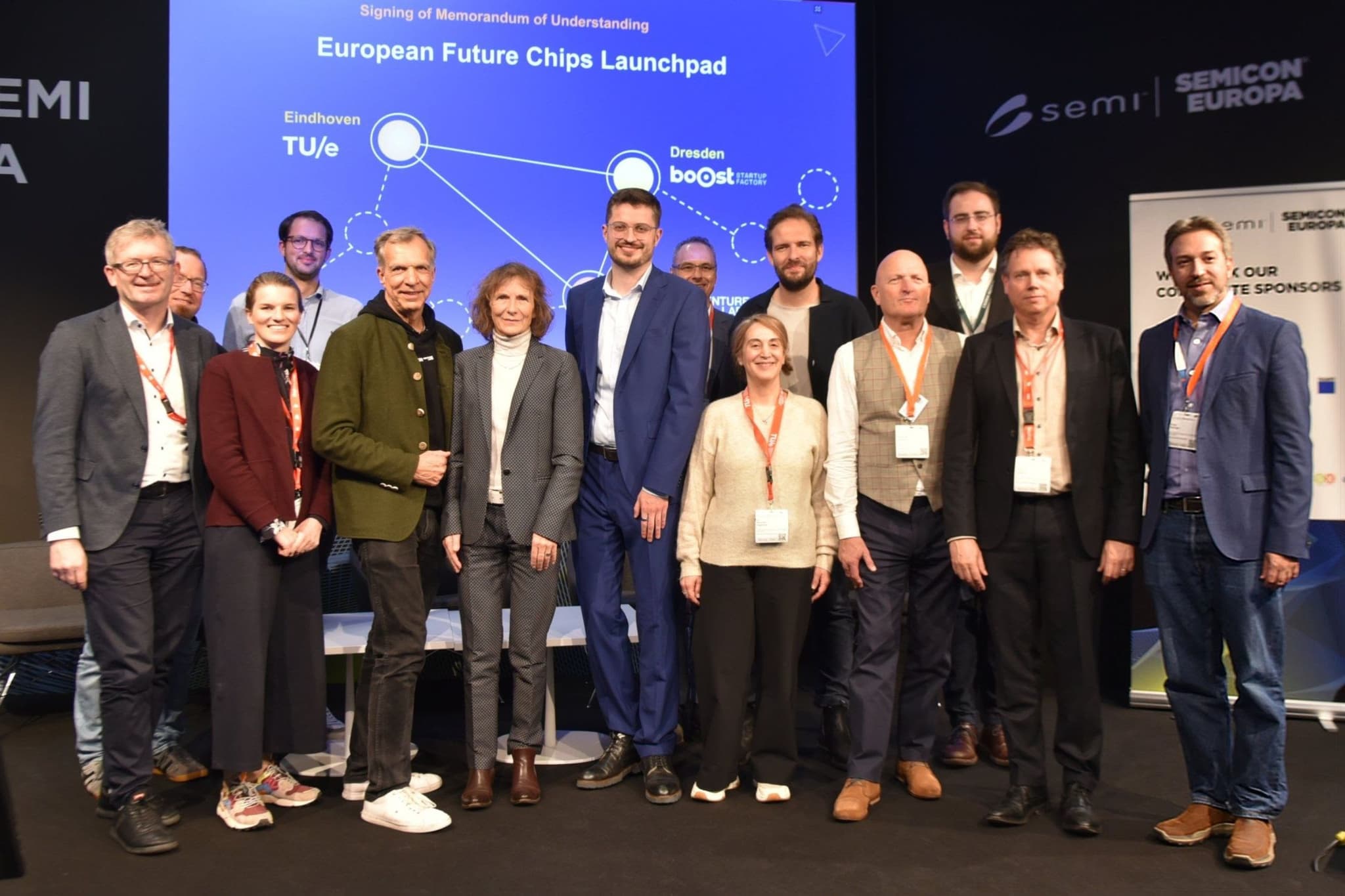
© UnternehmerTUM

Team IO+ selects and features the most important news stories on innovation and technology, carefully curated by our editors.
Europe excels at chip research but struggles to turn it into companies. To change that, Eindhoven University of Technology (TU/e) is teaming up with partners in Munich and Dresden on a cross-border launchpad for startups in semiconductors, photonics and quantum technology. The European Future Chips Launchpad (EFCL) was formalised on Wednesday at the SEMICON Europa trade fair in Munich.
The initiative gives founders and spin-offs in semiconductors, photonics and quantum technology access to infrastructure, mentoring, industry partners and investors in all three regions. The aim is to give them a single route from the lab to the market, so they don’t have to rely on what their home ecosystem can offer.
The EFCL brings together the TU/e, the Technology University of Munich's TUM Venture Labs, and the Dresden startup factory boOst. Helping deeptech founders scale across Europe is the goal.
Closing the lab-to-fab gap
The partners say Europe produces excellent semiconductor research but turns too little of it into investable, scalable companies. The white paper “Silicon Statecraft”, published by TUM Venture Labs and Brainport Development, calls this the gap between lab and fab. With chips underpinning everything from energy and mobility to AI and defence, the partners see closing that gap as a matter of European sovereignty: it keeps jobs, know-how and value creation on the continent.
“Chip startups are international by nature,” says Philipp Gerbert, CEO of TUM Venture Labs. “European founders need talent, customers and investors across the whole continent. With this MoU, we are building the launchpad that lets chip founders grow without borders and compete worldwide.”
Three complementary hubs
Each region brings something different. Brainport Eindhoven contributes its strength in lithography and integrated photonics. Munich offers a tightly knit innovation ecosystem built around TUM and UnternehmerTUM. Dresden, home to the Silicon Saxony network, is Europe’s largest microelectronics cluster, and boOst pools the startup activities of its universities and industry partners.
“Europe’s strength lies not only in investment, but also in how well we connect our innovation ecosystems,” says Silvia Lenaerts, Rector Magnificus of TU/e. “Together with Munich and Dresden, we are combining Europe’s strengths so that semiconductor breakthroughs give rise to new companies, innovative technologies and strategic value chains that can grow in Europe.”
Felix Hagleitner, managing director of boOst, said: “Deeptech founders need resources that extend beyond regional ecosystems. That’s why we’re pleased to contribute our research and industrial capabilities in the field of advanced manufacturing to the European Future Chips Launchpad."
Pilot planned for 2027
The partners have been working together informally since early 2026. So far, they have run a startup exchange between the three ecosystems and taken part in the TU Eindhoven Semiconductor Summer School. They have also organised a hackathon with SEMI Europe, which is taking place at SEMICON Europa this week.
By the first quarter of 2027, the partners plan to agree on a joint operating model covering governance, roles and a work plan. A two-year pilot is due to start later that year. They are seeking co-funding for it from sources that include the European Chips Act and industry partners. The launchpad is open to other European ecosystems that want to join.