
Euclyd is all in to free AI from its power problem
This week, we spotlight the winners of the G&A Award 2026. Today: Euclyd.
Published on July 17, 2026
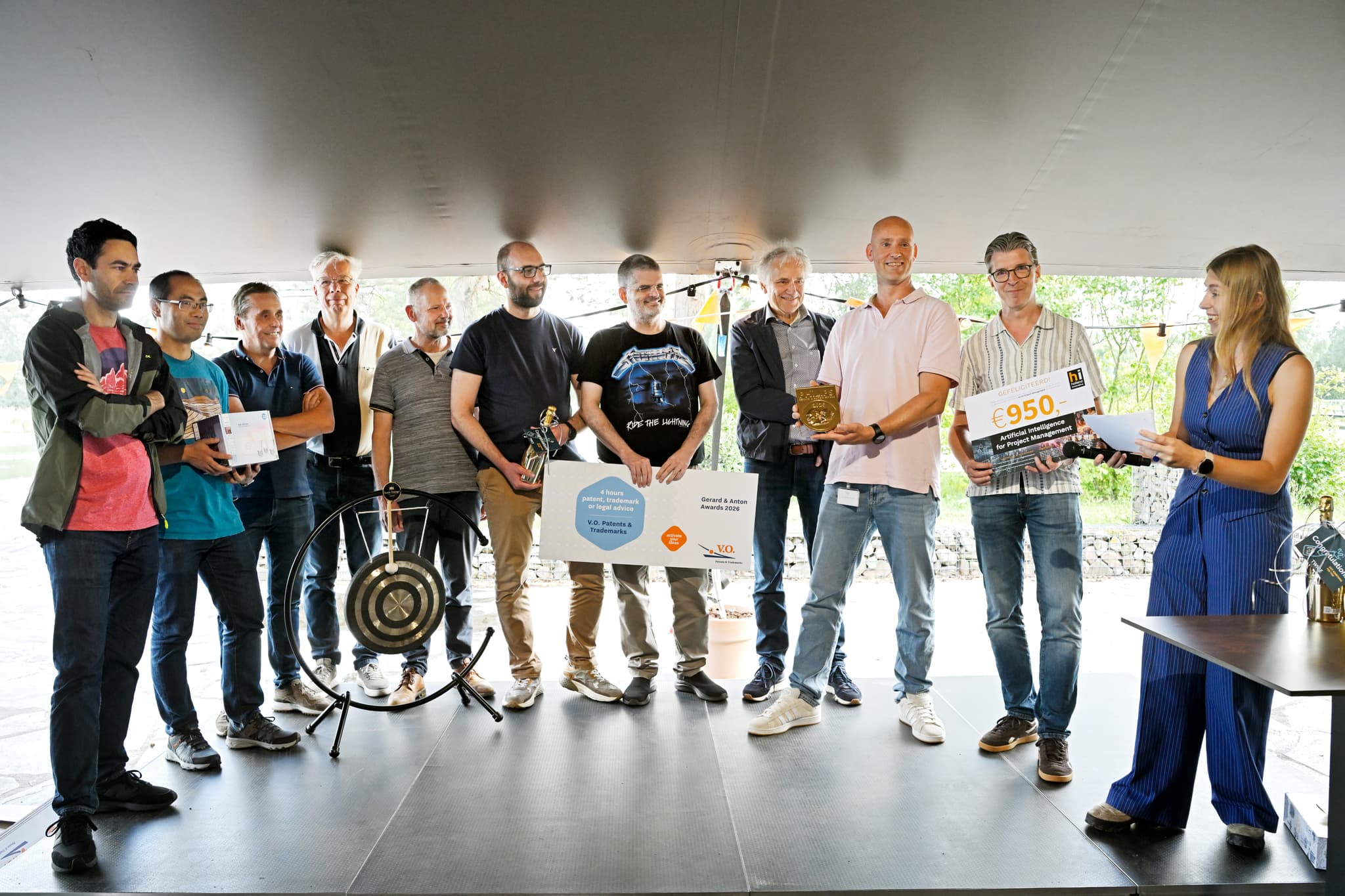
© Bart van Overbeeke Fotografie

Mauro swapped Sardinia for Eindhoven and has been an IO+ editor for 3 years. As a GREEN+ expert, he covers the energy transition with data-driven stories.
Every AI answer, every generated image, every agent quietly booking your flight runs on a token — and every token costs watts. Euclyd wants to make those tokens radically cheaper to produce.
The International Energy Agency projects that data-center electricity demand will more than double by 2030, with AI workloads alone quadrupling. As inference — the moment a trained model actually does something useful for a user — becomes the dominant AI workload, the chips built to run it are becoming a board-level energy problem, not just an engineering one. Euclyd, a chip startup based in Eindhoven, is betting that the industry has been solving this the wrong way.
.png&w=2048&q=75)
About Euclyd
Rethinking the chip from the gate up
Most AI chips in use today, including the GPUs that power the bulk of the industry, were originally designed for graphics and later adapted for AI training. That heritage comes with a cost: these architectures spend enormous amounts of energy shuttling data back and forth between memory and compute cores.
Euclyd's answer is CRAFTWERK, a chip system built specifically for inference rather than retrofitted from a gaming GPU. Instead of moving data through a memory stack, its architecture processes information simultaneously across many locations at once, an approach the company calls "Crafted Compute."
At the heart of the system is the CRAFTWERK SiP, a palm-sized chip package that crams in 16,384 custom processors. It can perform 8 quadrillion calculations per second (8 PFLOPS) at higher precision (FP16). The number of calculations per second can be higher (32 FLOPS) for lower precision (FP4). The chip package pairs with a terabyte of ultra-fast memory that Euclyd calls Ultra Bandwidth Memory.
Optimizing power usage
Euclyd's flagship product, the CRAFTWERK STATION CWS 32, bundles 32 of these chips into a single rack. Together, they deliver just over 1 exaflop of compute and 32 terabytes of memory. Euclyd projects the rack can churn out 7.68 million tokens per second while using around 125 kilowatts of power. While drawing a comparable amount of power to today's leading AI racks, the efficiency gain Euclyd claims comes from how much more useful work it can extract from that power.
Based on the modeled performance of Meta's Llama 4 Maverick, Euclyd claims this results in 100 times better power efficiency and cost per token than leading alternatives. That said, it's still just a projection: the company hasn't yet validated these numbers at commercial scale, since first silicon hasn't shipped yet.

G&A Awards 2026
Every year, we award 10 rising startups based in the Brainport region. In this series, you can get to know this year's winners better.
Growth moment
Euclyd's architecture went public in September 2025, when the company unveiled CRAFTWERK at the KISACO Infrastructure Summit in Santa Clara, its first detailed disclosure of the chip's specs and performance targets. The Eindhoven company has since opened an office in San Jose to be closer to the US customers and hyperscalers it's courting.
Since then, Euclyd has moved from architecture slides to a real roadmap. The company is now negotiating a funding round of at least €100 million to scale from prototype toward its first deliveries, building on a seed round of under €10 million. It's already in discussions with four potential customers, aiming to supply two next year and two more the year after, with full production of its multi-chiplet system targeted for 2028.
A partnership with ADTechnology, Korea's largest semiconductor design house, is meant to help turn CRAFTWERK's architecture into manufacturable silicon, a critical step for any chip startup trying to cross the gap between a compelling pitch deck and a working system in a customer's rack.
Heavyweight mentors, an underdog market
Euclyd's roster of advisers is unusually senior for a company barely two years old. Peter Wennink, ASML's CEO for a decade, sits on its board alongside Federico Faggin, who co-designed the world's first commercial microprocessor at Intel, and Steven Schuurman, founder of Elastic. Several of Euclyd's engineers came out of Silicon Hive, the well-known Eindhoven chip-design team later acquired by Intel.
That pedigree matters because the odds are steep. European AI chip startups raised roughly $800 million in 2026 so far, compared to $4.7 billion for their American counterparts in the same period, and Nvidia alone spent more than $18 billion on R&D last year — more than the combined capital of nearly every European challenger.
Euclyd's real test is ahead. But if the gate-level efficiency gains hold up in first silicon, the company hopes to make Eindhoven-crafted inference a name that matters well beyond the Brainport region.