
Fewer startups, bigger challenge: design scale from day one
Andy Lurling: “If we want a thriving ecosystem, we need to put founders at the center, and encourage them to guide the next generation.”
Published on February 18, 2026
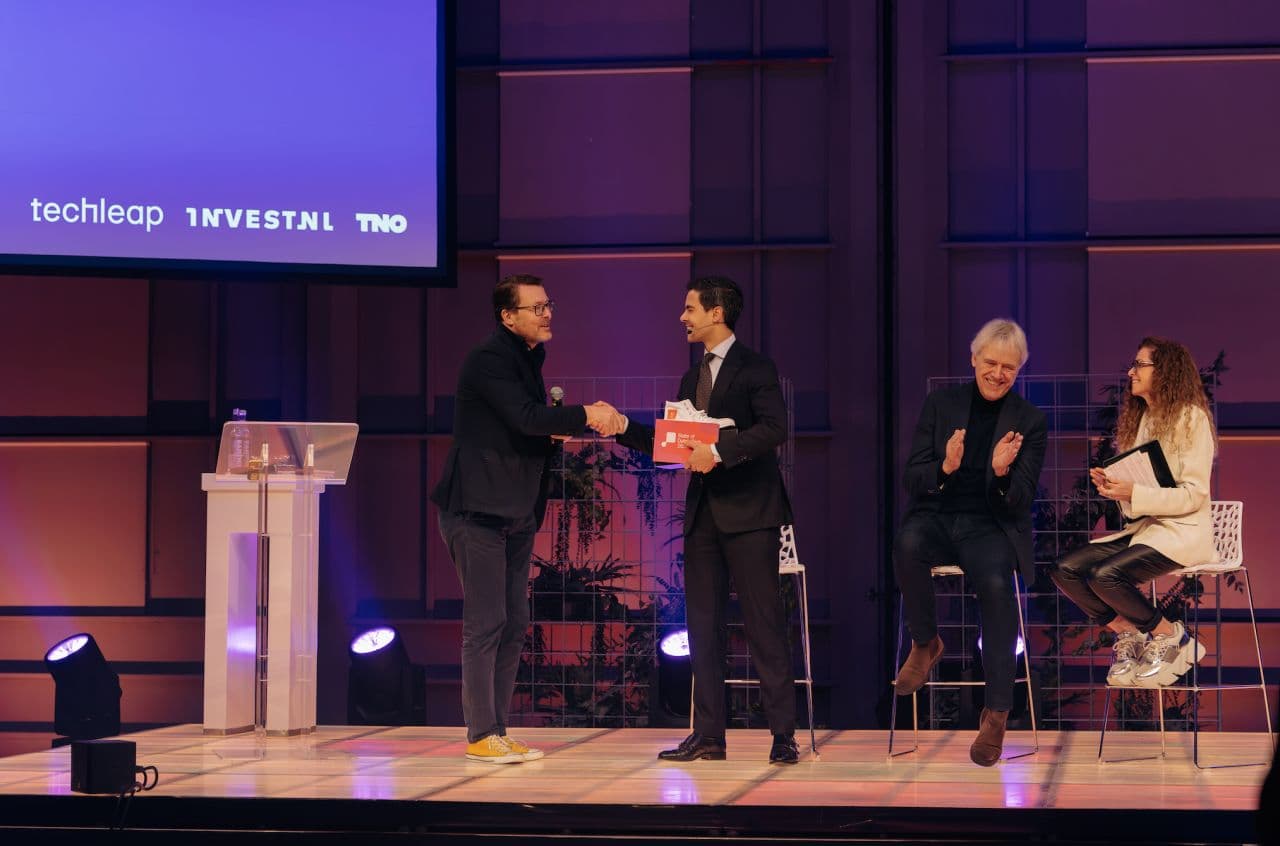
State of dutch tech 2026 © Techleap

Bart, co-founder of Media52 and Professor of Journalism oversees IO+, events, and Laio. A journalist at heart, he keeps writing as many stories as possible.
The Netherlands risks losing momentum in AI and deep tech as startup formation declines for the second consecutive year. According to investors and founders, the real problem is not starting companies, it’s scaling them.
The Dutch tech ecosystem is at a crossroads. The State of Dutch Tech 2026 report signals a worrying trend: the number of new AI and deep-tech startups has declined for the second consecutive year. While the country remains a strong European innovation hub, the pipeline of new companies is thinning, and concerns are shifting from startup creation to scale-up capacity.
Reflecting on the report, investor and entrepreneur Andy Lurling calls the trend “not just a statistic” but “a signal” for the ecosystem. “For the second year in a row, we’ve seen a decline in Dutch AI and deeptech startups,” he says. “That’s not just a statistic. It’s a signal”, Lurling writes on LinkedIn.
Andy Lurling
Starting is easy, scaling is hard
The State of Dutch Tech 2026 confirms what many ecosystem players have long felt: launching a startup has become more accessible thanks to incubators, early-stage funding, and strong research institutions. But turning those startups into global technology leaders remains difficult.
“I heard on stage that starting a startup is easy, scaling is difficult,” Lurling notes. “Of course, launching a startup is relatively accessible today. Building and sustaining one, growing it into a scale-up is a totally different story, and a completely different game.”
According to the report, Dutch startups still face structural bottlenecks in later-stage funding, talent acquisition, regulatory complexity, and international market access. While early-stage investment remains relatively stable, the number of companies reaching the scale-up stage is not growing at the same pace.
Lurling argues that the issue lies deeper than capital rounds or international attention. “Scale is not created in Series A or B,” he says. “It is not created when international investors arrive. It is not created when headlines call a company a ‘future unicorn.’”
Instead, he believes scale must be embedded from the beginning. “Scale is designed into the system from day one. Building a resilient, well-governed, globally competitive scale-up requires the courage to start plus next-level grit, resilience, support, and long-term thinking from the get-go.”
Foundations matter
One of the report’s key conclusions is that the Netherlands excels at research and early-stage innovation but struggles to build large, globally competitive tech firms. The number of scaleups has grown more slowly than in comparable European ecosystems, and the conversion rate from startup to scale-up remains a concern.
Lurling sees a cultural and structural blind spot. “The importance of building proper foundations in the earliest stage seems often too easily overlooked by the ecosystem,” he says. “In reality, this is the entrepreneurial law of nature: these foundations limit or sustain how big, bold, and bright you can build.”
The Dutch ecosystem has produced global success stories such as ASML and Adyen, yet these remain seen as exceptions rather than the norm. “Let’s not forget: ASML and Adyen were once startups too, that needed to weather many storms, floods and droughts,” Lurling says. “They did so because of the extraordinary people who had built and supported them.”
The report echoes this point: the Netherlands has strong ingredients for innovation, such as research institutions, corporate partners, and early-stage capital, but needs more consistent support throughout the growth journey.
Founders helping founders
One area where the ecosystem shows strength is peer-to-peer support among entrepreneurs. Experienced founders increasingly mentor younger companies, a dynamic that the report identifies as a key driver of successful scale-ups.
“What we see consistently working is (former) entrepreneurs helping entrepreneurs,” Lurling says. “Peer guidance, real-world experience, and shared learning often accelerate growth more and faster.”
He argues that founders should be central to ecosystem design. “If we want a thriving ecosystem, we need to put founders at the center, and encourage those who’ve been there to guide the next generation.”
This aligns with broader European discussions on strengthening founder networks, improving stock option regimes, and reducing regulatory barriers. The State of Dutch Tech 2026 suggests that ecosystems with strong founder-led mentorship and reinvestment cycles tend to produce more scaleups over time.
Policy and risk culture
Beyond mentorship, Lurling calls for structural policy changes to support entrepreneurs. “To truly support them, we - or better, the government - should consider safety nets and tax incentives for founders,” he says. “They are people who drive future job creation and innovation.”
Compared with Silicon Valley, European founders often operate in a more risk-averse environment, with stricter bankruptcy rules and less favorable tax treatment for stock options. This can discourage repeat entrepreneurship and slow the formation of new companies.
“It’s a bit different than in Silicon Valley,” Lurling acknowledges, “but we’d better accept most of us have a more risk-averse European mindset.”
The report supports this view, noting that policy frameworks play a major role in determining whether startups stay in Europe as they scale. Without improvements in later-stage funding and founder incentives, many promising companies may still look abroad for growth.
Strengthening the entire chain
Ultimately, both the report and Lurling’s reflections point to the same conclusion: the Netherlands must focus not only on creating startups but on sustaining them through every phase of growth.
“If we want more European technology leaders, we must focus on and strengthen the entire chain continuously,” Lurling says. “Let’s work on a European startup and scale-up ecosystem where entrepreneurship is structurally supported, across the entire chain and by all stakeholders.”
His message is both a warning and a call to action. “Let’s start,” he concludes.
For the Dutch tech ecosystem, the challenge is clear: fewer startups today could mean fewer global champions tomorrow, unless scale is built into the system from the outset.