
From lab to life: autonomous systems now deployed at scale
National Congress Autonomous Systems in Drachten brings together the entire value chain, from building blocks to a wide range of end users.
Published on February 18, 2026
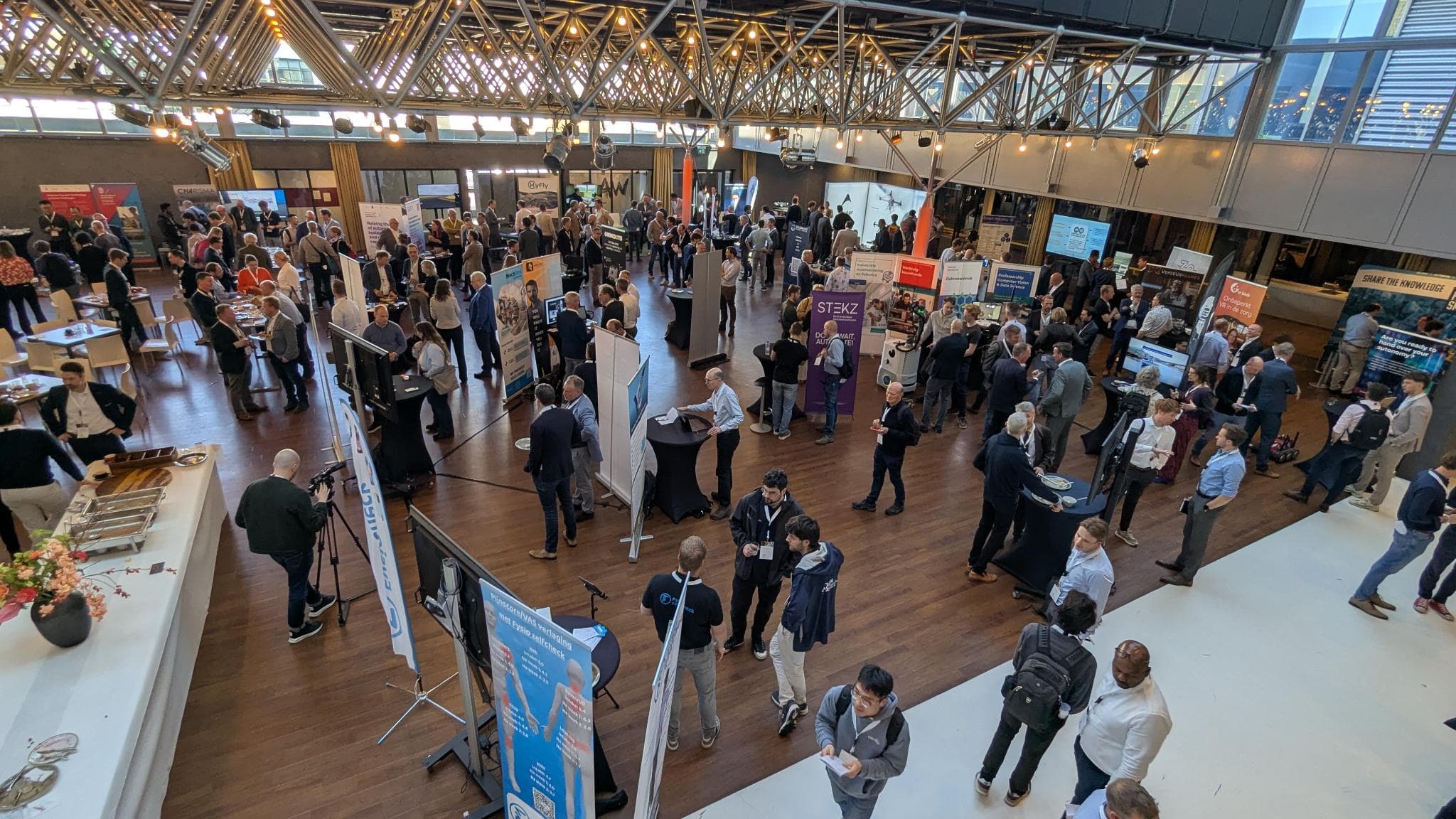
Demoplein, Nationaal Congres Autonome Systemen 2025

Bart, co-founder of Media52 and Professor of Journalism oversees IO+, events, and Laio. A journalist at heart, he keeps writing as many stories as possible.
Autonomous systems are at a turning point. What for years was developed primarily in research environments is now rapidly moving into factories, hospitals, distribution centers, and critical infrastructure. According to the organizers of the National Congress Autonomous Systems (NCAS’26), taking place on April 2 in Drachten, autonomy is evolving from a technological promise into an economic and societal game changer.
The congress’s central theme - From Lab to Life - captures that shift. “Autonomous systems are rapidly evolving from experimental technology into a new industrial standard,” says Hans Praat of the Northern Netherlands Development Agency (NOM) and organizer of the congress. “The shift is visible: autonomy is becoming a key technology for productivity growth, competitiveness, and addressing societal challenges.”
The entire chain on one stage
NCAS’26, the logical follow-up to the successful first edition of the event a year ago, aims not only to inspire but above all to connect. The congress therefore brings together the full chain of autonomous technology: from building blocks such as AI chips and sensor technology to system integrators and end users who apply the technology in practice. “Successful deployment of autonomous systems requires collaboration across the entire value chain,” Praat notes.
This is reflected in the program, which is more international in scope than the term “national congress” might suggest. Major technology providers such as NVIDIA and vision-AI specialist Fizyr will present the foundations on which autonomous systems run. Machine builders and system integrators like Demcon and KUKA will demonstrate how classical automation is evolving into intelligent, self-steering machines. And end users such as UMCG and online supermarket Picnic will illustrate how autonomy is transforming concrete processes, from patient care to logistics.
Autonomous systems now touch almost every sector: manufacturing, agriculture, logistics, healthcare, energy, water management, and smart cities. The congress will explore this broad range of applications, with this year also focusing on defense and security. Not by coincidence: autonomous applications often advance fastest in those domains and offer lessons for civilian sectors.
Strategic importance for the Netherlands
The plenary opening will be delivered by TNO CTO Christa Hooijer, who will outline the strategic importance of autonomy for the Netherlands and Europe. Autonomous systems are seen as a key technology for the so-called “Autonomy Economy,” in which AI, sensors, and robotics converge in new products and services.
This will be followed by a keynote address from Shankar Sastry (UC Berkeley), a pioneer in autonomous systems. His lecture on reliable autonomous technology will focus on how safety, trust, and certification are organized when machines operate independently in complex environments. According to Praat, this goes to the heart of the current phase: “The step from lab to real-world deployment requires not only technology, but also trust and clear frameworks. We’re extremely proud that a leading figure like Sastry will update us on this.”
Building blocks and breakthroughs
The role of AI and chip technology will feature prominently. NVIDIA will demonstrate how computing power, simulation, and digital twins accelerate the design and training of autonomous systems. At the same time, embedded AI enables real-time perception and decision-making, which is essential for safe deployment in dynamic environments.
Fizyr will illustrate how vision AI is already being applied in logistics and food processing. Through precise object recognition, robots can independently sort and process products. Such applications make clear that autonomy is no longer a distant prospect but a concrete product strategy for machine builders seeking to make their systems smarter and more flexible.
From technology to application
The congress also shows that the real breakthrough is happening among users. In healthcare, UMCG expects that a significant portion of patient care could, in the future, be supported by autonomous systems, though this would place high demands on safety and regulation. In retail, Picnic demonstrates how autonomous logistics and data-driven processes enable new business models.
Defense and security will also be addressed, with contributions from Airbus. Autonomous systems are already operational there, supporting reconnaissance, logistics, and cooperation between manned and unmanned systems. Lessons from that domain, particularly on reliability, certification, and human-machine collaboration, are, according to the organizers, highly relevant to civilian applications.
Autonomy as a product strategy
The common thread throughout the program is that autonomous systems are outgrowing the experimental phase. Companies are developing and integrating the technology, while users are increasingly willing to adopt it. “AI building blocks, deep-tech innovation, and high-tech machine building are coming together in working solutions,” Praat says. “This is creating not only technological progress but also structural economic and societal returns.”
As a result, autonomy is becoming a strategic pillar for industry, not only to produce more efficiently, but also to address labor shortages, make processes more sustainable, and develop new services. The congress in Drachten aims to show that the future of autonomous systems is no longer in the lab but in real-world deployment, and that collaboration across the value chain is crucial to accelerating that transition.
Anyone who wants to see how autonomous the Netherlands and Europe are becoming would do well to be in Drachten on April 2 and can already purchase tickets for the National Congress Autonomous Systems.