
Housing needs infrastructure. Can robots build it faster?
Before homes come roads, rail and walls. Danish startup ERLEtek wants robots to handle part of that groundwork.
Published on October 19, 2026
© ERLEtek

Mauro swapped Sardinia for Eindhoven and has been an IO+ editor for 3 years. As a GREEN+ expert, he covers the energy transition with data-driven stories.
A new neighbourhood isn’t just houses. It needs roads, retaining walls and, in a country below sea level, flood defences. In the Netherlands, even that groundwork is stalling: the government can’t afford roads and railways to approved new neighbourhoods with 30,000 homes. Pouring concrete the old way, one formwork panel at a time, won’t close that gap fast enough. ERLEtek, a spinout of the Technical University of Denmark (DTU), is betting that robots can.
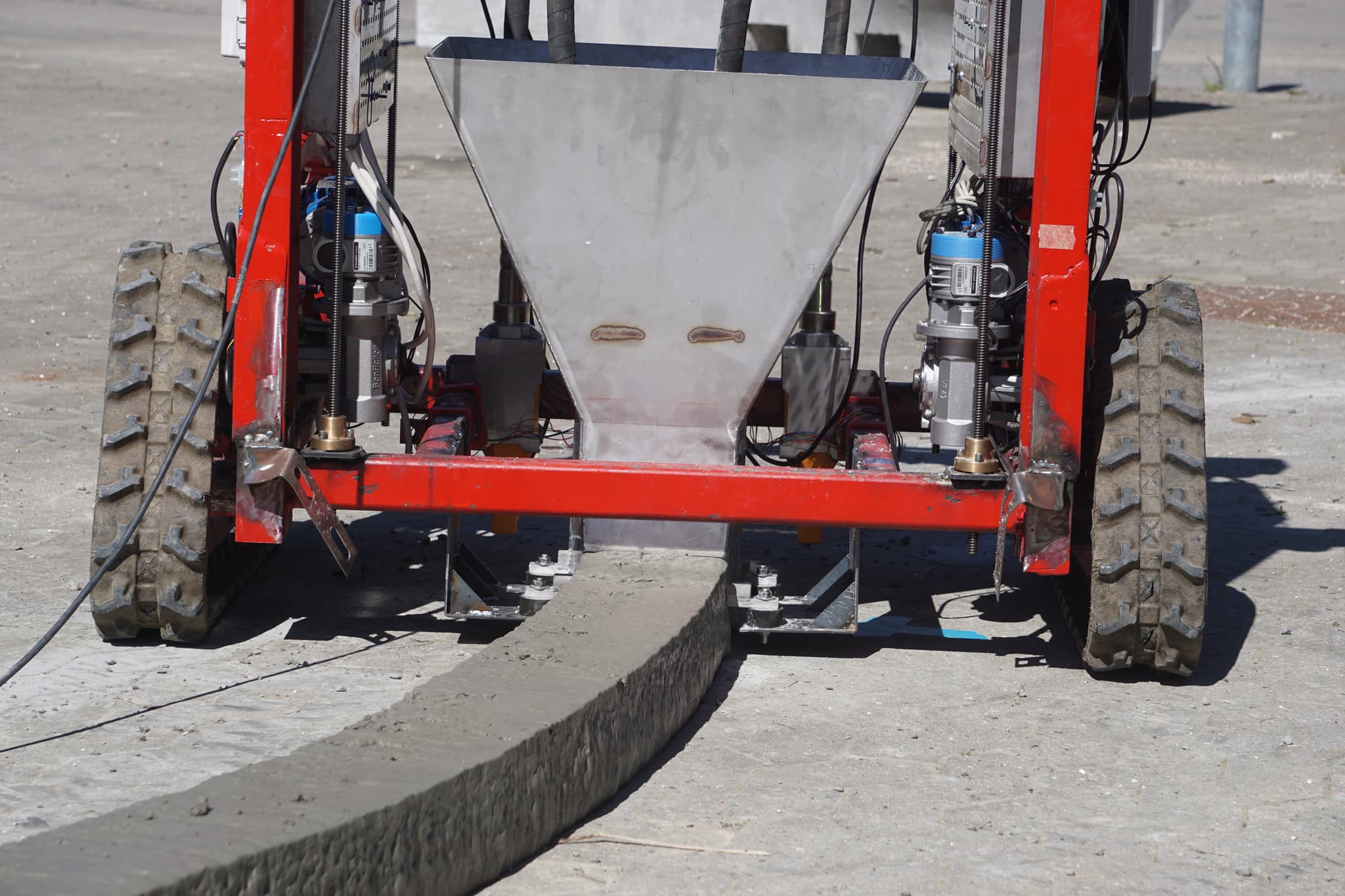
ERLEtek is developing construction robots that can build flood protection and retaining walls. The robot understands the space and can erect walls layer by layer, following the construction project and integrating into the workflow.
The company stems from the PhD work of its CEO, Pablo Alberdi Pagola, who founded the company alongside Jonathan Mikler (CTO), and Lasse Olsen (COO).

Beyond Borders
Innovation doesn’t stop at the border! In Beyond Borders, we spotlight disruptive innovations worldwide that can help tackle societal challenges in the Netherlands. How are they making an impact? How can they help?
On the site
The construction robot is, as Olsen explains, small enough to fit in the back of a van. Once on site, it uses its sensors and GPS to locate itself. After downloading the plans for what it needs to build, it starts executing, applying one layer of concrete on top of the next autonomously.
Currently, the robot can erect walls 10 to 40 centimetres thick. In the version under development, it can build up to 2 meters tall. The robot can hold up to 500 litres of material in its container, enough to build walls for half an hour between refills.
The robot can be refilled with dumper trucks, equipment contractors have on site. A 100-meter wall usually takes two construction workers around 280 labour hours. According to ERLEtek, it takes 80 hours for the robot, without any formwork — the structure needed to contain concrete until it sets.
The robot can work with standard concrete, lower-CO2 concrete, and clay-based mixtures. Working with concrete is challenging, as its consistency changes continuously. “A sensor measures what material goes in, and the software understands the material and how fast the vibration and material flow should be,” says Olsen.
Fitting into the industry
Finding space in a conservative industry — and often with thin margins to innovate — might sound daunting for a startup, yet Olsen sees an opening. Rising wages and resource costs are pushing contractors toward larger projects.
So he gathered smaller municipal jobs, then approached contractors to deliver them together, with ERLEtek carrying part of the risk. The company aims to fill this gap by taking over projects that are sometimes left behind.
To win their approval, demonstrations matter more than any pitch deck. "Construction is field-based, not conceptual: they need to see it and touch it to know whether it works," he says.
Moreover, the Danish company is opting for co-development. Rather than selling a finished machine, it puts the robot in contractors' hands and adapts it to how they already work. "The biggest hurdle for construction robots is that other companies have tried to impose a workflow built around their robot," Olsen says. "We're turning that around."
A swarm of robots
With a background in sales and a career across different finance jobs, Olsen met Alberdi Pagola at the football club he joined and learned about his background in construction site management. The two clicked immediately. Alberdi Pagola then met Mikler, having a background in autonomous robots. Together, the three turned the idea into ERLEtek.
“At Carlsberg, I felt like a very small wheel in a big corporate machine. I needed more hands-on work, direct feedback, and the feeling of making a difference, so I was very keen to join ERLEtek,” says Olsen.
The first project with the Technical University of Denmark (DTU) started in 2023. The research spanned two years, and they later established the company in 2025. Erle, a Basque word meaning bee, reflects the startup's ambition: to create a swarm of robots that operates on construction sites. Seven people work for the startup.
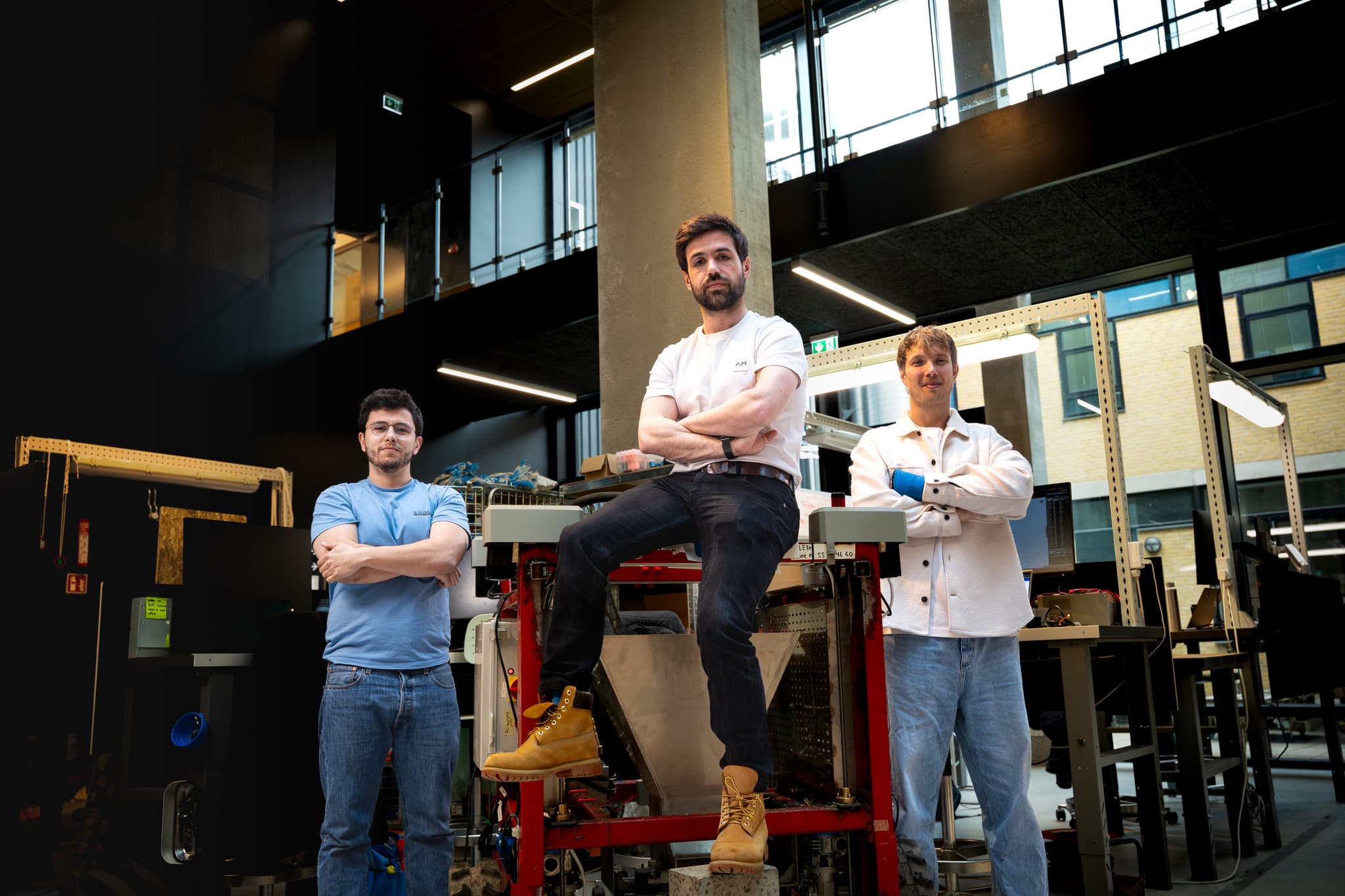
From left to right: Jonathan Mikler, Pablo Alberdi Pagola, and Lasse Olsen. - © ERLEtek
A literal moonshot
The same technology has caught the attention of the European Space Agency (ESA), which is exploring how to build lunar infrastructure from materials already available on the Moon. ERLEtek won two contracts with ESA and has been testing regolith, the layer of loose dust and broken rock that covers the Moon’s surface.
Olsen sees the space work as more than a side project. "You may not make it, but you still have to think as though you will, and you may develop valuable technologies along the way," he says.
Concrete projects on planet Earth
But before launching into orbit, the team is focused on Earth and upcoming projects. At the end of October, ERLEtek will print a ten-meter, one-meter-high wall in a large test pool run by a fire department and an engineering company, then flood it and measure the water pressure.
In the summer, it will build a 100-meter coastal-protection wall on a Danish island with a municipality and a construction partner. Smaller municipal jobs, such as curved infrastructure elements and flower beds, are also in the pipeline.
“We want to build more partnerships with construction companies, take on more projects, and move closer to a world where construction companies use robots as a normal part of their work,” Olsen says.
For the Netherlands, that future can’t come soon enough. Approved neighbourhoods still lack roads and railways, and much of the country relies on walls to keep the water out. Every meter of wall a robot builds is one less a short-staffed crew has to build.