
Innovation in Brainport: why so many good ideas still fail
Innovation Research Brainport: Marc Maas spoke with twelve innovation managers, R&D managers, CTOs and founders at manufacturing companies.
Published on February 7, 2026

Team IO+ selects and features the most important news stories on innovation and technology, carefully curated by our editors.
Guest post by Marc Maas, Reversed.
Demos Pitches & Drinks as inspiration
During one of the editions of Demos Pitches & Drinks, Marc Maas got into conversation with the founders of startups and scale-ups from the Gerard & Anton community. Those conversations continued outside of Demos Pitches & Drinks and formed the basis for an in-depth study into innovation and success. The result (download here) is a clear explanation of why so many innovations fail. During last Wednesday's DPD, Marc returned to share the most important insights with the community. He also turned it into this blog post.
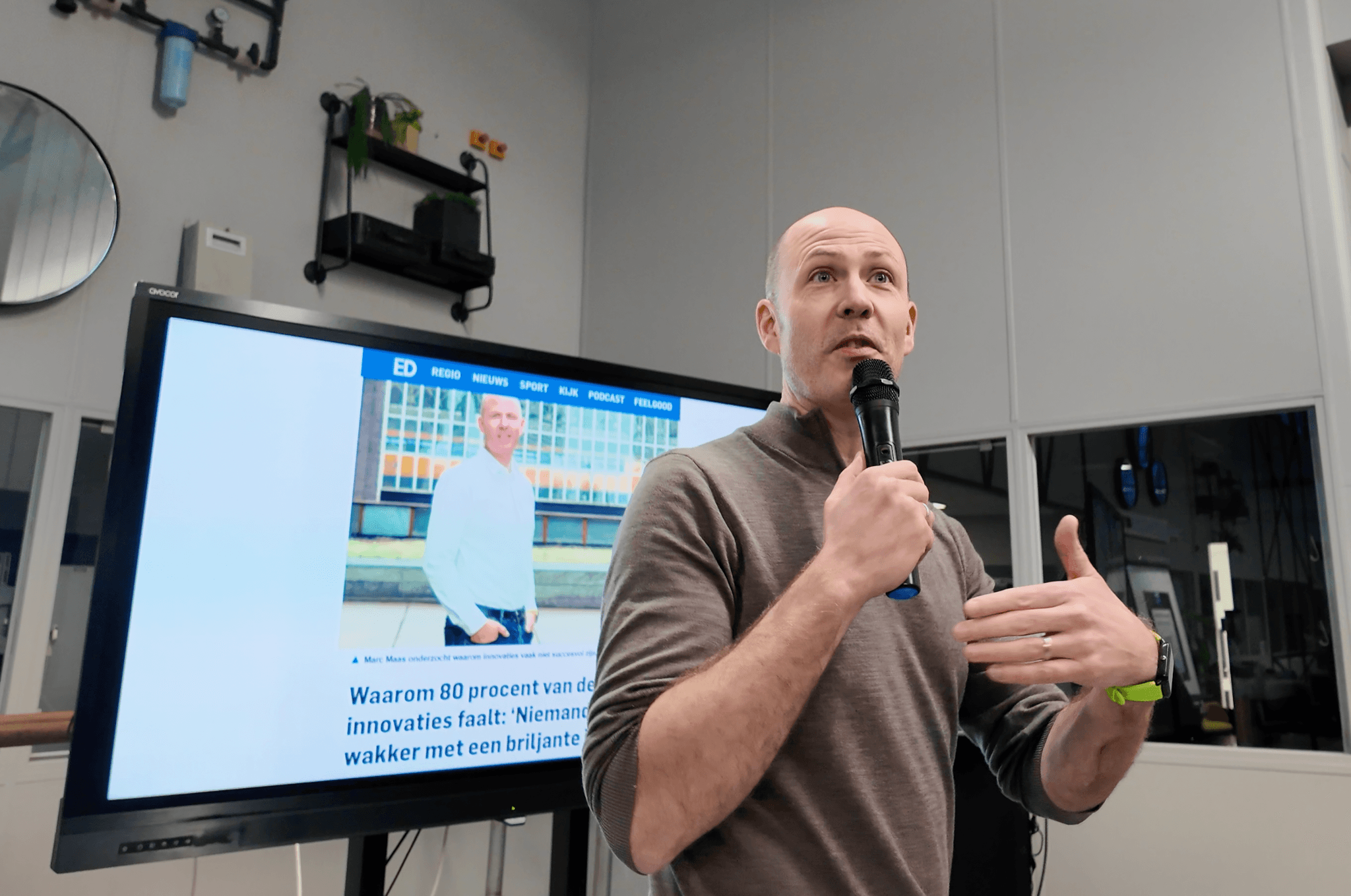
Marc Maas
Innovation is central to the Brainport region. At the same time, one number keeps coming back to me: around 80% of new products fail in the market. That figure has been stubbornly high for years and shows little sign of improvement.
Not because companies are engaging in foolish actions. Quite the opposite. The manufacturing companies I spoke with are smart, technically strong, and highly motivated. Yet somewhere between idea and market, things often go wrong.
Driven by that curiosity, I initiated the Innovation Research Brainport independently. In 2025, I conducted in-depth interviews with 12 innovation managers, R&D managers, CTOs, and founders from manufacturing companies in the region. Not about frameworks or theory, but about day-to-day reality: successes, failures, and doubt.
This resulted in three key lessons, particularly relevant for startups and manufacturing companies seeking to increase their chances of successful innovation.
Lesson 1 – Innovation is not a straight line, but you still need direction
On paper, innovation looks manageable. In reality, almost all participants described the same picture: a winding road.
Plans shift. Priorities collide. Sales pulls on ideas, R&D wants to do things properly. Along the way, new insights and opportunities emerge that also demand attention.
What stood out is this: companies that handle this well do not try to eliminate the chaos, but create rhythm within it. They accept that innovation moves, while deliberately building moments to decide whether to continue, pause, or stop.
Without that rhythm, one of two things happens. Either everything becomes ad hoc and fragmented, or innovation slows down under the weight of meetings and caution.
Successful innovators, therefore, do not rely on rigid roadmaps but on clear agreements about ownership, decision-making, and focus. That turns out not to be a luxury, but a prerequisite for progress.
Successful innovators, therefore, do not rely on rigid roadmaps but on clear agreements about ownership, decision-making, and focus.
Lesson 2 – Most failures start with building too early
This may be the most confronting insight from the research: teams consistently start building too soon.
Not because they do not care about customers, but because the organization pushes them forward. There is sales pressure, enthusiasm for an idea, and technical curiosity. Before you know it, teams are already sketching, prototyping, or tooling, while the underlying problem is still vague.
What makes this difficult is that customers often do not know which solutions they need. Yet companies often speak to them and question them in the language of solutions.
Customers know what frustrates them, what impedes them, and what they are trying to achieve. But for product and technology experts, it is surprisingly hard to conduct conversations in a way that surfaces those underlying needs.
This is where issues often arise. Companies listen, but they do not always ask the right questions. As a result, solutions are built for assumptions rather than for real problems.
The companies that do better explicitly invest time in understanding before building. Observing, probing, seeing customers in their context. That takes time, but ultimately saves money, rework, and disappointment.
For startups in Brainport, this represents a major opportunity. Especially in the early stages, the real advantage lies in gaining a deeper understanding before committing to solutions.
Lesson 3 – Success is not in the hardware, but in the layer around it
A third recurring theme from the interviews: success lies not in the hardware but in the layer surrounding it.
Onboarding, service, software, installation, support, revenue model. Together, these elements determine whether a product is actually used and valued.
Yet many manufacturing companies treat this “outer layer” as something to be addressed later. First, the product has to work. The rest will follow.
The more successful participants invert this logic. From the start, they think about the complete experience:
- How does a customer understand what this product means for them?
- What happens after the sale?
- Where does convenience appear, and where does friction arise?
One striking insight: the more technical the product, the more important this layer becomes. Not because the technology is less important, but because customers no longer differentiate on specifications alone.
For startups, this may be the most important lesson. If you focus only on your product, you leave value on the table. Markets do not buy features; they buy solutions that fit into people's daily lives.
Innovation requires more listening than convincing
What stayed with me most from this research is how frequently listening was mentioned and how difficult it is. Listening takes time. It produces no immediate output. It often clashes with the urge to demonstrate progress quickly.
Still, the conversations show that companies that consistently invest in understanding, rhythm, and coherence see their innovations land more effectively. Not perfectly, not without mistakes, but with a higher chance of success.
If Brainport can grow in one area, it is here. Fewer assumptions, more insight. Less building driven by enthusiasm, more building driven by understanding.
This is not a plea for slowing down. It is a plea for making smarter choices.
The full Innovation Research Brainport report is available for download here (in Dutch) and contains detailed analyses and verbatim interview quotes.
External Content
This content is from youtube. To protect your privacy, it'ts not loaded until you accept.