
LiS aims to grow to 700 instrument makers, also beyond Leiden
Leiden Research Instrument Makers School (LiS) celebrates its 125th birthday: “Without our technicians, innovation comes to a standstill”
Published on May 8, 2026
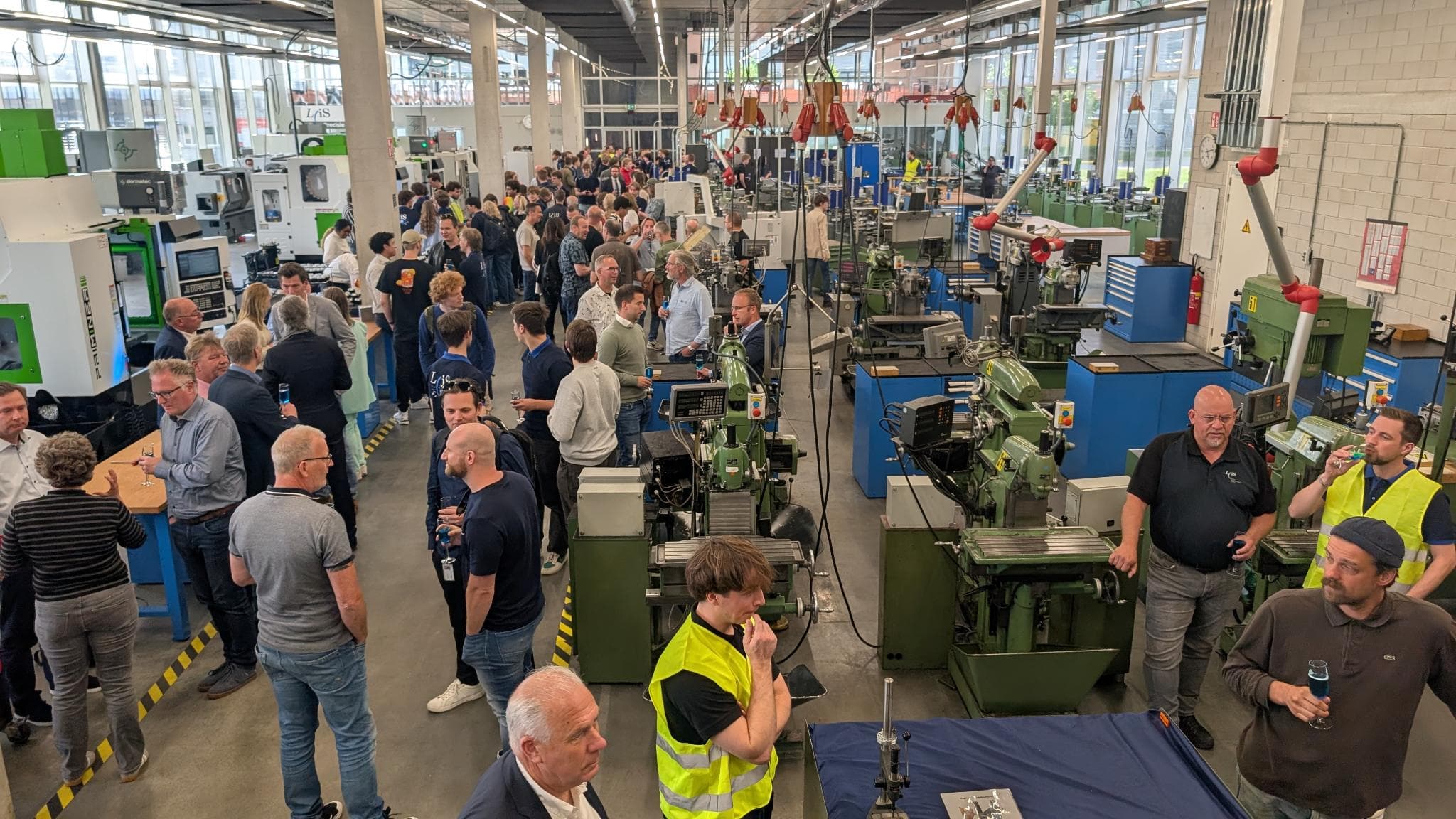
Students, alumni, teachers, and invited guests in the LiS's large workshop during the school’s 125th-anniversary celebration.
Bart, co-founder of Media52 and Professor of Journalism oversees IO+, events, and Laio. A journalist at heart, he keeps writing as many stories as possible.
The Leidse Instrumentmakers School (Leiden Research Instrument Makers School, LiS) aims to scale significantly in the coming years to help address the growing shortage of technical talent in the Netherlands. During the celebration of the school’s 125th anniversary, director Stef Vink announced a new growth phase, titled Scaling up the LiS portfolio. Thanks to a substantial subsidy from the national Beethoven program, the oldest vocational mbo school in the Netherlands will spend the next four years expanding its educational programs and strengthening cooperation with other high-tech regions.
“125 years of history is wonderful, but the future is even more important,” Vink said during his speech. “The economic earning model of the Netherlands is running at full speed, but it is also under pressure. We need to train more skilled professionals to realize and reshape the technological ambitions of the Netherlands.”
The LiS was founded in 1901 by physicist Heike Kamerlingh Onnes, who needed practically trained technicians for his experiments in Leiden. The school has now been training instrument makers for science and industry for more than a century. From Airbus and ASML to research institutes such as CERN, the LiS maintains close ties with the international high-tech sector.
What is the LiS?
Growth ambition: from 400 to 700 students
Where the school still had 85 students in 1997 and trains around 200 students in Leiden in 2025, its national impact has now become much larger, according to Vink. “At this moment, we are training around 400 people in the Netherlands, and we want to grow to 700 in the coming years.”
That growth must be realized through two action lines. The first focuses on strengthening the network of regional instrument-making institutions and developing shorter yet high-quality learning pathways. With this, the LiS wants to accelerate the influx of students while safeguarding the quality of vocational craftsmanship.
The second action line revolves around stronger cooperation with the Brainport region around Eindhoven. There, the LiS wants to offer the instrument maker program, or parts of it, together with regional partners. According to Vink, this will make the school “even a little bit more a school of the Netherlands and everything around it.”
That cooperation aligns with the national Beethoven program, in which government, educational institutions, and companies are investing in additional talent for the Dutch semiconductor and chip industry. Since 2024, the LiS has been part of that program together with Leiden University.
Critical moment for technical vocational education
The LiS anniversary celebration took place amid a rapidly growing shortage of technical personnel. According to the school, there are currently more than 71,000 technical vacancies open in the Netherlands, while enrollment in vocational mbo education is declining.
Vink therefore also used the anniversary as a call to politicians in The Hague. “What Kamerlingh Onnes understood in 1901 still applies just as strongly today: without good instrument makers and technicians, innovation comes to a standstill.”
The school plays an important role within the Leiden knowledge cluster around the Leiden Bio Science Park and works together with organizations including TNO, LUMC, and SRON. During their education, students work on concrete innovations for sectors such as aerospace, medical technology, and precision engineering.
Representatives from education, industry, and politics attended the anniversary event, including the mayor of Leiden and officials from the Ministry of Education. The opening was provided by Adnan Tekin, chairman of the MBO Raad.