
London's Airhive acquires Dutch carbon capture competitor Carbyon
Airhive has acquired Carbyon, bringing together two direct air capture startups with different takes on removing CO2 from the air.
Published on July 14, 2026
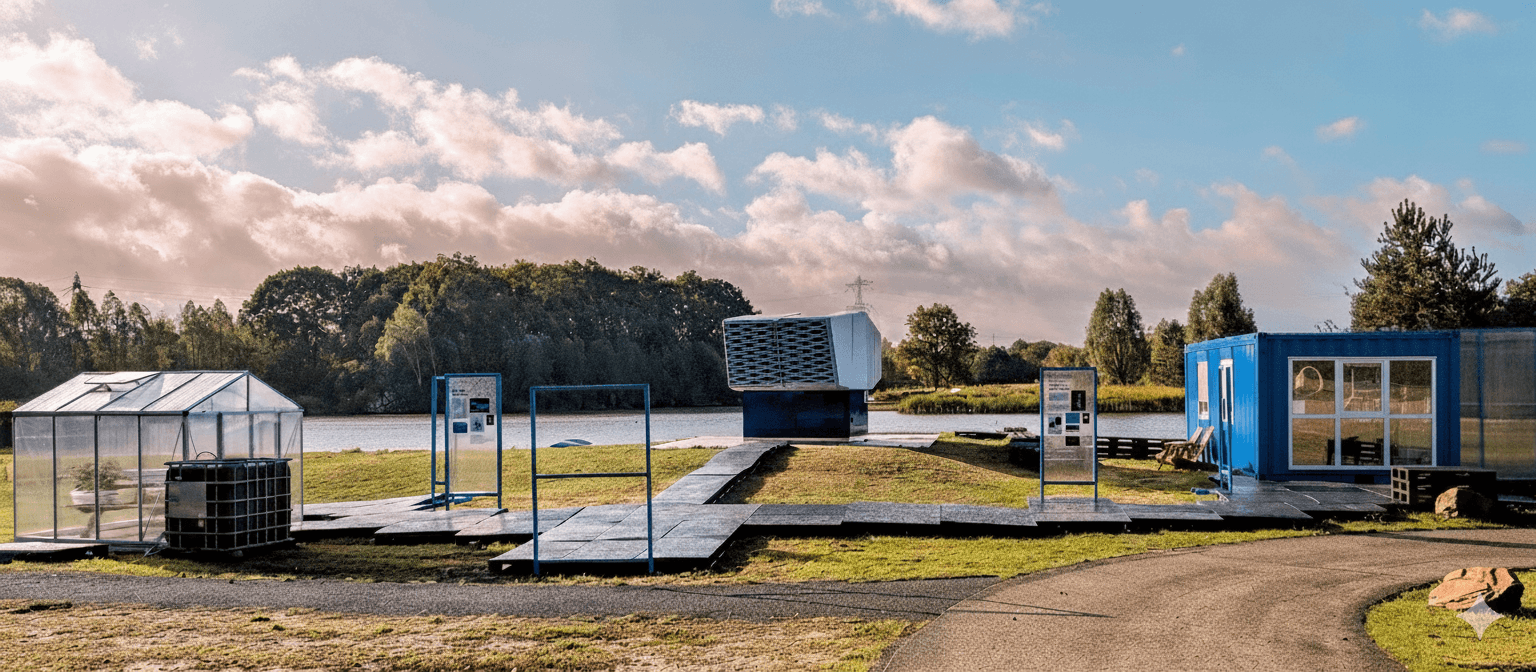
Carbyon Go at High Tech Campus Eindhoven

Team IO+ selects and features the most important news stories on innovation and technology, carefully curated by our editors.
London-based direct air capture (DAC) company Airhive has acquired its Dutch competitor, Carbyon, marking a notable consolidation move in the fast-growing carbon removal industry. The deal was reported by Bloomberg. Financial terms of the acquisition have not been disclosed.
“Market oscillations have underlined the case for consolidation” in the carbon-removal industry, Airhive said in a statement Tuesday. Both companies work in direct air capture, a technology that removes carbon dioxide straight from ambient air rather than from industrial smokestacks, but they've pursued distinct engineering paths to get there.
.png&w=2048&q=75)
Two approaches to pulling CO2 from the air
Airhive is building a hybrid geochemical-DAC technology that leverages fluidization to deliver fast, low-cost CO2 removal. In simple terms, air is blown through a bed of loose mineral particles, causing them to behave almost like a bubbling liquid. This "fluidized bed" trick, borrowed from other industries, speeds up how quickly the minerals can grab CO2 from passing air. Those minerals — made from abundant, non-toxic rock — soak up the CO2, and the system then heats them to release the gas in a pure form.
Because the heat used in that step is recovered and reused rather than wasted, the whole process becomes cheaper to run. Airhive builds its equipment into modular units that fit inside standard shipping containers, with each unit able to capture about 1,000 tonnes of CO2 a year, making the machines easy to transport and install almost anywhere. The company started in a small lab in West London in 2022 and is backed by investors including AP Ventures and Coca-Cola Europacific Partners.
Carbyon, founded in Eindhoven in 2019, took a different approach, built around speed. Picture a spinning drum: air passes over one side of it, where a special coating grabs onto carbon dioxide molecules in a matter of seconds. The drum then rotates that same section around to its other side, where it's briefly heated for just a few minutes, releasing the captured CO2 in a concentrated, high-purity form.
That coating is applied using atomic layer deposition, a precision thin-film technique originally developed for computer chip manufacturing, which lets the drum's surface grab and release CO2 unusually fast. Because each cycle of capturing and releasing is so quick, the machine can process more carbon dioxide in a smaller footprint — the basis for Carbyon's claim to build the fastest direct air capture machine on the market. The company raised about $17.9 million in total funding, including a €15.3 million Series A round in 2024, from backers such as Lowercarbon Capital, ISAI, and Invest-NL, and ran a test facility at Eindhoven's High Tech Campus.
A maturing but still nascent market
DAC remains a small but rapidly evolving sector, with a handful of players — including Climeworks and Heirloom Carbon Technologies — currently dominating market share estimates. Analysts tracking the space have long predicted that consolidation, partnerships, and long-term offtake agreements would reshape the competitive landscape as the technology moves toward commercial scale, and the Airhive-Carbyon tie-up appears to be an early example of that trend playing out between two venture-backed European challengers. For now, neither company has issued a detailed public statement on how Carbyon's fast-swing technology will be integrated with Airhive's fluidized-bed systems.