
Meat burger, but 30% plant-based: hybrids are the future
Meatless aims to make the meat industry more sustainable by adding plant-based ingredients to burgers, meatballs, and chicken cutlets.
Published on October 5, 2026
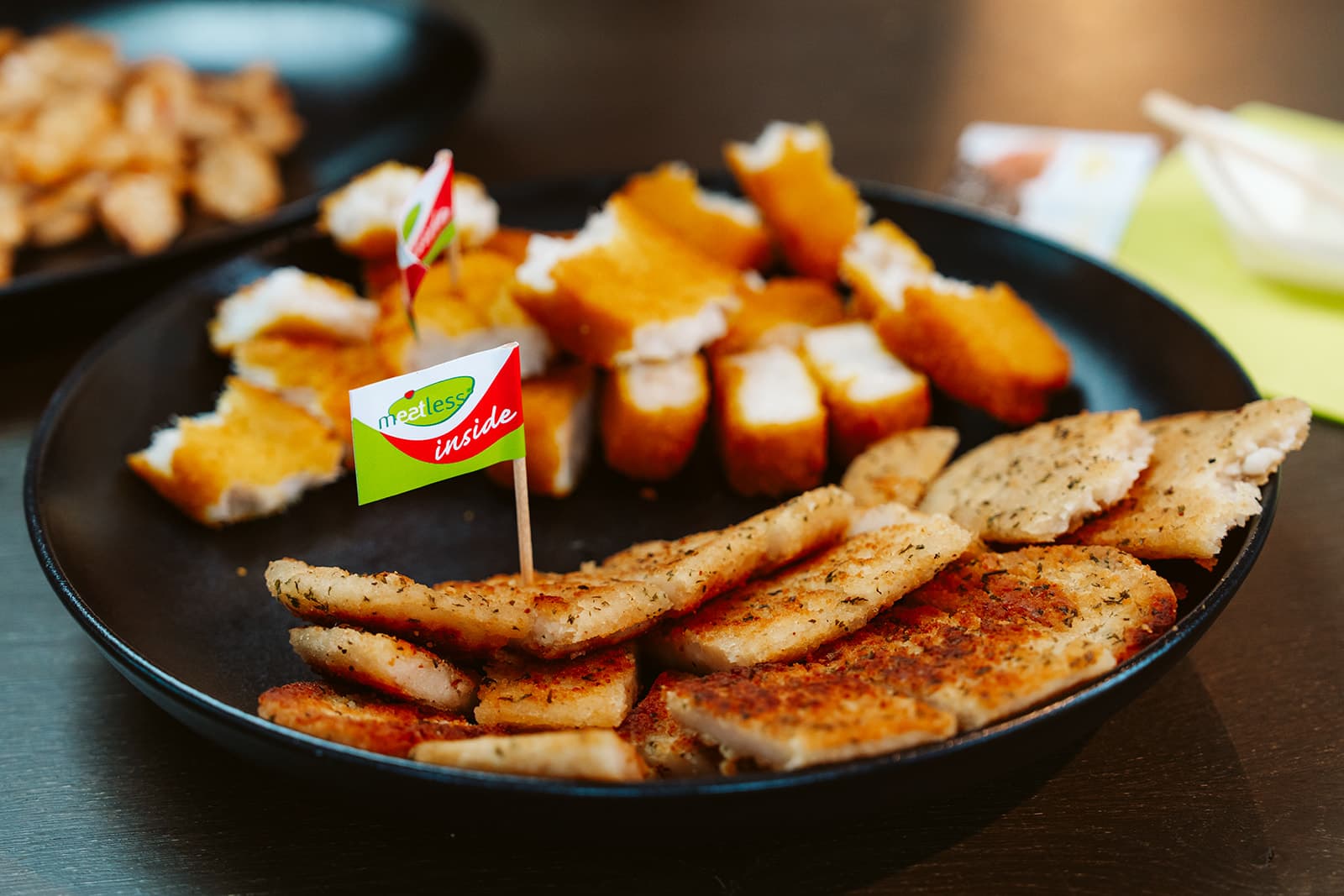
Photo: Merel Tuk

Our DATA+ expert and Editor-in-Chief, Elcke Vels, explores AI, cyber security, and Dutch innovation. Her "What if..." column imagines bold scenarios beyond the norm.
Demand for meat continues to rise, but the planet cannot sustain that growth. Meatless solves this with hybrid products: a blend of meat and plants. The result is a product that closely resembles the original in terms of taste, texture, and nutritional value. Not a radical turnaround, but a gradual shift toward eating less meat. Elcke Vels from IO+ was given an exclusive tour of the Meatless factory in Zeeland. The press tour was organized by New Dutch.
It’s a bit of a drive, but it’s well worth it. Our group of journalists receives a warm welcome at the factory in Goes, Zeeland. After a presentation, it’s time to see the production process with our own eyes. We’re handed a red hairnet and a blue lab coat.
Once on the factory floor, I catch a familiar scent: rice. Not the modest amount I usually cook in a small pot on the stove at home. The rice glides through the factory on a wide conveyor belt. A little further down the line, it’s processed into a kind of flake. The texture is already starting to look suspiciously like that of a meat substitute. We get to taste the result. “I actually don’t taste anything at all,” I say to our tour guide. That’s exactly the point, he replies. Rice has no distinct flavor of its own, making it an ideal base for hybrid products.
“Our best-selling ingredient right now is rice. It’s white in color, has no aftertaste, and is hypoallergenic,” says Managing Director Niels Hower. “That means you can use it in many different ways, such as in fish products.”
In addition to rice, Meatless works with various other plant-based ingredients, including fava beans and wheat. Fava beans are particularly interesting because of their contribution to biodiversity and soil quality. They’re grown locally in countries such as Germany, Belgium, and France.
Solving multiple problems
Hybrid products can help alleviate some of the issues surrounding the meat industry, Hower explains. By replacing part of the meat with plant-based ingredients, fewer animals are needed to produce the same amount of end product. This can reduce the pressure on animal welfare and livestock farming. Furthermore, the climate impact of plant-based raw materials is generally lower than that of meat, meaning a hybrid product can have a smaller carbon footprint.
The role of microproteins
The observant reader may have already guessed: rice and wheat contain relatively little protein. So how can they serve as a basis for meat substitutes? Meatless has a solution for that, Hower explains. “Rice does indeed not contain much protein on its own. Fava beans contain about 5 to 6 percent, and wheat slightly more, but even that isn’t particularly high. That’s why we’re developing blended solutions. For example, we combine rice with microproteins, which allows us to increase the protein content to 7 percent.”
Flavor is preserved
So there’s plenty of protein. But what about the flavor? I’ve noticed by now that the rice product itself has almost no flavor, but what about the other products? Doesn’t the flavor of a burger or fish stick change once a large portion of the product consists of plant-based ingredients?
“Even with a 50-50 ratio, the flavor of animal protein remains so strong that you can barely taste the difference. At most, you might notice a slight difference in texture,” says Hower.
At the factory in Goes, it’s not just talk. After the tour, trays of products are set out in front of us. I take a bite of the partially plant-based fish stick. And indeed: personally, I can hardly tell it apart from a “real” fish stick.
Consumer acceptance
Then there’s another challenge: consumer acceptance. I’m a vegetarian myself, but I can imagine that someone who deliberately buys a meat burger actually expects a meat burger. Clear communication about the ingredients seems important to me. I decide to share my thoughts with Hower.
He replies: “When we’re talking about a piece of meat or fish, that’s certainly true.” Hower hopes that open communication about the composition of hybrid products will increasingly become the norm. As an example, he cites Lidl in the United Kingdom, which recently launched a range of hybrid meat products. Pea protein has been added to meatballs, burgers, and sausages. Lidl explicitly positions the products as “High Protein” and also makes it clear that they contain plant-based protein.
Still, he believes that information doesn’t always need to be prominently displayed on the front of the package. “When you buy lasagna, you’re buying the lasagna as a whole. In that case, it matters less whether the meat sauce is made entirely of meat or is partly plant-based. In such a situation, you can choose not to explicitly state that on the front of the package.”
Letting it all sink in
After the tour, I walk back outside and get on the bus. As it pulls away and I gaze out the window, I let everything I saw and heard at the Meatless factory sink in once more.
If it were up to me, the future of our food would be entirely plant-based, with vegetables, fruits, and products like veggie burgers taking center stage. But that’s not the direction things are heading (yet). We live on a planet with billions of people, and everyone has their own ideas about what should be on their plate.
So in today’s world, I’m glad hybrid products exist. It’s not a major turnaround, but a gradual shift toward more plant-based options.