
Mistral Large 4: Europe’s answer to closed frontier AI models
Le Chonk, Europe’s most powerful open AI model, combines performance with sovereignty and affordability. Here’s how.
Published on November 11, 2026

Merien co-founded E52 in 2015 and envisioned AI in journalism, leading to Laio. He writes bold columns on hydrogen and mobility—often with a sharp edge.
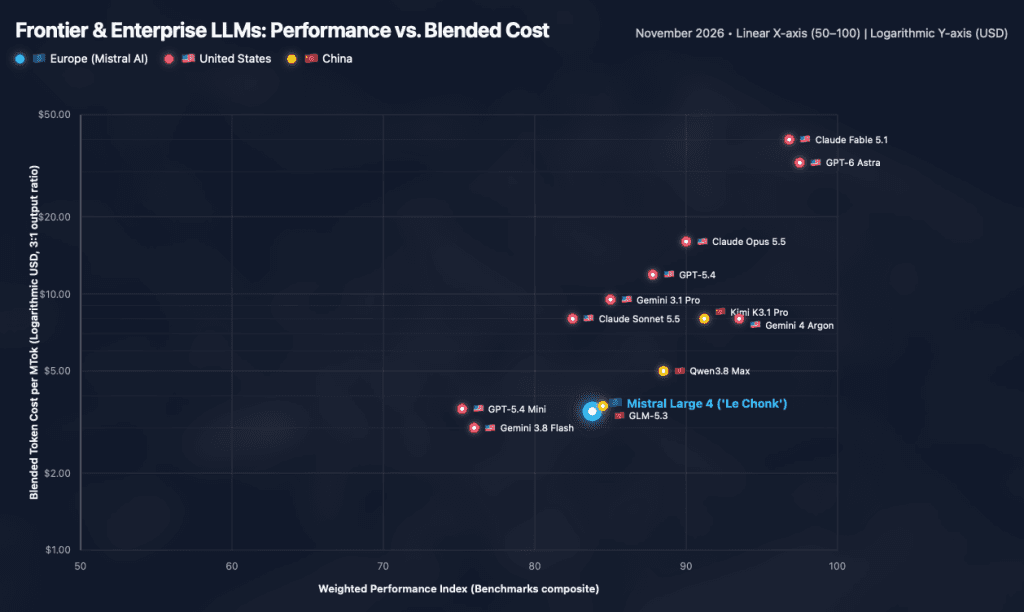
On October 6, 2026, Mistral AI launched Mistral Large 4, nicknamed Le Chonk – a trillion-parameter open-weight model trained entirely in European data centres. The model is a direct response to the dominance of American and Chinese AI giants, focusing on cybersecurity, agentic workflows and multimodal analysis. With a performance index score of 83.8 and a weighted cost of $3.48 per million tokens, it positions itself as one of the most cost-efficient frontier models in the world.
European sovereignty in practice
Mistral Large 4 is the first open-weight frontier model to be developed, trained and hosted entirely in Europe. It was trained on 3,800 NVIDIA Grace Blackwell GPUs in Mistral’s own European data centres, with plans to reach a total computing capacity of 1 GW by 2030. This ensures that sensitive data remains within the EU, a crucial requirement for sectors such as healthcare, finance and government.
The open-weight architecture allows organisations to deploy, adapt and audit the model themselves – an advantage over closed models such as Claude Opus 5.5 or GPT-6 Astra, where users depend on external providers. Mistral emphasises that the model addresses dependence on American AI in critical sectors such as cybersecurity, where many closed models refuse to carry out security-related tasks.
Performance: where does Le Chonk excel?
Mistral Large 4 scores highly on benchmarks for cybersecurity, agentic workflows and multimodal tasks. On the Artificial Analysis Cyber Index, it achieves 82% in vulnerability reproduction and patching, and solves 93% of Cybench challenges – the highest scores ever recorded for an open model.
In multimodal tasks, such as visual grounding (Dense 200), it outperforms GPT-6 Astra, scoring 42% compared with 41%. For agentic coding, the model scores 41% on Terminal-Bench 4.0 and 59.9% on AutomationBench, demonstrating its ability to handle more complex, long-running tasks.
The model also outperforms GPT-6 Astra and all other open-source models on legal and financial benchmarks, including HarveyAI and FinWorkBench. Combined with a context window of one million tokens, these capabilities make it suitable for tasks such as malware analysis, document processing and scientific simulations.
Cost efficiency: a game changer for businesses
With an input cost of $1.36 and an output cost of $4.18 per million tokens, Mistral Large 4 is considerably cheaper than competitors such as Claude Opus 5.5 ($16/$20) and GPT-6 Astra ($32.50/$40).
Its weighted cost of $3.48 per million tokens places the model in the 'most attractive quadrant' of the Artificial Analysis Intelligence Index, where performance and price are well balanced. For comparison, GLM-5.3, one of China's strongest open models, costs $3.65 per million tokens, while Qwen3.8 Max comes in at $5.00.
For European businesses looking to reduce costs without compromising on performance, Le Chonk offers an attractive alternative. Its lower costs also make it more accessible to SMEs and research institutions that might otherwise lack access to frontier models.
Open weights: transparency as a competitive advantage
The biggest difference between Mistral Large 4 and closed models is its open-weight architecture. Under the Mistral Ecosystem Open-Weight License, users can download, modify and host the model themselves, provided they do not sell API access without a commercial licence.
This enables European organisations to integrate the model into their own infrastructure, which is crucial for sectors with strict compliance requirements, such as banks and government agencies. Open weights also lower the barrier to innovation: researchers and startups can fine-tune the model for specific applications without depending on the roadmap of a major tech company.
In this way, Mistral hopes to foster an ecosystem in which European AI developers can compete with American and Chinese players.
Limitations and future prospects
Despite its impressive performance, Mistral Large 4 still trails the absolute top models on some benchmarks. On the Artificial Analysis Intelligence Index, it scores 83.8, compared with 97.5 for GPT-6 Astra and 96.8 for Claude Fable 5.1. It also performs less strongly than specialised competitors on general knowledge benchmarks such as MMLU.
However, it makes up for these shortcomings with its focus on practical applications. Cybersecurity, agentic workflows and multimodal analysis are areas in which the model excels.
Mistral is working on further improvements through reinforcement learning and plans to release specialised models based on Le Chonk, targeting sectors such as aviation, automotive and semiconductors. With a recent €3 billion funding round and plans to reach 200 MW of computing capacity by 2027, Mistral is demonstrating its commitment to Europe's AI independence.