
OECD launches startup database tracking 4.5 million companies
New dataset offers unprecedented view of the global entrepreneurial ecosystem and how innovation-driven companies grow, fund, and scale.
Published on March 13, 2026


Bart, co-founder of Media52 and Professor of Journalism oversees IO+, events, and Laio. A journalist at heart, he keeps writing as many stories as possible.
Startups may be small companies, but their impact on innovation, productivity, and job creation is enormous. Yet understanding how they emerge, grow, and interact within ecosystems has long been difficult. The Organisation for Economic Co-operation and Development (OECD) now hopes to change that with a new data resource that tracks nearly 4.5 million start-ups worldwide.
The newly released OECD Start-ups Database combines multiple global datasets to provide a detailed, micro-level picture of entrepreneurial activity across countries, sectors and funding sources. By integrating information on funding rounds, founders, patents, trademarks, and company performance, the database aims to give policymakers and researchers a much clearer understanding of how start-up ecosystems function.
According to the OECD, the initiative provides one of the most comprehensive tools yet for analysing innovation-driven entrepreneurship worldwide.
Why startups are hard to measure
Startups play a disproportionate role in economic transformation. They generate breakthrough innovations, create new markets, and contribute strongly to employment growth.
But studying them systematically has always been challenging. Many startups are privately held, small, and short-lived, which makes consistent data collection difficult. Differences in national reporting systems and definitions further complicate international comparisons.
Traditional data sources have additional limitations. Venture capital databases typically focus on companies backed by VC investors, which represent only a small fraction of the startup universe. In the United States, for example, less than 0.1% of companies receive venture capital funding.
Administrative datasets from governments capture firm creation and employment trends but often lack information about innovation, founders, or financing. Surveys, meanwhile, provide rich insights but are limited in scale.
The OECD’s new database attempts to bridge these gaps by combining multiple data sources and linking them to broader economic indicators.
Combining multiple data sources
At the core of the OECD Start-ups Database are two major entrepreneurial ecosystem platforms: Crunchbase and Dealroom. Crunchbase, created in 2007, focuses strongly on the United States but tracks start-ups globally. Dealroom, launched in 2013, has deeper coverage of European start-ups. By merging both datasets, the OECD achieves broader geographic coverage than either source alone.
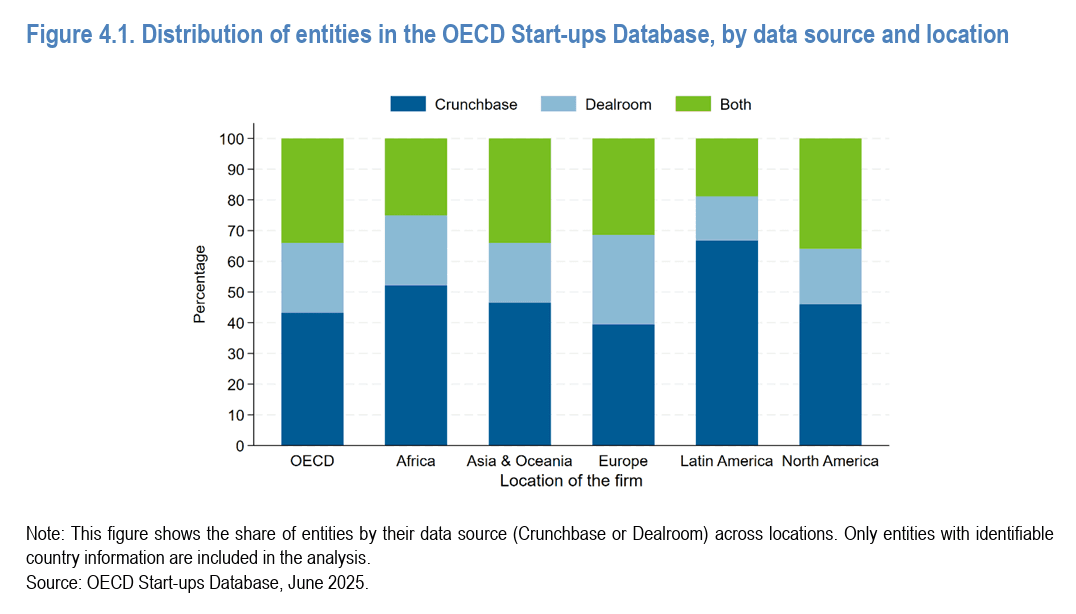
The combined dataset includes detailed information on:
- founders and founding teams
- investment rounds and funding types
- investors and venture capital firms
- company descriptions and technologies
- locations and founding dates
The OECD then enriches these records with additional data sources, including:
- patent filings from the global PATSTAT database
- trademark registrations in the US, EU, and Japan
- financial performance data from Moody’s Orbis
- exit events, such as acquisitions or IPOs
- government and corporate venture capital investors
Together, these sources allow researchers to follow startups not only from founding to funding, but also through innovation activity, scaling, and exit.
What the data reveals
Even at this early stage, the database already highlights several major trends in the global start-up landscape.
First, North America and Europe still dominate the global startup ecosystem in terms of the number of companies and funding activity. However, startups from the rest of the world now represent roughly 30% of the total sample, and their numbers are growing faster than in traditional innovation hubs.
Second, venture capital remains the dominant source of funding globally, but alternative financing channels are also important. These include grants, crowdfunding, corporate venture capital, and angel investments. Such alternative funding mechanisms appear particularly significant in Europe, where venture capital markets are historically less mature than in the United States.
Finally, startup ecosystems remain geographically concentrated. Investors and startups tend to cluster in specific innovation hubs, although cross-border investment, especially into North American companies, remains significant.
A sudden drop?
The sharp drop in newly registered start-ups after 2021, visible in the OECD data, likely reflects a combination of economic and data-related factors rather than a sudden collapse in entrepreneurial activity. The global venture capital boom of 2020–2021, fuelled by low interest rates, abundant liquidity and pandemic-driven digital demand, created unusually favourable conditions for launching new companies. When monetary policy tightened in 2022 and investors became more cautious, funding volumes fell sharply, which immediately reduced the number of start-ups able to secure early financing.
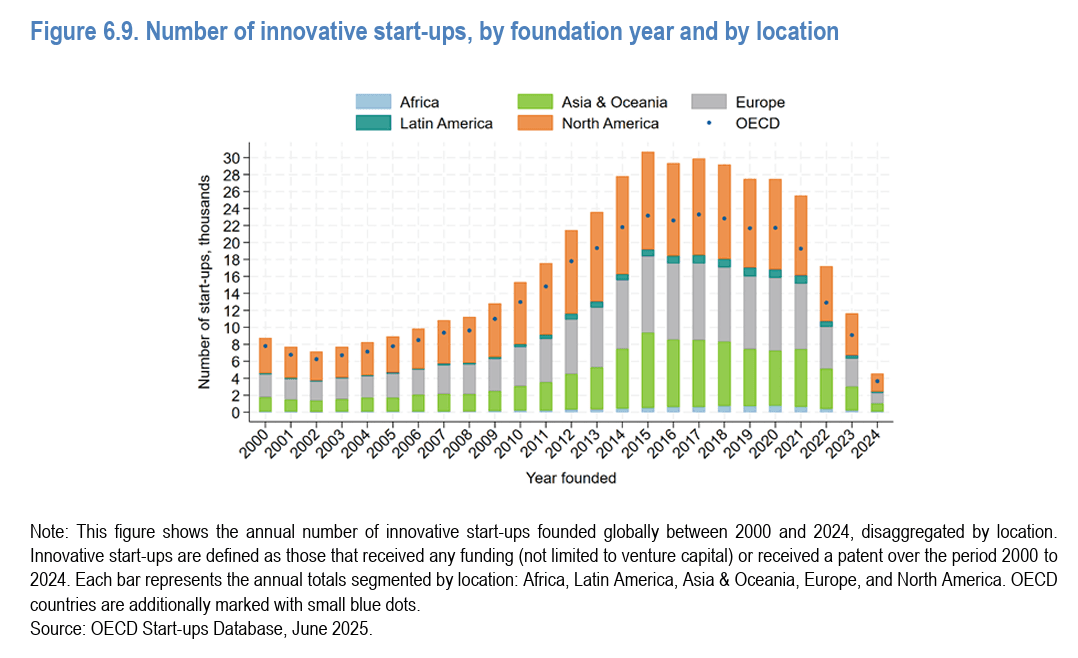
At the same time, the OECD notes that start-ups often appear in databases only after reaching visible milestones, such as raising funding or launching a product. Because of these registration lags, the most recent years in the dataset, especially 2023 and 2024, are likely still incomplete, meaning that part of the apparent decline may disappear as more companies are added retrospectively.
A tool for innovation policy
The OECD emphasises that the database was designed primarily as a policy and research tool. By linking entrepreneurial data with information on patents, trademarks, and firm performance, the database enables deeper analysis of how innovation ecosystems work. Researchers can study questions such as:
- How start-ups contribute to technological breakthroughs
- Which funding models support innovation best
- How ecosystems differ across countries and regions
- How policies influence start-up growth and exit strategies
For policymakers trying to strengthen innovation ecosystems, these insights could prove valuable. Evidence-based policy is particularly important as governments increasingly invest in startup ecosystems, from venture funds to incubators and innovation hubs.
A more global picture of entrepreneurship
Perhaps the most important contribution of the OECD database is that it moves beyond the historically US-centric view of start-up ecosystems. By combining multiple sources and linking them to global innovation data, the project provides a far more balanced picture of entrepreneurial activity across regions.
For the OECD, this broader perspective is essential. Innovation-driven entrepreneurship is no longer confined to Silicon Valley or a handful of European capitals. It is becoming a truly global phenomenon.
With the new database, researchers and policymakers now have a powerful tool to understand that transformation, and perhaps shape the next generation of innovation ecosystems.