
Philips Research is learning to fail faster and succeed sooner
For Betsabeh Madani-Hermann, innovation does not begin with a shiny piece of technology. It begins with curiosity and stubborn determination
Published on June 26, 2026
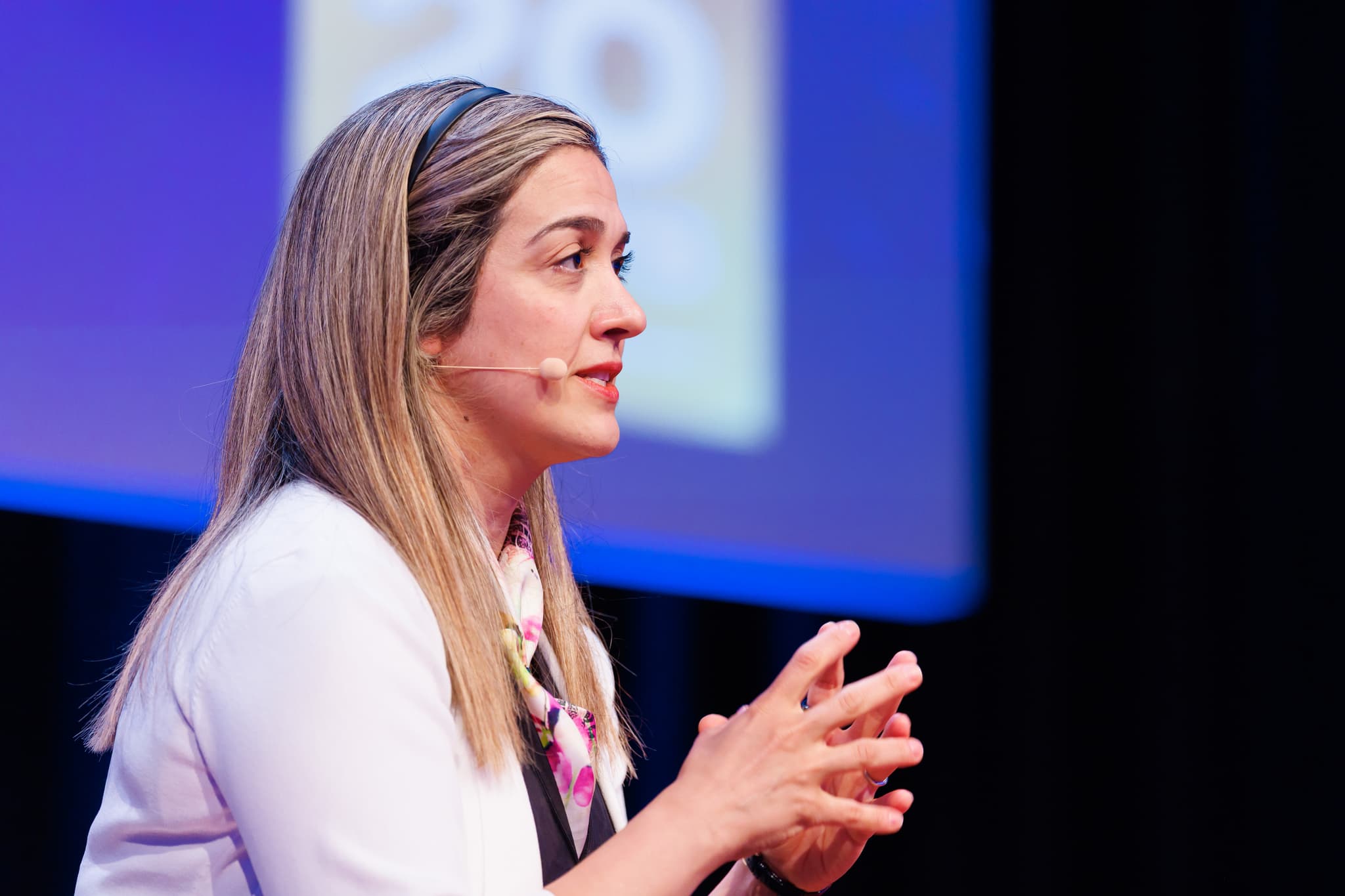
Betsabeh Madani-Hermann © Bram Saeys

Bart, co-founder of Media52 and Professor of Journalism oversees IO+, events, and Laio. A journalist at heart, he keeps writing as many stories as possible.
At Holst Centre Innovation Day, Betsabeh Madani-Hermann set out a clear philosophy for corporate innovation: protect the future from today's pressures, test ideas rigorously, and turn research into a chain reaction that reaches the real world.
For Betsabeh Madani-Hermann, innovation does not begin with a shiny piece of technology. It begins with curiosity and with the stubborn determination to keep following that curiosity beyond the lab.
.png&w=2048&q=75)
Her own career has crossed physics, astrophysics, biochemistry, engineering, venture capital and business strategy. The connecting thread, she told the audience at Holst Centre Innovation Day, is not a particular discipline but a fascination with what happens when science becomes useful. “I have a passion for science,” she said, “but I have an even bigger passion for what happens when science leaves the lab.”
That is a fitting perspective for the Global Head of Research at Philips. Madani-Hermann took up the role in 2023, becoming the first woman to lead Philips Research, after a career spanning health technology, biotech, AI, robotics and cleantech.
On a day dedicated to Holst Centre’s role in creating new industries, her message landed squarely in Eindhoven’s innovation tradition. Research is essential, she argued, but it cannot live in isolation. It needs a route to the market, the right partners around it and, perhaps above all, a willingness to make choices.
Protecting tomorrow from today
At Philips, Madani-Hermann leads two innovation tracks with very different rhythms.
The first is the Exploratory Innovation Program: a fast, broad internal programme that resembles an early-stage startup accelerator. Employees from across Philips can submit ideas, assemble teams and receive a relatively modest budget to test whether an opportunity is worth pursuing. The projects typically run for two to six months.
The second track is reserved for the much bigger bets. Philips’ Breakthrough Innovation Program focuses on projects that may take years and require investments in the millions. Those projects are deliberately shielded from the immediate pressures of the business.
“In every corporation, you have things that are for today and things that are for tomorrow,” Madani-Hermann said. “Sometimes today can be blinding because, if there are a lot of pressures today, you may sacrifice your future for it.”
That is why breakthrough programmes are ring-fenced: separate teams, protected budgets and a commitment not to abandon a strategic technology simply because another part of the business has a difficult quarter. It is a deceptively simple principle. But for large companies trying to keep innovating while running an existing business, it may be one of the hardest disciplines to maintain.
‘Fail fast, succeed faster’
Madani-Hermann’s preferred version of Silicon Valley’s familiar “fail fast” mantra is more optimistic: “Fail fast, succeed faster.” It does not mean celebrating failure for its own sake. It means making decisions early, based on milestones that are agreed upon before a project begins. Funding is released in stages, not all at once. When a team fails to meet a key milestone, Philips can stop the project and redirect its resources towards opportunities with stronger potential.
Since 2023, the Exploratory Innovation Program has received 215 applications across five cohorts, plus a special internal edition focused on operational efficiency. Of those, 46 projects were selected. 29 had graduated successfully by the time of the Innovation Day interview; 13 were still active, while four had been stopped.
For Madani-Hermann, those numbers are not evidence of a perfectly functioning selection machine. “I’m not saying we’re making correct decisions 100%,” she said. “We’re just trying to reduce the amount of risk that we have. There is no guarantee in research and development.”
The key is to make the programme demanding without making it discouraging. Teams that are rejected receive feedback and, where possible, introductions or coaching. Some have returned with stronger proposals after one or two unsuccessful attempts. That matters, she said, "because a company that wants intrapreneurs cannot treat rejection as a dead end. It has to become part of the learning process."
Innovation is not a moment
The strongest ideas may eventually travel from the exploratory programme into a larger business unit, conventional R&D, or a breakthrough path. Not every successful experiment needs to become a moonshot.
One current project, for example, applies agentic AI to regulatory assessment for Philips’ applications in China. It may not sound as glamorous as a new robot or next-generation semiconductor, Madani-Hermann acknowledged, but it can create measurable value by making specialised work faster, more consistent and more efficient.
That example reveals something important about how she sees innovation. It is not just about headline-making technologies. It is about creating better routes from knowledge to impact. “Some people think innovation is more of an instant in time,” she said. “I am part of the group that believes it’s more of a chain reaction.”
Basic science leads to engineering. Engineering becomes products. Products find their way into markets, workflows and real lives. The real work lies in managing all the transitions in between.
Breaking silos before they slow everything down
Madani-Hermann’s focus on connection also led her to create the Philips R&D Leader Forum: a regular virtual gathering of research leaders from across the company. "The format is deliberately informal." Participants meet every five to eight weeks, under Chatham House rules and without substitutes. Leaders from very different parts of Philips, from personal health categories such as toothbrushes and shavers to teams developing monitoring equipment for neonatal intensive-care units, share challenges, solutions and opportunities.
The point is not to compare revenue targets or business-unit performance. It is to remove friction. One team may have found a route to additional funding. Another may have solved a procurement, cybersecurity or regulatory challenge. Someone else may need help upskilling a team or navigating a factory issue. What looks like an isolated problem in one business can turn out to be familiar territory somewhere else in the company.
“We’re actually more similar than we are different,” Madani-Hermann said. That insight also shaped her view of Brainport. The region’s distinctive strength, she argued, is not merely its individual companies or institutes, but the density of expertise and trust between them. “The best technologies don’t always win,” she said, recalling the ecosystem thinking of business strategist Ron Adner. Success depends on the wider system around a technology: suppliers, customers, universities, regulators, investors and industrial partners.
Build, buy, partner and invest
For companies, that means accepting that innovation cannot be fully contained within their own walls. “You have to build, buy, partner and invest,” Madani-Hermann said. In Brainport, that ecosystem has been built over decades. The value of that long history is speed. When organisations already know one another, she noted, they do not have to start every collaboration with a cold call.
That is also why Holst Centre still matters twenty years after its founding. Its original ambition - bringing industry, academia and the public sector together around shared technological challenges - was unusually forward-looking, Madani-Hermann said. Now, the task is to keep adding to that inheritance.
Strong science, strong networks and resilience are the ingredients that allow societies and companies to take on difficult challenges, she concluded. The responsibility of this generation is to make sure those ingredients are not only preserved, but turned into something the next generation can build on.