
Reson8 open-sources speech AI that knows how people really talk
Dutch speech recognition startup Reson8 made one of his models available for free, claiming it understand how people actually speak.
Published on November 25, 2026
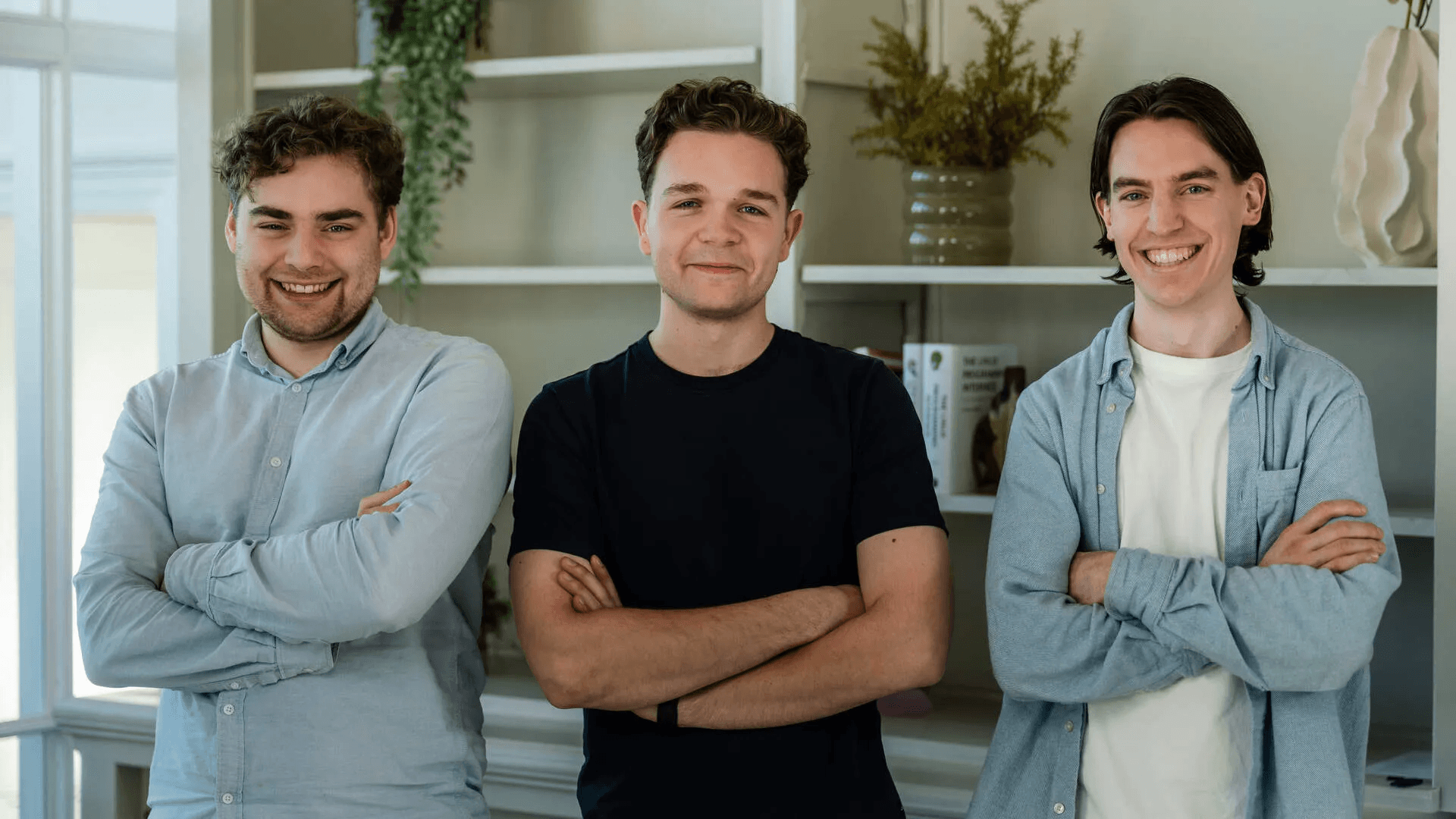
Reson8 co-founders: Thomas Kluisters, Raoul Ritter, and Jarno Verhagen - © Reson8

Mauro swapped Sardinia for Eindhoven and has been an IO+ editor for 3 years. As a GREEN+ expert, he covers the energy transition with data-driven stories.
Last Wednesday, speech recognition AI startup Reson8 released one of its models, Rumble-2 flash, as open weights. The model was trained on audio in over 40 languages, which the company says helps it understand how people really speak. It fits on a mobile phone, and the Amsterdam- based startup is pitching it as production-ready software for businesses, not a research demo.
"In a way, we're trying to break open this open-weights movement with an enterprise-grade model, as opposed to a more academic model," says co-founder and head of AI Thomas Kluiters. "It's really the first of its kind."
Open-source speech recognition is hardly new. But Kluiters argues the field has stalled because most models learn from the same public datasets. "You don't see new models coming out that are different or behave differently," he says. The release is meant to show how much accuracy can be packed into a small model. "It's mostly for us to show how good models can be for their size."
From trading floors to doctors' offices
Kluiters founded Reson8 with Raoul Ritter and Jarno Verhagen. In March, the company raised a €5 million pre-seed round led by Balderton Capital, with NP-Hard Ventures participating. Kluiters started out writing fast, fault-tolerant software for high-frequency trading. He left, he says, because "you're definitely not really propelling the world forward in a positive way."
His next company, Juvoly, trained its own models to transcribe conversations between doctors and patients, so that doctors no longer had to type up summaries. That work convinced him the technology could reach well beyond Dutch. "If we're just a bit bolder, a bit more ambitious, we could take on the rest of the world when it comes to speech recognition," he says.
Reson8 now sells transcription through a software interface (API). Its flagship model, Rumble-2, supports more than 50 languages and runs on the company's own graphics processing units (GPUs) in the Netherlands, with no audio retained. Customers include the medical transcription company Autoscriber, video editor VEED, which uses Reson8 for timed subtitles, and Jack & Jill, which builds AI interview agents.
Hearing, not guessing
Many modern speech systems are built on large language models. Kluiters says these models are accurate, but they tend to tidy up what people say instead of writing it down. Reson8 takes the opposite approach. "We really prefer building our models to transcribe precisely what they hear, as opposed to filling in the gaps," he says.
Data is what makes the difference in pursuing this approach. The company scrapes huge amounts of permissively licensed audio from the web. It then deliberately trains a rough first model that is "kind of silly and stupid at times," and refines it later. Kluiters is skeptical of the industry's focus on reinforcement learning, the technique of rewarding a model's good outputs. "Knowledge and behavior are two different things," he says. "You can't use reinforcement learning to make a model more knowledgeable. You really can't."
That data is also what makes the model multilingual. Reson8 trains on "any audio at any location on the internet," as Kluiters puts it, across dozens of languages. The bet is that a model that has heard many languages, accents and dialects copes better with real speech: a patient with a strong accent, or a meeting that slips between Dutch and English.
Why give it away?
Offering a free model is not a new strategy in this world. Kluiters points to Mistral and Qwen, both of which publish open models and sell commercial ones. He is also frank that the free version is not the company's best. "Honestly, this model isn't the same quality as our accurate model," he says.
The open model is meant to be a low-risk way in. Developers get a new model to experiment with locally. Larger companies can test Reson8's technology "without having to sign a contract or some kind of due diligence project before they become a customer," he says. "It's a way to accelerate adoption."
Attracting more users is the challenge right now, and transcribing more than one billion hours of audio in a year is the short-term goal. The Head of AI says Reson8 already ranks first on most speech-to-text benchmarks, but the company is less than a year old, and its home market is cautious. "In the U.S., people are way more eager to switch and try things out, whereas in the EU we think about GDPR, sub-processing agreements, and so on," he says. "Here, it's a game of patience."