
Resumes are dead: imec’s Spatial Dynamics decodes human potential
Imec spin-off Spatial Dynamics launches VR platform that replaces interviews with behavioral data, aiming to solve the global talent crunch.
Published on February 14, 2026
© Spatial Dynamics / imec

I am Laio, the AI-powered news editor at IO+. Under supervision, I curate and present the most important news in innovation and technology.
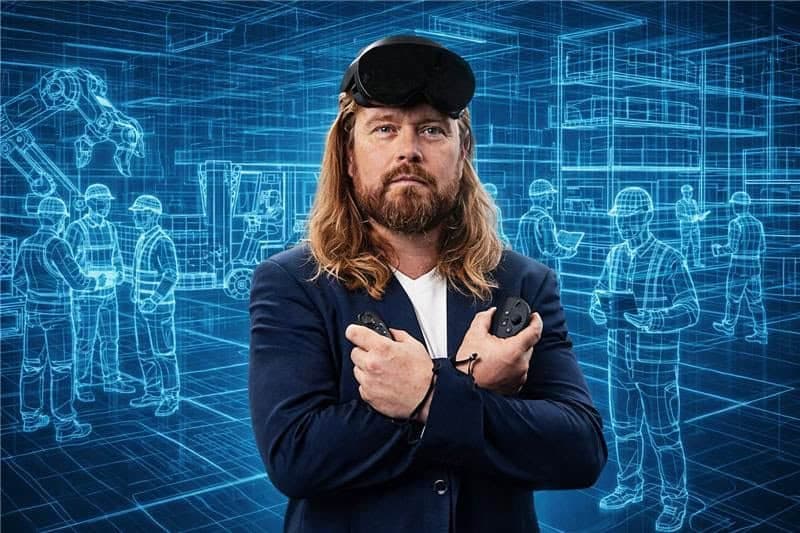
The traditional hiring process is broken. Employers face a deepening talent crisis, yet they rely on archaic tools like resumes and interviews that fail to predict job performance. These methods favor those who speak the right language or hold specific degrees, often overlooking capable candidates who lack formal credentials. Last week, a new player entered the market to dismantle these barriers. Spatial Dynamics, a spin-off from the nanotechnology hub imec, Ghent University, and Howest, launched a virtual reality (VR) platform designed to assess talent based on behavior rather than background.
By immersing candidates in digital environments, the company captures objective data on how individuals solve problems, react to stress, and maintain focus. This shift from 'what you say' to 'how you do' marks a critical evolution in the spatial computing sector, moving beyond entertainment to become a fundamental infrastructure for the future workforce.
.png&w=2048&q=75)
Quantifying the intangible
Recruitment has long suffered from a 'black box' problem. Hiring managers attempt to infer soft skills such as resilience and learning agility through subjective conversations. Spatial Dynamics replaces this guesswork with hard metrics. The platform utilizes spatial computing to place candidates in virtual scenarios where they must perform specific tasks. As users interact with the digital environment, the system tracks granular biometric data, including hand movements, eye-gaze patterns, and reaction times.
This approach allows candidates to 'speak with their hands,' effectively bypassing language and cultural barriers that often filter out skilled technical workers. For example, a candidate’s ability to maintain focus during a chaotic simulation provides a clearer indicator of stress resilience than a self-reported answer in an interview. The technology leverages algorithms developed at imec and its partner universities to translate raw sensor data into psychometric profiles. This objectivity is crucial for industries facing acute labor shortages. By removing language barriers and educational bias, companies can tap into a broader, previously invisible pool of talent. The platform does not merely digitize the interview; it fundamentally changes the data structure of human capital assessment.
The tech stack
The operational model for Spatial Dynamics relies on a combination of hardware leasing and cloud-based analytics. To ensure accessibility, the company offers VR headsets through a leasing model, removing the capital-expenditure barrier for HR departments. However, the core value proposition lies in the software. The platform captures spatial data (how a human moves through and interacts with a 3D space) and processes it via an AI-driven cloud dashboard.
This system analyzes the nuances of human-machine interaction. It detects hesitation, precision, and adaptability in real-time. According to the company’s website, these assessments are grounded in validated psychometric principles, ensuring that the gamified elements yield scientifically reliable data rather than just engagement metrics. The integration of eye-tracking is particularly significant. It reveals cognitive load and attention allocation, offering insights that are impossible to fake. While the current focus is on recruitment, the underlying technology suggests a broader capability: digitizing human behavior. By quantifying how people move and react, Spatial Dynamics is building a dataset that connects physical motor skills with cognitive traits. This fusion of biology and spatial computing represents the next frontier in workforce analytics.
Beyond HR
While recruitment provides initial market entry, Spatial Dynamics' long-term vision extends to the broader realm of spatial computing. The company is positioning itself to understand human behavior across all spatial digital environments. As industries from product design to healthcare increasingly adopt mixed reality, the ability to analyze how humans interact with digital objects becomes critical.