
Seamless bone-to-tendon implants move a step closer
Bone is hard, tendon is soft, and joining them is notoriously tricky. Delft researchers have found a 3D-printable solution.
Published on October 5, 2026
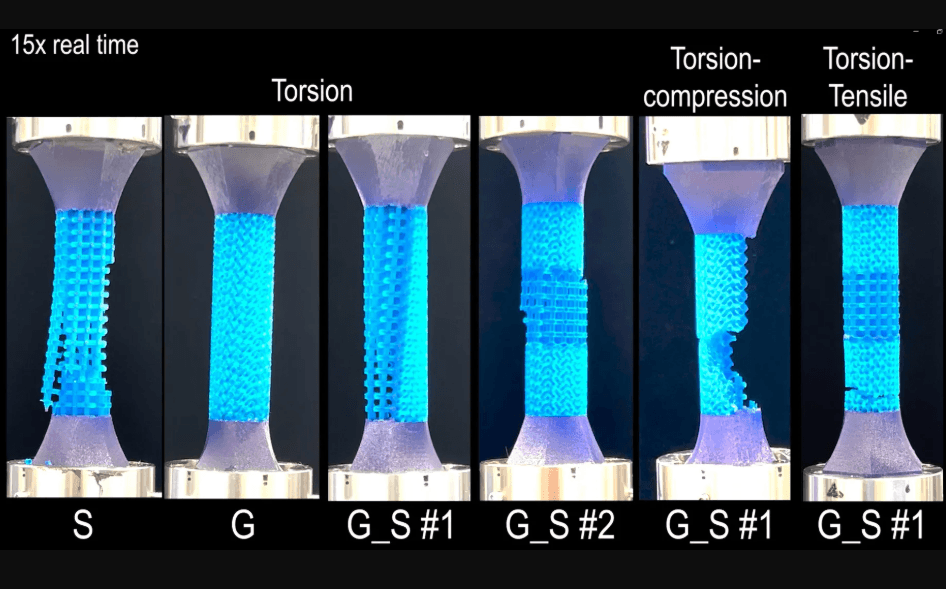
© TU Delft

Team IO+ selects and features the most important news stories on innovation and technology, carefully curated by our editors.
Bone and tendon could hardly be less alike. Bone is hard and rigid; tendon is soft and stretchy. Yet where the two meet, the body joins them so well that the connection rarely fails. Engineers have tried for decades to mimic their link for better implants, for instance. Now researchers at Delft University of Technology (TU Delft) have come a big step closer, having engineered 3D-printed structures that switch from bone-like to tendon-like in a very short space.
“Musculoskeletal disorders are among the leading causes of disability worldwide,” explains associate professor Mohammad J. Mirzaali, “and improved methods for connecting hard and soft tissues could help advance future implants and tissue engineering strategies.”
The fix: a building block that fits both sides
The approach centres on a new transition cell that links two types of metamaterials: materials whose behaviour comes from their internal architecture rather than from what they are made of. One type, built from smooth curved sheets, is stiff, strong and well suited to bone cells. The other, built from networks of thin beams, can be made flexible, like tendon.
Combining them used to force a bad trade-off. A direct joint creates a weak seam, while a slow blend takes up far more space than the compact junction in the body. The Delft team avoided both. They found curved-sheet shapes whose connection points sit in exactly the same places as common beam lattices, and used them as a "twin" that slots in between. Their algorithm aligns the two structures and completes the switch within a single building block a few millimetres across.
Ready to print, easy to tune
The method is built for practical use. Software turns each design directly into a file for a 3D printer, and designers can dial the stiffness of the transition cell. The code is published alongside the paper, so other researchers can put it to work.
It also holds up. The team squeezed, stretched, twisted and bent their printed hybrids, and loaded some of them up to a million times. The joints held: when the structures eventually failed, they broke within the individual parts, not at the seam. A bone-to-tendon demonstrator changed in stiffness by a factor of 37 to 84 from end to end, close to the 26- to 71-fold change in real bone-tendon junctions.
Next step: helping the body rebuild itself
The researchers are now growing living cells on the hybrid structures. Zadpoor explains that they want to learn how geometry affects the way cells attach, grow and specialise. If shape alone can nudge cells toward becoming bone on one side and tendon on the other, future implants could do more than match the body's mechanics: they could actively help it heal. Today's prototypes are plastic and still some way from patients, but the blueprint is now in place.
Besides healthcare use, the same toolbox could also help engineers design lightweight car and aircraft parts, where stiff and bendable materials also mix.