
Startup makes road markings glow. ‘Crucial during a rainstorm’
A white line that stays put, even when it rains. That’s Luxene’s promise.
Published on April 9, 2026

Our DATA+ expert and Editor-in-Chief, Elcke Vels, explores AI, cyber security, and Dutch innovation. Her "What if..." column imagines bold scenarios beyond the norm.
You can see the white lines on the road clearly—until it starts raining heavily. Just when you need those road markings the most, they become hard to see. “It’s a problem we hear about all the time,” says Maarten Tobias. He is the founder and CEO of Luxene: a young startup that wants to change road surfaces for good. Not with extra streetlights or built-in lights, but by making the road markings glow using fiber optics.
A white line that stays visible, even when it rains. That is Luxene’s promise. And all without electronics in the asphalt. That’s a key point, because previous attempts to incorporate light into the road surface failed for that very reason. LED lights embedded in the asphalt would break due to vibrations or moisture.
Fiber optics: the solution
Luxene’s solution is simple but effective: “We use a laser located off the road,” Tobias explains. “We then send that light via fiber optics to the road marking.” That fiber optic cable lies beneath a specially adapted, transparent top layer. The light can shine from the bottom up—exactly where you’d normally see the white line.” Because there’s no electronics in the asphalt, the system is much more robust. Fiber optic cables are already buried everywhere and can withstand harsh conditions.
Because the light lines are divided into segments, they can be intelligently controlled in the future. Think of road markings that light up red in the event of an accident, or light that moves in sync with a car’s speed. “And we can add many more functionalities,” says Tobias. It essentially becomes a kind of intelligent road surface.
A first test section
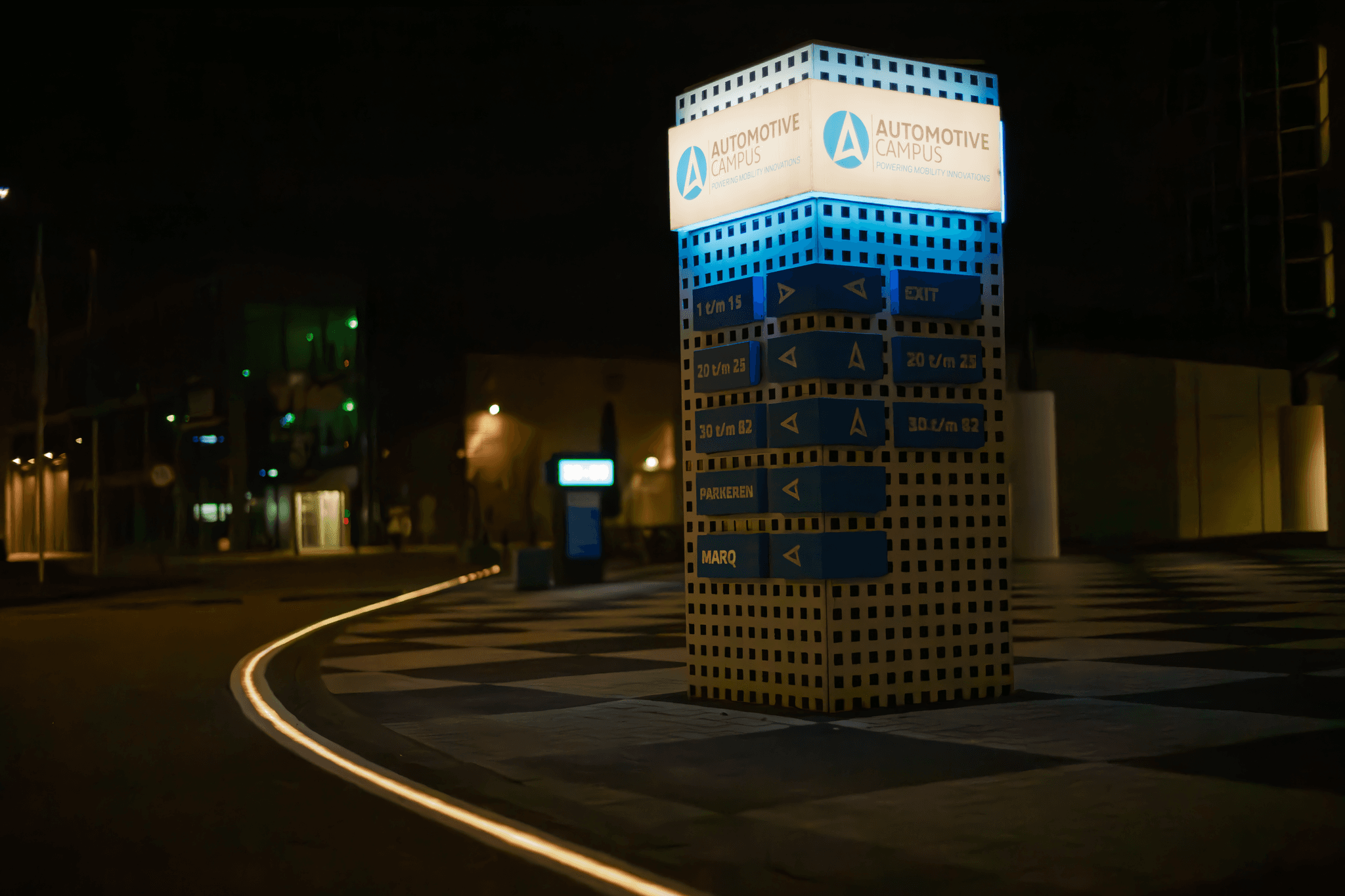
At the Automotive Campus in Helmond, the idea has now become a reality. There, a first test section of about fifty meters has been installed. It’s not the final product yet, but it is an important step. Tobias: “We’re seeing what’s already working well and what could be improved.”
For example, they’re still tweaking the intensity and color of the light. “How bright should it be? What’s comfortable for the driver? We still need to find answers to those kinds of questions.”
Ready for the future: autonomous systems
The impact of the technology extends beyond human drivers. Autonomous vehicles also rely on visible road markings. These systems “look” at the road using cameras and encounter the same problem as humans when lines are poorly visible. “In that sense, we’re also preparing for the future,” says Tobias.
A conservative market
Still, the biggest challenge for now isn’t the technology, but the market. “The world of roads and infrastructure is quite conservative,” says Tobias, “with lengthy bidding processes.” Introducing a new technology into a fairly conservative market simply takes a lot of time, he explains.
New pilot: one kilometer long
Still, there is confidence. The startup has secured several investments and is currently in talks with a province to set up a larger pilot spanning more than one kilometer. Tobias: “I hope this new pilot will be launched in the summer. For us, this will be an important proof of concept.”
No shortage of ambition
By the end of this year, the first commercial product should be ready. And: the team will have doubled in size by then, predicts Tobias. “Currently, there are five of us. We hope to have about ten people by the end of the year.”
There’s no shortage of ambition. Ultimately, in about five years, Luxene aims to scale up to thousands of kilometers of road both within and outside the Netherlands, “especially in places where street lighting is lacking or difficult to install.”