
The man behind the world of Star Trek also designed for Philips
Behind Philips' innovations lies the power of design. Reporter Elcke Vels discovered this during an exhibition.
Published on October 30, 2026
Credits: Igor Roelofsen / Twycer

Our DATA+ expert and Editor-in-Chief, Elcke Vels, explores AI, cyber security, and Dutch innovation. Her "What if..." column imagines bold scenarios beyond the norm.
Sci-fi legend Syd Mead became world-famous for his work on science fiction films. What’s less well known is that he worked at Philips for twelve years, where he was given the freedom to design things: cassette recorders, hair dryers; and in his sketches, he reimagined office buildings. That forward-thinking spirit lives on at Philips: even today, designers within the company work every day on tomorrow's innovations.
Star Trek, Blade Runner, Tron, and Aliens. These are just a few of the science fiction films for which Syd Mead designed futuristic worlds. His gaze was always fixed on the future. No wonder Philips and other companies gave him years of freedom to envision what tomorrow’s products and environments might look like. If anyone could imagine the future, it was him.
While working on *Star Trek: The Motion Picture*, Mead led a remarkable double life. By day, he designed everyday products for Philips, from toasters to electric shavers. By night, he worked in his hotel room on V’Ger, the film's mysterious alien entity.

An office building designed by Syd Mead. Credits: Royal Philips N.V.
At the Philips Museum, during Dutch Design Week 2026, the work that the world-famous Syd Mead created for Philips was on display. I decided to check it out.
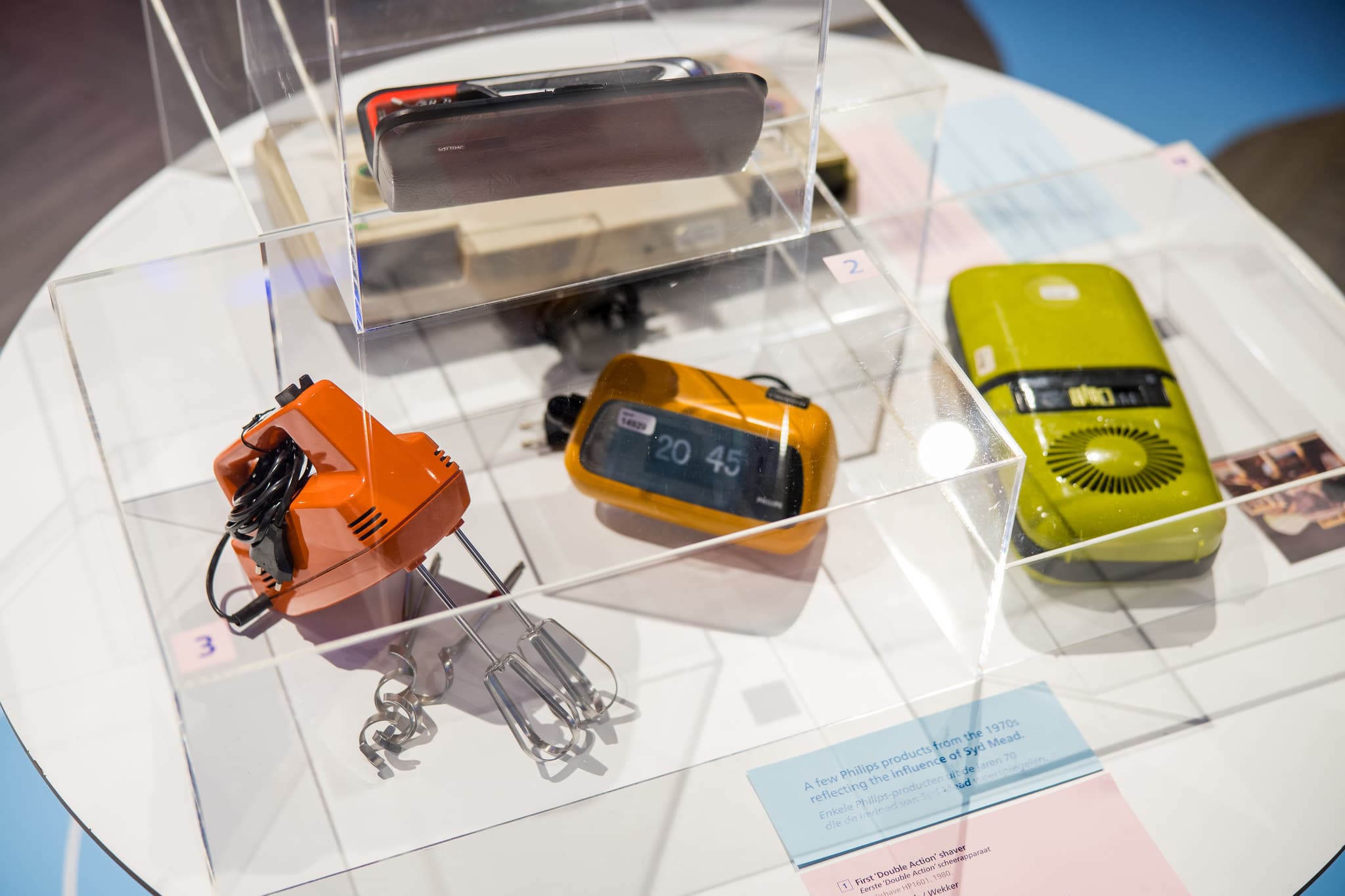
Several 1970s products on display show how Mead left his mark on the future. A device that resembles an old-fashioned telephone turns out to be a portable hair dryer with an inflatable hood. In 1977, women could wear it on their heads while keeping their hands free for other tasks. Also on display are a 1972 mixer and a 1975 alarm clock, both designed by Mead. As I walk through the exhibition, one thing becomes clear to me: Mead was anything but idle.
Moreover, his work extended beyond appliances alone. Through drawings of, among other things, a hospital of the future, he showed how he thought about technology's role in daily life and healthcare. I find it fascinating to see how a designer from that era could already be so far ahead of his time.
'His way of thinking is still relevant'
At the museum, I meet Barbara Koop, head of usability at Philips. She tells me a lot about Mead’s work. She also explains how his vision lives on at Philips. “We want to show that his way of thinking is still relevant. We’re still looking to the future and trying to understand what people will need down the road.” She also shows me work by other designers featured in the exhibition.
Thinking about the future is by no means unimportant. Whereas Philips used to design mainly living-room devices, the company now also works on healthcare technology. Such technology often needs to last ten to fifteen years. With MRI scanners, it’s therefore important to consider not only today’s needs but also tomorrow's.
The role of design in Philips MRI systems
After taking a thorough look at the exhibition, I walk down the stairs. There, Hyelin Lee, a product designer for Philips MRI systems, gives a presentation.
A key point in her presentation: as a product designer, you look beyond the technical possibilities. “Above all, you must involve the patient for whom you’re designing the product in the design process from the very beginning.”
For patients, an MRI scan can be quite nerve-wracking. They lie in a confined space, must remain still, and are exposed to loud noise. Sometimes, uncertainty about the results adds to that stress. “By designing the technology to revolve as much as possible around the patient and their needs, we can make the experience more pleasant,” says Lee. As an example, she cites an MRI table that can be adjusted to an extra-low height. This makes it easier for patients who are in wheelchairs, for example, to get onto the table. In this way, a relatively simple design choice makes the MRI scan more accessible.
Another example of how design improves healthcare is the increasingly lightweight design of MRI scanners. Lee: “Older systems were sometimes so heavy that they couldn’t simply be moved between floors or through a hospital building. A lighter design, with BlueSeal technology, makes the technology more accessible and gives hospitals more freedom in where they deploy the scanners.”
In Ukraine, for example, Philips deployed a mobile MRI scanner at various hospitals where this technology had not previously been available. Between April and October 2022, the scanner performed more than a thousand examinations.
A lesson for everyone
Beyond MRI systems, Philips designers are working on numerous other innovations. Among other things, they design ultrasound equipment, patient monitors, and wearable technology that helps healthcare providers keep a closer eye on patients.
In short: Mead has since passed away, but design still plays a major role at Philips. As pressure on the healthcare system increases and people live at home longer, it’s important that technology meets the needs of patients and healthcare providers. Smartly designed applications make healthcare more affordable and efficient. As Koop puts it: “We want to give healthcare providers back their time so they can focus more on the patient.”
After the exhibition, I walk home. On the way, I realise Mead’s vision doesn’t belong only in science fiction movies or the healthcare sector, but also in our daily lives. Perhaps we can all learn from Mead: the future doesn’t just happen to us; we can design it ourselves.