
The missing middle, a U.S. IPO myth and a coordination failure
Policymakers, funds, venture capitalists and academics gathered ahead of Hessel Mittelmeijer’s PhD defence to focus on deep-tech startups.
Published on November 17, 2026
Bart, co-founder of Media52 and Professor of Journalism oversees IO+, events, and Laio. A journalist at heart, he keeps writing as many stories as possible.
Europe does not have an invention problem; it has a conversion and speed problem. That was the central diagnosis in a sold-out Coronazaal at Eindhoven University of Technology (TU/e) today, where policymakers, pension funds, venture capitalists, and academics gathered ahead of Hessel Mittelmeijer’s PhD defence to dissect why deep-tech startups stall in the “missing middle”, and how to build an ecosystem that finally scales them.
Hessel Mittelmeijer © DeepTechXL
Opening: an innovation flywheel, not a linear pipeline
Opening the symposium From Lab to Commercialisation: Building Europe’s Deep-Tech Financing Chain, TU/e President Koen Janssen noted how rare it is for a doctoral defence to be accompanied by such a high-profile lineup. Addressing the gap between proof of concept and commercial viability, Janssen pointed to Brainport Eindhoven, where TU/e’s nearly 30-year foundation in photonics and materials science is now translating into industrial scale, as proof that deep-tech ecosystems thrive on dense, trust-based networks rather than linear technology transfer.
Universities, he argued, must become spaces where science and industrial reality challenge one another, creating an "innovation flywheel" backed by interconnected European instruments like FP10 and the European Competitiveness Fund. Fittingly, the event coincided with TU/e’s Sustainability Day, underscoring Mittelmeijer’s focus on embedding sustainable impact into venture value.
Framing: the missing middle as a coordination failure
Presenting the core findings of his dissertation, Financing the Future, Hessel Mittelmeijer, who also serves as managing partner at DeepTech Capital Partners, laid out the stark transatlantic divide: while Europe generates nearly half of global quantum patents, less than a quarter of European startups reach scale-up status, compared to over half in the United States.
Mittelmeijer’s research, spanning over 1,500 scientific articles and 100 interviews, reframes the "valley of death". Rather than a pure shortage of money, it is a coordination problem:
- Two sides of the coin: Deep-tech founders face long, capital-intensive R&D trajectories ("the blue phase") before reaching commercialisation ("the red phase"), while traditional VCs often lack the technical expertise to assess early-stage engineering risks and avoid high deal costs.
- Active value creation: Closing the gap requires specialised funds equipped with a hands-on "toolbox", from IP support to global sales networks, and standardised impact metrics (such as DeepTech Capital Partners' VC Green Scheme) that turn sustainability into measurable exit value.
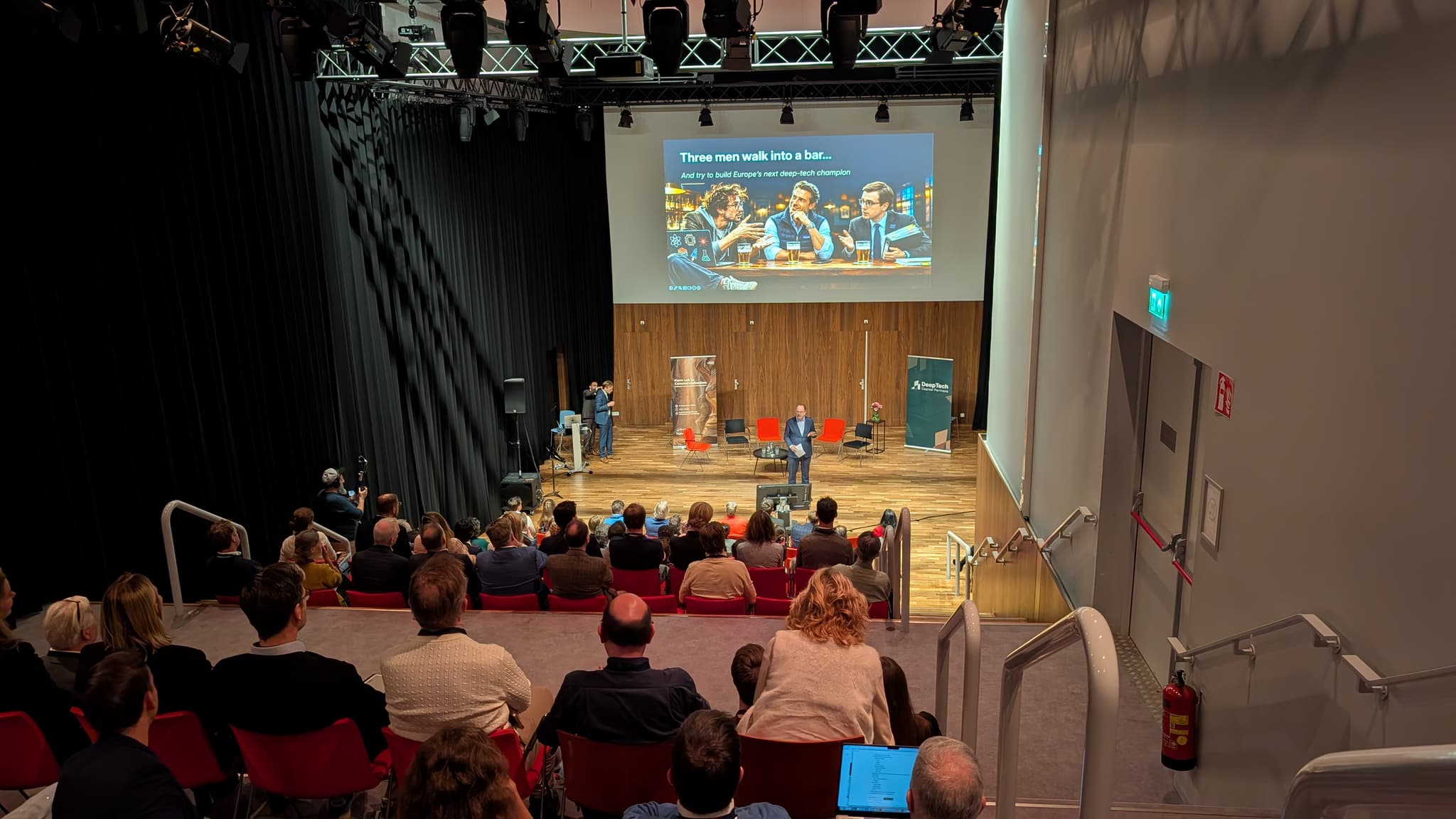
Rinke Zonneveld, Invest-NL
Setting the scene: three founders, four beers, and a missing customer
To illustrate the systemic friction, Invest-NL CEO Rinke Zonneveld walked the audience through a fictionalised, yet painfully recognisable, parable of a Dutch photonics founder, a VC investor, and a policymaker meeting over four rounds of beer across a decade.
- Round 1: The founder has spent seven years developing breakthrough university science, only to spend the equivalent of another PhD negotiating IP and equity terms with the university.
- Round 2: With a working prototype built, the founder needs €30 million for a first commercial plant, while the policymaker demands private co-investment and the VC hesitates, because the most crucial actor, an industrial launching customer willing to take a risk, isn't at the table.
- Round 3: Years later, an American VC offers €100 million to scale, triggering panic from the policymaker over European strategic autonomy, even though Europe lacks the domestic growth capital to match the offer.
- Round 4: Facing a successful exit, the only viable buyer is an American tech giant, as Europe lacks both mega-acquirers and deep domestic IPO liquidity.
Zonneveld’s takeaway was pointed: none of the three actors is the villain; each acts rationally within their own mandate. Europe doesn't merely suffer from a financing gap, he concluded, but a coordination gap where institutions optimise their own slice of the chain rather than taking joint responsibility for the entire journey.
The scientific perspective: patient capital and engineering roots
Moderated by HighTechXL CEO John Bell, a fireside chat between Prof. dr. Dimo Dimov (University of Bath) and Prof. dr. Aard Groen (University of Groningen) placed Europe’s struggle in historical and structural context.
Dimov noted that the U.S. venture ecosystem did not emerge overnight; it was deliberately engineered over decades following the 1957 Sputnik shock through leveraged public-private vehicles (SBICs), the creation of Nasdaq for exits, and regulatory reforms allowing pension funds into venture capital. Crucially, Dimov’s research shows that VCs with engineering backgrounds drive more IPOs, whereas finance-heavy VCs focus on minimising failure—a risk-averse mindset that has historically hindered hardware-heavy European deep tech.
Groen emphasised that while Europe boasts a massive 500-million-person market and world-class universities, it remains fragmented and overly beholden to short-term financial returns. Drawing on his work building accelerators in Twente, where 500 small tech firms emerged without becoming global giants, Groen stressed that technical founders often lack commercial and entrepreneurial training, and urged Europe to defend its industries against subsidised foreign competition while building cross-regional scale.
Deep-tech expertise: the cost of time and the "conversion system"
From her dual vantage point as CFO of TNO and chair of the Tech Transfer Board, Susan Swarte sharpened the diagnosis: "Europe doesn’t have an invention problem; we have a conversion problem, and increasingly, a speed problem."
While the Netherlands punches above its weight in scientific publications (2.5% globally) and leads in fields like photonics and quantum optics, its share drops to 2% in patents, 1% in global quantum investment, and zero unicorns. Worse, moving from Series A to Series B takes five to eight years in Europe versus 2.3 years in the U.S., a delay that burns cash, exhausts talent, and lets competitors catch up.
Swarte argued that Europe must stop thinking about a linear financing chain and start building a conversion system where five elements arrive simultaneously:
- Strategic technology choices where Europe can hold defensible "control points" (like ASML in lithography).
- Specialised, active capital rather than passive money.
- Shared infrastructure, from pilot lines to grid capacity.
- Launching customers across industry and government.
- Commercial leadership, pairing brilliant scientists with seasoned operators who know how to manufacture repeatedly at scale.
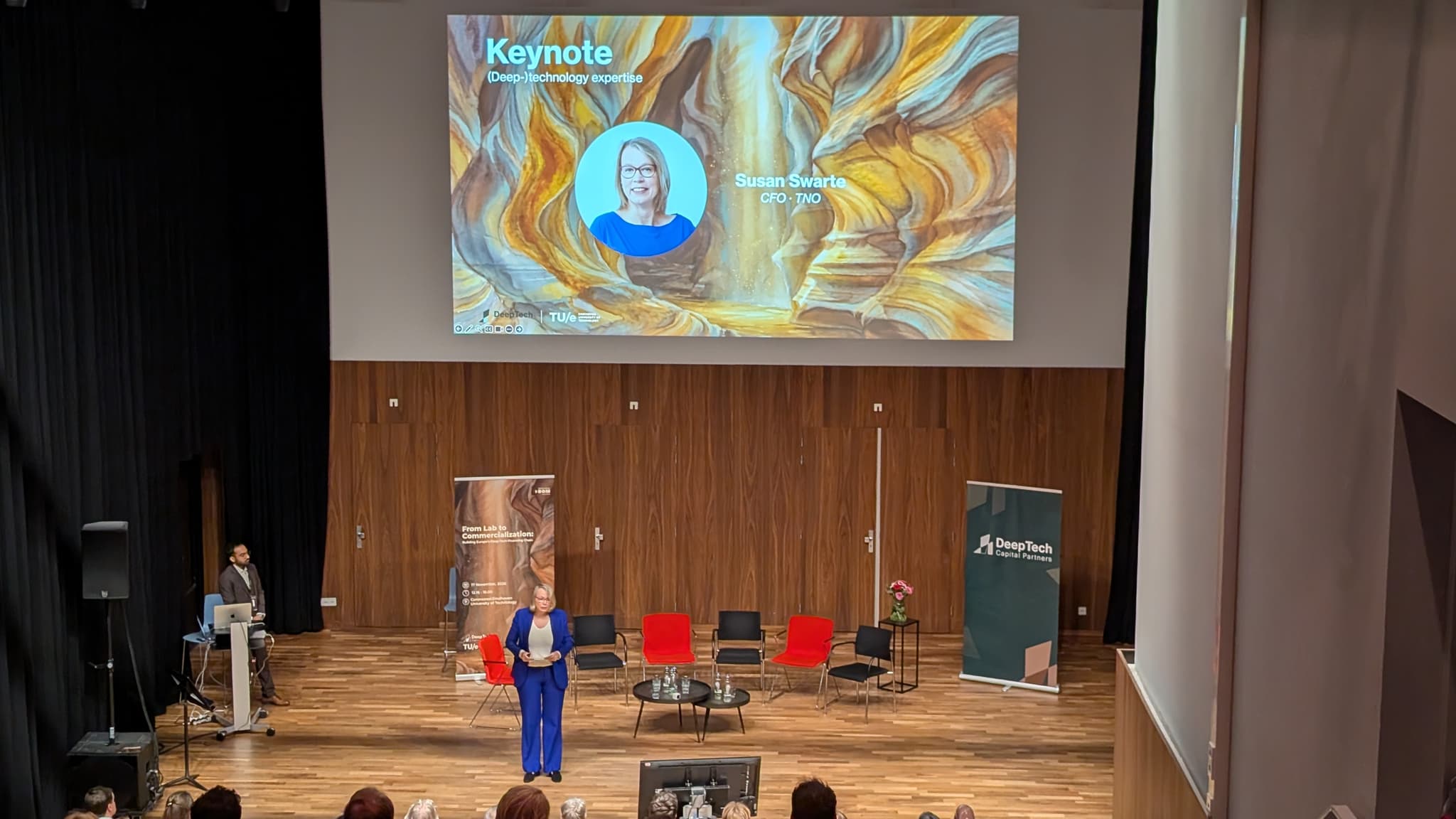
Susan Swarte, TNO
Institutional capital: how PME unlocked €350 million for Dutch innovation
Marcel Andringa, executive board member of the €60 billion pension fund PME (representing 1,600 Dutch metal and high-tech employers, including ASML, NXP, and VDL), offered a candid look at how institutional money actually moves.
For years, PME did not invest in its own sector, partly out of fear of conflicts of interest and partly because standard pension fund mandates require multi-billion-euro fund sizes and 30-year track records that young deep-tech VCs simply lack. That changed a decade ago after PME surveyed its participants and received an unmistakable mandate: invest in our own sector.
By adjusting its governance framework to back smaller, specialised teams alongside co-investors like TNO and ASML, PME has committed €350 million to Dutch innovation funds, including Innovation Industries, DeepTech Capital Partners, and Keen Venture Partners. While private equity overall has lagged public equities since 2021, Andringa revealed that PME’s Dutch startup and scale-up portfolio is delivering an average annual return of roughly 20%, with standout performers like Nearfield Instruments, Axelera AI, and Smart Photonics. With another €400 million to €500 million earmarked for the coming years, Andringa stressed that pension funds can back deep tech, provided governments respect their fiduciary duty to deliver market-rate returns.
Public exit markets: debunking the U.S. IPO myth
Closing the individual keynotes, Euronext Amsterdam CEO René van Vlerken tackled a persistent European dogma: that maturing deep-tech scale-ups must list in the United States to access liquidity and higher valuations.
Citing data from New Financial, HSBC, and Goldman Sachs, Van Vlerken dismantled the myth:
- Underperformance abroad: Since 2021, European companies listing in the U.S. have suffered an average aftermarket performance of -30%, compared to +3% for listings on Euronext.
- Triple the cost: Going public in the U.S. costs roughly three times as much in legal, banking, and audit fees (4–5% in Europe versus 12–15% in the U.S.) and exposes founders to severe personal litigation risks.
- Small fish in a big pond: A €5 billion European scale-up is treated as a mid-cap anchor in Amsterdam, whereas on Wall Street it is an overlooked micro-cap starved of analyst coverage.
Van Vlerken emphasised that the battle for a European IPO is won or lost years earlier, at Series B and C—if a scale-up’s cap table is dominated by U.S. VCs, they will naturally pull the exit across the Atlantic. While welcoming EU reforms toward a Savings and Investments Union and unified market infrastructure, he urged European investors to step up in late-stage rounds so future champions can scale and list at home.
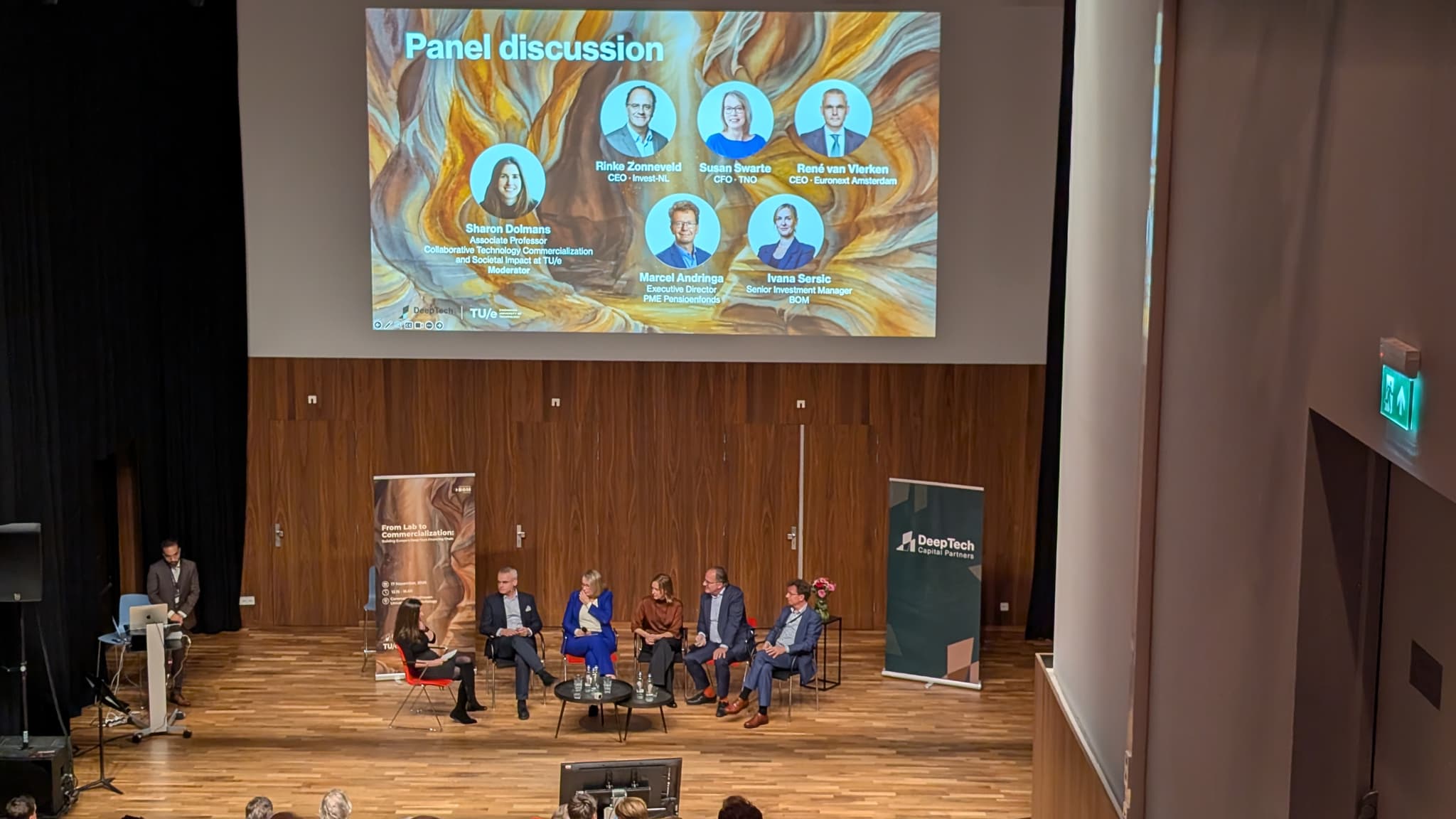
From discussion to action, by 2029
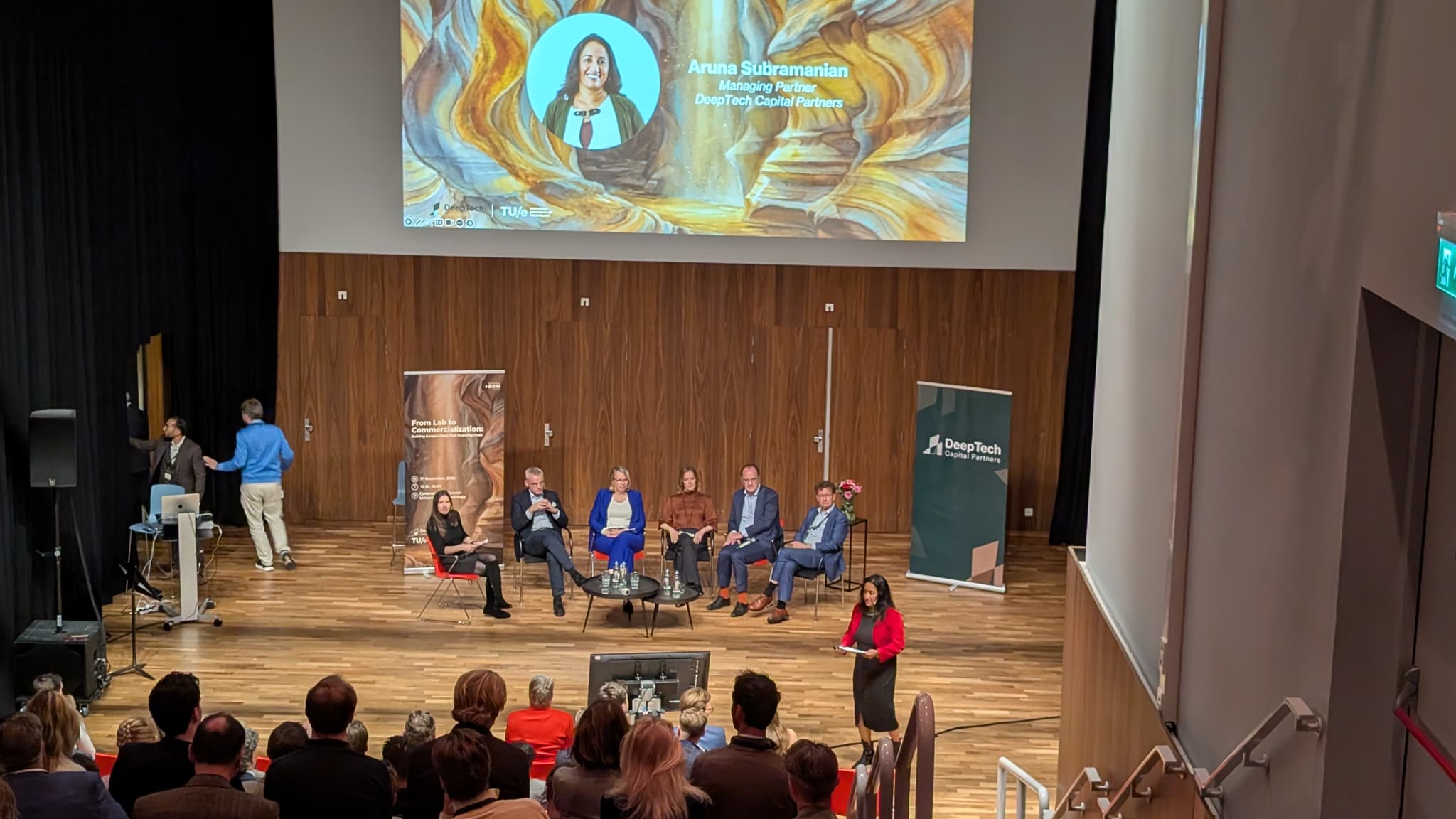
In a lively panel moderated by TU/e Associate Professor Sharon Dolmans, BOM Senior Investment Manager Ivana Sersic Vollenbroek joined Zonneveld, Swarte, Andringa, and Van Vlerken to address practical bottlenecks. Vollenbroek highlighted a cultural hurdle across the ecosystem: a tendency to scrutinise risks and "punch holes" in early business plans rather than backing the potential to build new industries, alongside the need to bring corporate suppliers in as strategic co-investors. Zonneveld also pushed back against media narratives surrounding rounds like QuantWare’s €150 million raise, noting that 80% of the capital came from Dutch investors even when headlines focused on U.S. participation.
Asked what single change they want to see by November 2029, the panellists offered concrete commitments:
- Marcel Andringa (PME): Less talking and more rolling up sleeves across pension funds, VCs, and policymakers.
- Rinke Zonneveld (Invest-NL): Institutional investors embracing venture capital not out of political pressure, but because it is an attractive, high-performing asset class.
- Ivana Sersic Vollenbroek (BOM): More private capital willing to invest in hardware and lab infrastructure, and reframing the "valley of death" around value creation rather than burn rate.
- Susan Swarte (TNO): Focusing on conversion speed so TNO spin-offs employ more people by 2030 than the institute itself.
- René van Vlerken (Euronext): Seeing at least three of the Dutch scale-ups on Marcel Andringa’s portfolio slide complete successful IPOs on Euronext Amsterdam by 2029.
Closing takeaways: "It takes an ecosystem"
Wrapping up the afternoon before attendees headed to the University Club ahead of Mittelmeijer’s formal defence, DeepTech Capital Partners Managing Partner Aruna Subramanian distilled the consensus into a single takeaway: "Europe’s next technology champions will not emerge from better inventions alone. They will emerge if we combine focus, coordinated execution, fast execution, and capital that stays for the entire journey."
Echoing the proverb that it takes a village to raise a child, Subramanian concluded that raising a deep-tech champion takes an entire ecosystem; one that stops treating financing as a relay baton and starts operating as a single, synchronised conversion system.