
The portable artificial kidney that fits in a wheeled suitcase
What's the latest on the portable artificial kidney developed in the Netherlands?
Published on November 23, 2026

Team IO+ selects and features the most important news stories on innovation and technology, carefully curated by our editors.
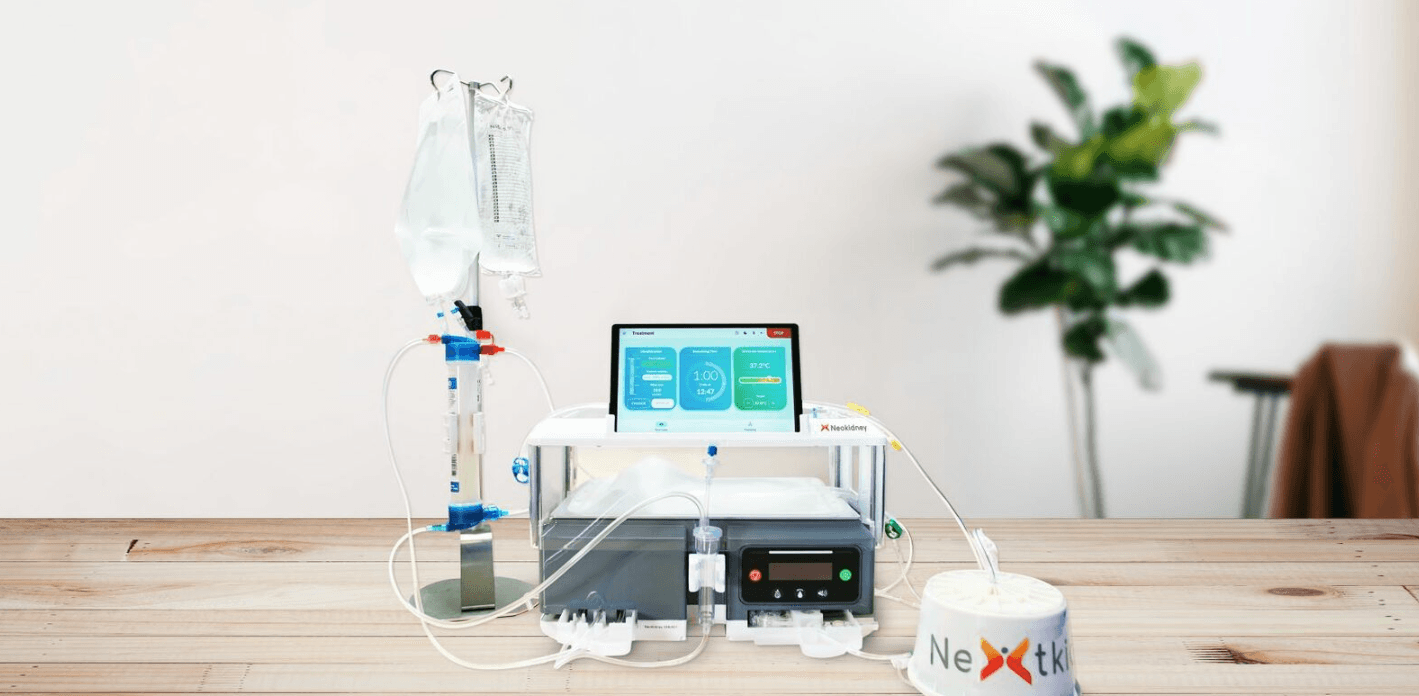
An artificial kidney that fits into a wheeled suitcase and gives patients more freedom to undergo dialysis wherever and whenever they want. It sounds like a vision of the future, but the Dutch Neokidney is getting closer and closer to becoming a reality. After more than ten years of development, 500 treatments have already been successfully performed in European hospitals. The next step: patients using the device independently at home.
Development of the Neokidney began in 2014, when the Dutch Kidney Foundation decided to take the initiative in creating a portable artificial kidney. Existing dialysis machines are large, consume a lot of water, and typically tie patients to a fixed schedule of multiple hospital visits per week. Despite earlier plans by, among others, the Dutch dialysis pioneer Willem Kolff, a compact, mobile artificial kidney remained elusive for a long time.
The reason was not so much a lack of technical capabilities, but primarily a lack of willingness to invest. Developing a medical device requires years of research, clinical trials, and tens of millions of euros, while commercial interest lagged behind. That is why the Dutch Kidney Foundation joined forces with health insurers CZ, Menzis, and Zilveren Kruis. That initiative ultimately gave rise to the Dutch medtech company Nextkidney.
From 500 treatments to home use
The Neokidney has now reached an important clinical milestone. A total of 500 hemodialysis treatments have been performed with the device at four European medical centers, under the supervision of dialysis nurses. The clinical trial phase took place at the University Medical Centers (UMCs) in Utrecht and Leiden, among other locations, and has now been successfully completed.
The next phase began in November 2026. In this phase, the device is being tested in patients’ homes, where they perform the treatments independently. This phase will again involve 500 treatments. The goal is to determine whether the Neokidney not only functions safely and effectively under the supervision of medical staff but is also practical for use outside the hospital.
From hospital schedule to greater freedom
The potential is significant. Dutch kidney patients currently often rely on three dialysis treatments per week, each lasting three to four hours. The Neokidney is designed to make it possible to schedule and perform these treatments more independently, without having to visit a dialysis center every time.
A key component of the technology is a filter containing the enzyme urease. This enzyme breaks down urea, a waste product in the blood, and makes it possible to recycle the dialysis fluid. As a result, the device requires approximately 4.5 liters of dialysis fluid, compared to about 120 liters for traditional hemodialysis. Consequently, the compact machine requires much less fluid and is significantly easier to transport.
The potential implications for healthcare are also noteworthy. Home dialysis can reduce the strain on dialysis centers. According to earlier research by the Julius Center at UMC Utrecht, healthcare costs could drop by at least 30 percent with the portable artificial kidney, provided patients are trained to perform dialysis independently.
Market launch in sight, but not yet a foregone conclusion
Nextkidney expects the Neokidney to become available in early 2028. Before then, the home trials must be successfully completed, and the device must receive CE marking. This certification is necessary to bring the system to the European market.
To finance the final development and testing phase as well as the market launch, Nextkidney has raised over 20 million euros in recent months. Through a crowdfunding campaign, the company is aiming to add another 3 million euros to that total.