
These 6 Dutch startups raised money in July: here is what they do
Every month, we list the investments that caught our attention the most.
Published on August 19, 2026
© Monumental

Team IO+ selects and features the most important news stories on innovation and technology, carefully curated by our editors.
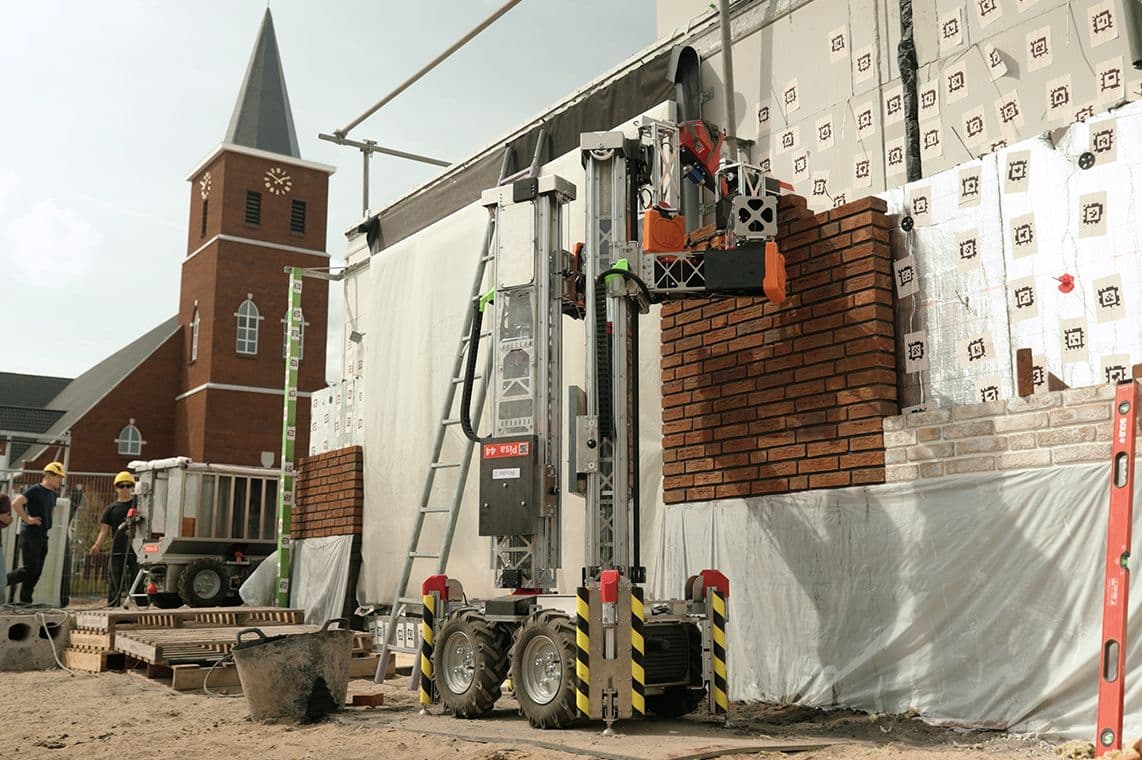
Monumental raises $32M for robots that lay bricks
Amsterdam-based company Monumental raised $32 million for its autonomous bricklaying robots. With this financing round, led by Khosla Ventures, the company aims to expand its robot fleet across Europe and enter the US market.
The core of the company's technology is Atrium, a software system that the startup describes as the connective layer between the digital and the physical sides of construction. Starting with architectural design, the position of every single brick and mortar joint is calculated. Following the creation of a full 3D reconstruction of the construction site, robots can start laying bricks. Every action a robot takes on-site is logged, giving the company a continuous stream of telemetry, video, and quality data it uses to catch errors, monitor performance, and refine the fleet over time.
Xeltis raises €20.5 million for medical implants
The Eindhoven-based medtech company Xeltis has raised €20.5 million in new funding. The funds will be used to advance the development of its aXess™ vascular implant toward approval by the U.S. Food and Drug Administration (FDA) and a launch on the U.S. market.
This implant was developed for patients in need of hemodialysis, a treatment that uses an artificial kidney machine to cleanse the blood when their kidneys no longer function properly. Xeltis implants are designed to enable the body to form new blood vessels on its own. This money will help the company expand production, launch the product in Europe, and work on new medical programs.
Laser printing startup Keiron lands €20 M to fix chip assembly
Keiron Printing Technologies, an Eindhoven-based manufacturer of electronics-assembly equipment, closed a €20.7 million Series A funding round in July. The company makes older paste printing systems built around Laser-Induced Forward Transfer (LiFT), a laser-based, non-contact deposition method, which addresses the shortcomings of traditional solder paste printing.
The company's flagship HF2 LiFT Printer is designed to replace the stencil printer, jet printer, and automated inspection system found on a typical assembly line with a single digital platform. Solder paste printing is the primary cause of defective circuit boards, responsible for 70% of failures. Keiron claims its system can boost industry yield from an industry-typical 60% to above 95%, while cutting lead times, boosting uptime and speeding up line programming.
Protein-rich potato: Wageningen startup lands €5 million
Aardaia, a Wageningen-based agtech startup, raised €5 million to accelerate development of the aardaker, a nitrogen-fixing, protein-rich tuber the company believes could become a new staple crop for Europe. Rather than tweaking the handful of crops the world depends on, the company is focusing on the thousands of existing species on Earth, developing them for modern needs.
The aardaker is a wild tuber found from the Netherlands to central Siberia that was once eaten across Europe but never farmed at scale. The company says the crop pairs the productivity of a root crop with the nitrogen-fixing biology of a legume, meaning that it doesn't require synthetic fertilizer to produce protein. According to the company, the crop could help Europe reduce its dependence on costly, carbon-heavy imported proteins.
Whispp raises 5 million for AI that restores voices
Whispp has raised €5 million in growth funding to further develop its speech technology and roll it out internationally. The company develops AI that can restore weakened or impaired voices. Whereas many existing solutions mainly focus on filtering out noise, the Eindhoven-headquartered company naturally reconstruct voices, building on their natural traits.
This technology is aimed at people with voice impairment and speech disorders. Voice reconstruction happens in real time, directly on a smartphone or computer, without a cloud connection. The software works in multiple languages.
Stroke simulation platform inSteps secures €450K funding
inSteps, a spin-out of Amsterdam University Medical Center, has secured a €450,000 convertible loan to further develop its AI-driven computer simulation platform for developing thrombectomy devices — used to remove blood clots from the brain.
1.1 million EU citizens suffer a stroke every year, resulting in thousands of deaths. In the most severe cases, clinicians use thrombectomy devices to remove blood clots from the brain. Developing these devices, however, is expensive, slow, and heavily reliant on animal models that poorly predict how a device will actually perform in the human body. The startup wants to close this gap with its platform, which enables it to develop and test device models in clinically realistic scenarios, thereby reducing simulation times.