
Trade secrets: the importance of discretion
Trade secret attorney Annelies de Bosch Kemper-de Hilster explains why trade secrets play an important role within organizations.
Published on June 4, 2026

Our DATA+ expert and Editor-in-Chief, Elcke Vels, explores AI, cyber security, and Dutch innovation. Her "What if..." column imagines bold scenarios beyond the norm.
As a business, you can’t start thinking about intellectual property (IP) early enough. Suppose you make an invention—should you go for a patent, a trade secret, or is a combination of the two best? An important lesson from Annelies de Bosch Kemper-de Hilster, attorney at V.O. Patents & Trademarks: contact a patent attorney at an early stage. “Startups are vulnerable. The last thing you want is for important matters to become public knowledge.”
The principle of a patent is fairly simple to explain. As the patent holder, you have the exclusive right to the invention for 20 years. However, that invention must be described in the patent application and thus becomes public knowledge. This allows competitors to specifically search for a ‘workaround.’
.png&w=2048&q=75)
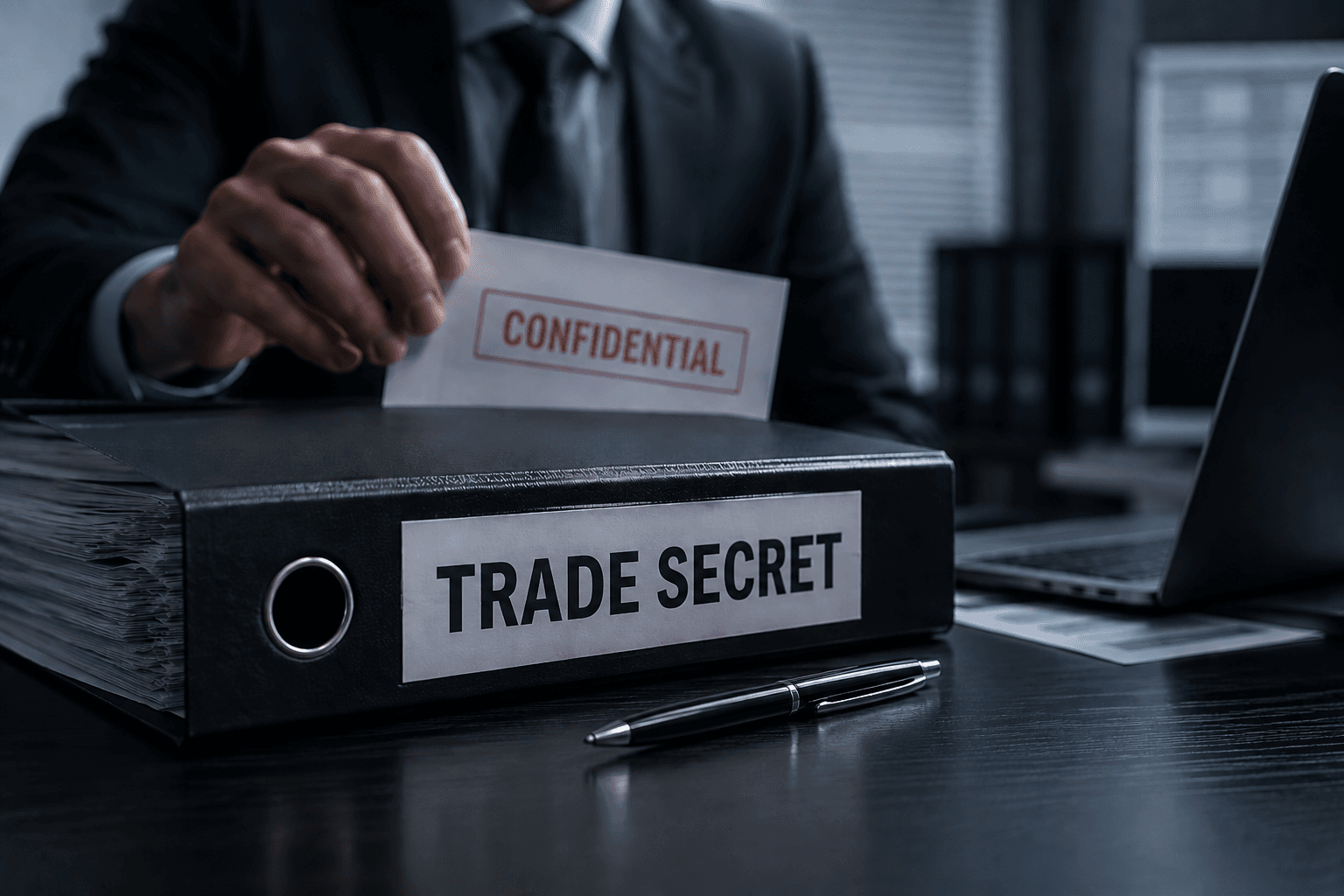
Sometimes, keeping certain elements confidential—whether or not in combination with a patent—is the best option. Trade secrets may relate to technical information, but other types of knowledge may also fall under this category. Examples include commercial, strategic, or administrative information.
V.O. advises inventors and companies of all sizes on patents, NDAs, IP clauses, and confidentiality provisions in contracts. In addition, the firm provides guidance on practical measures within organizations, such as safeguarding sensitive information, access control, and raising awareness among employees.

Annelies de Bosch Kemper-de Hilster
When secrecy works better
There are classic examples that clearly show that secrecy is a smart option, says De Bosch Kemper-de Hilster. “A manufacturer of liquid abrasive once devised a trick that eliminated the need to shake the product beforehand: it always remained a somewhat opaque substance.” That method of preparation might have been patentable, but not broadly enough to ensure that potential workarounds would fall under the patent. The alternatives could not be legally covered. In such cases, confidentiality is often stronger, she explains. “That way, the company maintained a competitive edge without giving competitors more insight than was desirable.”
Protecting a trade secret
The protection of trade secrets is also enshrined in law. To qualify for that legal protection, however, three conditions must be met:
- the information must be secret
- the information has (commercial) value because it is secret
- reasonable measures are taken to keep the information secret.
Especially regarding that last point, companies have their work cut out for them. In addition to the usual contractual provisions such as NDAs and clauses in employment contracts, it is important that everyone is aware of what must be kept secret and that this is always kept in mind. Professional organizations sometimes use a classification system for this purpose. It is a kind of “traffic light model,” the attorney explains. Documents with the color code red are strictly confidential and accessible only to a very select group of employees. Orange information may be shared more widely, but only with explicit permission. Green documents are intended for general use, both within and outside the organization. Contractual provisions such as NDAs and clauses in employment contracts often form the basis.
And more measures are being taken. Now that many people are working in a hybrid model, the emphasis quickly shifts to digital security. Sharing data unsecured via email or cloud storage can undermine the legal status of a trade secret. “Strict IT protocols are therefore not a luxury, but a necessary condition for legal protection,” says the attorney. But in addition to digital barriers such as encryption and restricted access rights, physical measures also play an important role. “Think of a clean desk policy or locked rooms where only authorized personnel with an access card are allowed to enter.” V.O. also points out these kinds of issues and regularly visits companies to check whether everything is properly secured and organized.
The vulnerability of startups
For startups, striking the right balance between sharing and keeping quiet is often a matter of life and death. “Startups are vulnerable. The last thing you want is for important information to be leaked,” the attorney continues. In the early stages, a product is often still under active development, which means it’s sometimes too early to file a patent application. At the same time, it’s precisely for startups that it’s necessary to connect with investors and potential partners. In doing so, it’s often unavoidable that information about technology and processes is shared. For startups, this can be quite a tricky balancing act.
Hologenomix: building a biotech startup
Hologenomix receives support from V.O. in determining the right strategy regarding patents and trade secrets. The startup is developing a technique to extract large quantities of cell-free DNA and RNA from urine. This material could ultimately help with more sensitive detection of conditions such as cancer. While existing techniques often rely on small blood samples, Hologenomix focuses specifically on large urine volumes. This provides more genetic material to work with, which can make diagnostic tests more accurate.
Hologenomix is currently in the middle of the development phase. Co-founder Eric van der Toorn: “In the coming months, we’ll focus on research to reduce the need for bladder removal in patients with muscle-invasive bladder cancer. At the same time, we’re working on a machine that will eventually commercialize the technology.” In this phase, protecting the technology is becoming increasingly important.
According to Van der Toorn, as a founder, you need to be well-versed in various areas—from financing and leadership to intellectual property protection—even though the latter is a specialty in itself. “For us, the transition from just founders to an organization with employees was quite significant. Suddenly, you’re dealing with multiple levels of access and restrictions.” That’s why you have to explicitly define certain things. What is confidential and what isn’t? Of course, you trust your employees—otherwise, you wouldn’t hire them. But if something ever goes wrong, it must be clear that certain information was actually treated as a trade secret.”
Hologenomix, the founder explains, received valuable advice on this from V.O. “They also helped us draft a patent application. We could turn to them with questions like: should we go for a Dutch or international patent, and what data do we need?” The patent has since been filed; what is being patented is the machine, while the method remains confidential.
“As a startup, you simply can’t know everything. I would therefore urge other aspiring entrepreneurs: reach out to a party that understands IP,” says Van der Toorn.
Not a black-and-white choice
De Bosch Kemper-de Hilster agrees. “Engage a patent attorney early on. They can assess what makes sense in that specific case. Often, it’s not as simple as choosing between a patent and a trade secret. Even if you ultimately opt for a patent, there may still be a layer of trade secrets surrounding it. A patent doesn’t protect everything; the know-how surrounding it is often just as important. ”
Another important lesson, she concludes, is to create awareness about trade secrets within the organization right from the start. “A startup can’t start this early enough. It’s not enough to sign an NDA just once. A good strategy requires repetition, training, and constant vigilance.”
Sponsored
This story is the result of a collaboration between V.O. Patents & Trademarks and our editorial team. IO+ is an independent journalism platform that carefully chooses its partners and only cooperates with companies and institutions that share our mission: spreading the story of innovation. This way we can offer our readers valuable stories that are created according to journalistic guidelines.
Want to know more about how IO+ works with other companies? Click here