
Turning night into day: Luna's smart glasses lighting up the dark
Luna has designed a pair of glasses to help people with night blindness see clearly in the dark.
Published on October 1, 2026
© Tim Rensing - Luna
Mauro swapped Sardinia for Eindhoven and has been an IO+ editor for 3 years. As a GREEN+ expert, he covers the energy transition with data-driven stories.
The first time a young woman with night blindness tried a prototype of Luna’s glasses, the device looked nothing like glasses. It was a bulky headset held together with tape, with wires running to a backpack that held a laptop and a power bank. A computer mouse dangled from the back so she could scroll through image settings. Makeshift as it was, it let her spot a hedgehog in the grass, and she cried — she had never seen one before.
“We never thought people would want this device to see hedgehogs in the dark,” says Karst Hoogsteen, founder of the Arnhem-based company. The glasses mean more than getting from A to B in the dark, but regaining independence.
Finding a solution for himself – and the others
Hoogsteen started the company because he is affected by retinitis pigmentosa (RP). This inherited disease affects about 1 in 4,000 people and gradually destroys the retina's light-sensitive cells, starting with the rods that handle dim and peripheral vision.
As his own sight declined, Hoogsteen turned to computer science and moved to the United States to work in an ophthalmology lab at Harvard Medical School, researching how cameras and near-eye displays could improve vision for people with visual impairments. When the pandemic hit, he returned to the Netherlands and started Luna, determined to build something that could help people like him and his brother – also affected by RP.
His first idea was a shortcut: write software for existing smart glasses. A shelf in Luna's office still holds the attempts, from Google Glass and Meta and Sony headsets back to Nintendo's 1990s Virtual Boy. None had been designed with night vision in mind. The challenge turned out to be fitting what is essentially a smartphone into a glasses frame, where "even if a component is super small, it's already too big,” he explains.
From nothingness to light
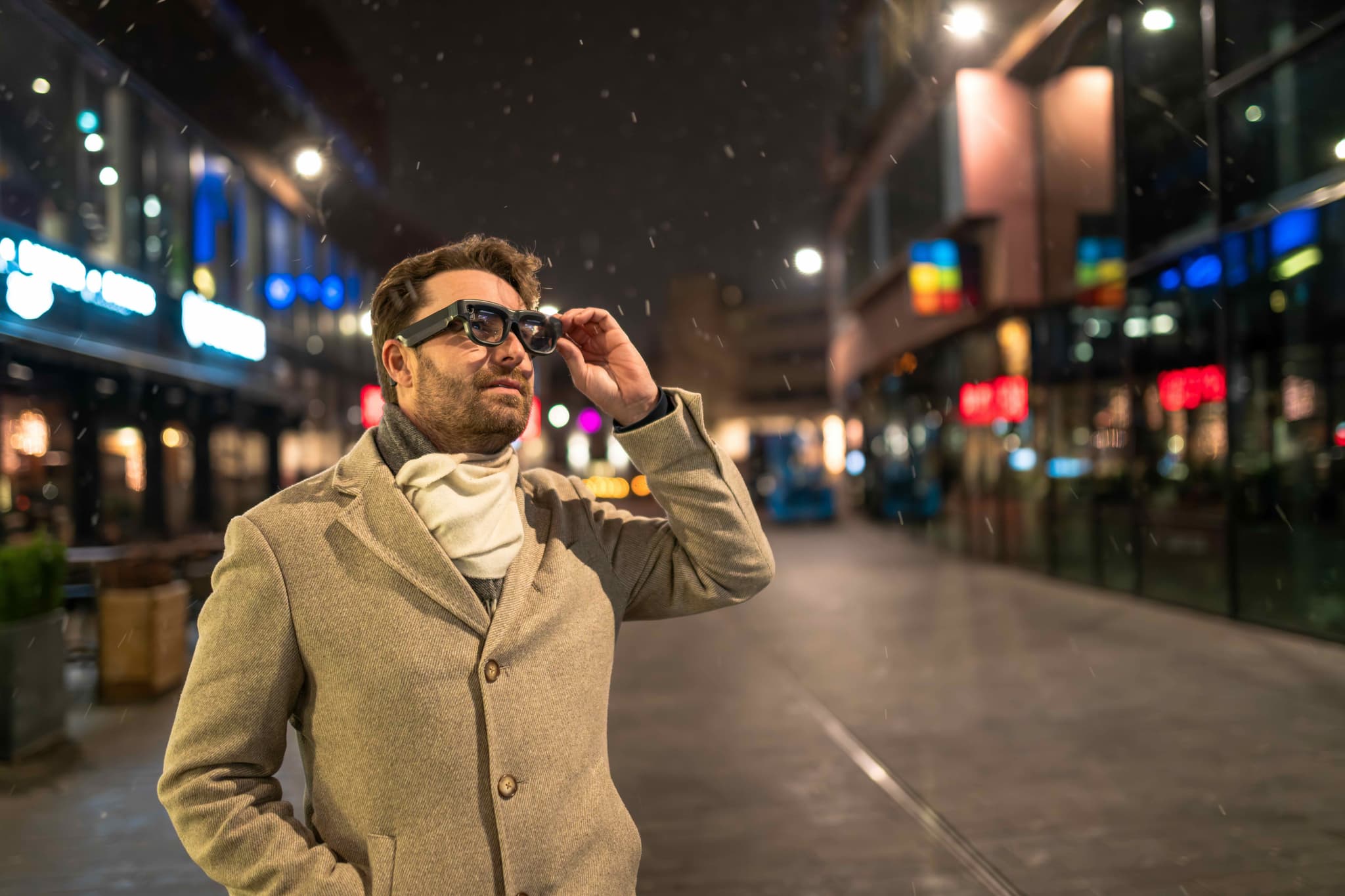
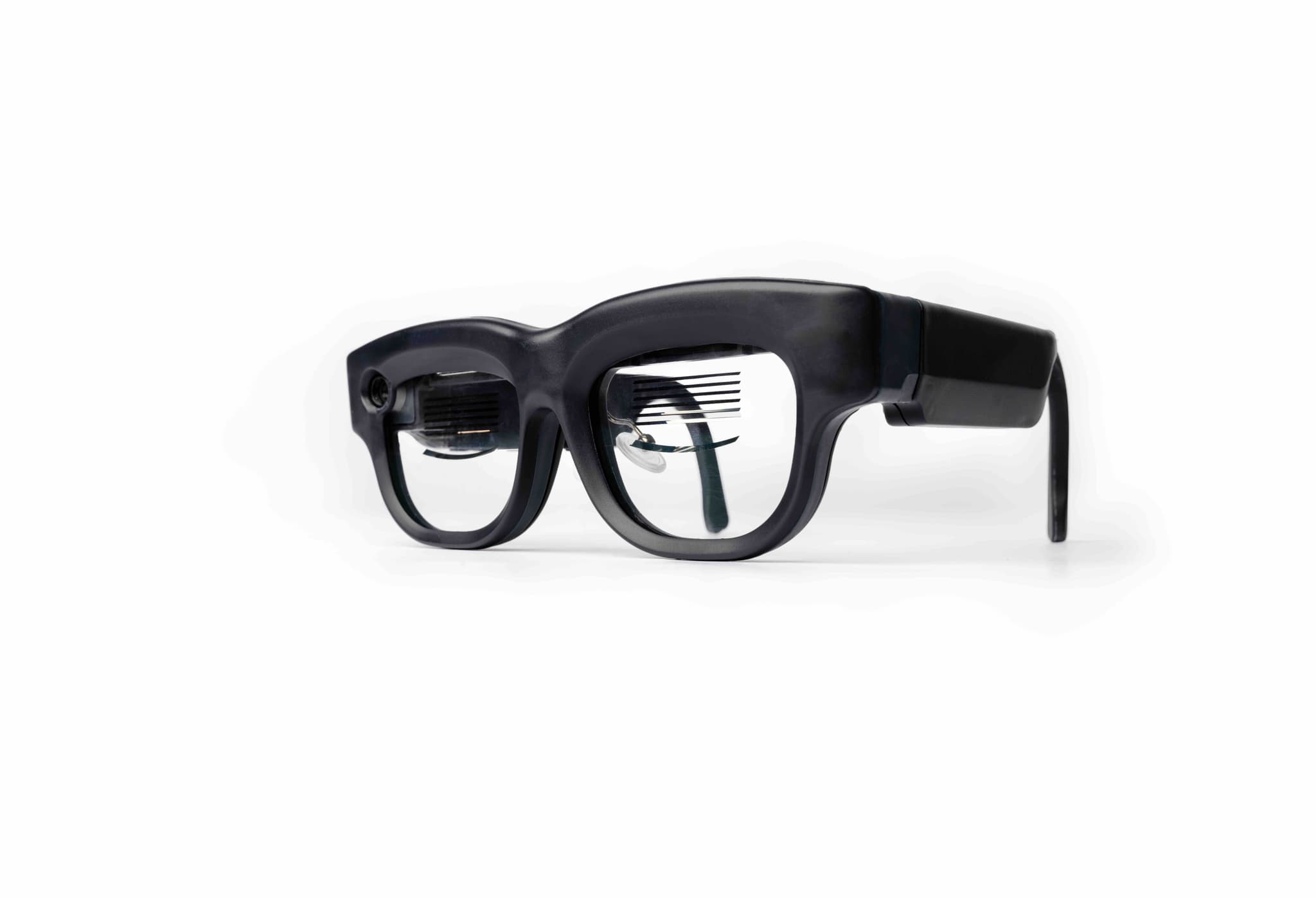
Luna’s glasses integrate a tiny night-vision camera, and a small processor embedded in the frame corrects the image for color, brightness, and contrast. A small projector at eyebrow height sends that image into waveguides, the see-through lenses, where tiny mirrors reflect it into the wearer's eyes in real time.
"Without the glasses, it's just black, just nothingness," Hoogsteen says of his own street after dark. "I see the points of the streetlights, but not where the light hits the ground, or a front yard, or a house." With the glasses on, he sees his neighbors' gardens, and he can tell that the flowers are red and the plants are green.
© Tim Rensing - Luna
A necessary aid
For people affected by RP, street lamps, lit windows, and moonlight aren't enough to walk safely to a bus stop or back from a restaurant toilet. According to a study Luna ran with a rehabilitation center, some patients need up to a thousand times more light than normal to detect the same objects.
Night blindness reaches well beyond RP. Around a quarter of people with glaucoma struggle in low light, and conditions such as choroideremia and congenital stationary night blindness cause it too. Hoogsteen estimates some 20 million people worldwide live with night blindness that can't be treated.
That is where Luna's approach comes in. Because the lenses are see-through and the camera decides what to amplify, the glasses can brighten a dark street while leaving an oncoming car's headlights alone. "That's too bright, let's not display it; that's too dark, let's amplify the light there," Hoogsteen explains. Night driving is a long-term goal, though, he admits, "it will take some time to get there."
Make them as close to a pair of glasses as possible
The first 50 pairs of Luna glasses went to those Hoogsteen calls early adopters. On its website, the company is now accepting pre-orders for a second production round of 500 pieces. The price ranges from €3,500 to €5,000, depending on the configuration.
Luna has recently closed a funding round – the amount hasn’t been disclosed — which will help the startup improve design. This is key to helping people feel comfortable using them. “The smaller we make it, the more people will find it acceptable to use in their daily lives. It is important for people not to stand out and wear their medical dossier on their face,” Hoogsteen underlines.
The glasses can run for about an hour on their battery, and longer if connected to a power source — they keep working while charging. This is not much of an issue, user feedback confirms, as the glasses are mostly worn for short outings, such as walking to the bus stop or strolling the dog.
Overcoming the stigma on camera glasses
Camera glasses have recently been under scrutiny. Privacy concerns around Meta wearables have fueled the debate in recent weeks. Luna is striving to change the narrative, showing how camera glasses can actually help people see. Its camera glasses can’t record videos or take pictures. The images are gone after the user has seen them.
A security guard once asked Hoogsteen whether he was filming while visiting a dimly lit museum. “I showed him how the camera feeds the lens, and that it makes things brighter. He was very understanding and allowed me to use them.”
Luna is now considering a card users can show, with a link to an official statement confirming the glasses can't record.
His long-term goal is broader than night blindness: to build a company that uses cameras and displays to help people "see better, perceive more." Most smart glasses today are designed for entertainment and photos. He thinks that leaves space for one built to improve human vision. Still, they should not become a new white cane, but rather a normal pair of glasses.