
Would you panic if air conditioning were banned?
In the column series “What If…,” Elcke Vels explores intriguing scenarios that deviate from the status quo.
Published on June 27, 2026

Our DATA+ expert and Editor-in-Chief, Elcke Vels, explores AI, cyber security, and Dutch innovation. Her "What if..." column imagines bold scenarios beyond the norm.
Air conditioning is anything but an elegant, sustainable way to cool down. There are better methods for cooling homes and cities. Why did we even build houses and cities where air conditioning is necessary in the first place? In this column, we’ll conduct a thought experiment. We’ll consider a scenario in which air conditioning is suddenly banned. And we’ll explore whether we’ll finally feel the urgency to seriously embrace sustainable alternatives.
When I opened my weather app a few days ago, I had to look twice. Does it really say 35? Am I confusing the 3 with a 2? I took another close look: no. Today is going to be a struggle.
.png&w=2048&q=75)
So the first thing I do is plug in the air conditioner. Just like many other Dutch people, I imagine. It’s certainly a nice and easy way to cool off. A sustainable solution? Definitely not.
The numbers don’t lie
I’m sure you’ll agree with me when you look at the numbers. Portable air conditioners are the least efficient: they consume up to 20 times more energy than a fan. Even the classic split-system air conditioner is anything but sustainable: on average, it consumes about 0.7 kWh per hour per room, which amounts to roughly 0.6 kilograms of CO₂ emissions after three hours of cooling—comparable to a 12-minute hot shower. And that’s still an underestimate, because cooling often takes place at times when solar energy isn’t available, forcing the power grid to rely on additional fossil fuels.
On top of that, air conditioners are placing an increasingly heavy burden on the power grid. On hot summer days, the growing number of air conditioners creates peak demand on the grid, with summer loads now approaching those of the coldest winter evenings. And then there are the refrigerants in the systems themselves: often hydrofluorocarbons, greenhouse gases that are hundreds to thousands of times more potent than CO₂. In short: air conditioners remove heat from our homes, but at the same time contribute to a world that will be uninhabitable in the long term.
Air conditioning is being banned. Now what?
For many people, the answer to the question of whether we can do without air conditioning right now will be “no.” For the elderly, young children, and people with asthma, a hot home is simply unbearable. A valid question is: why did we build a city where air conditioning is necessary in the first place? Why did we remove grass from gardens and replace it with stone and tiles? Surely there must be a better way.
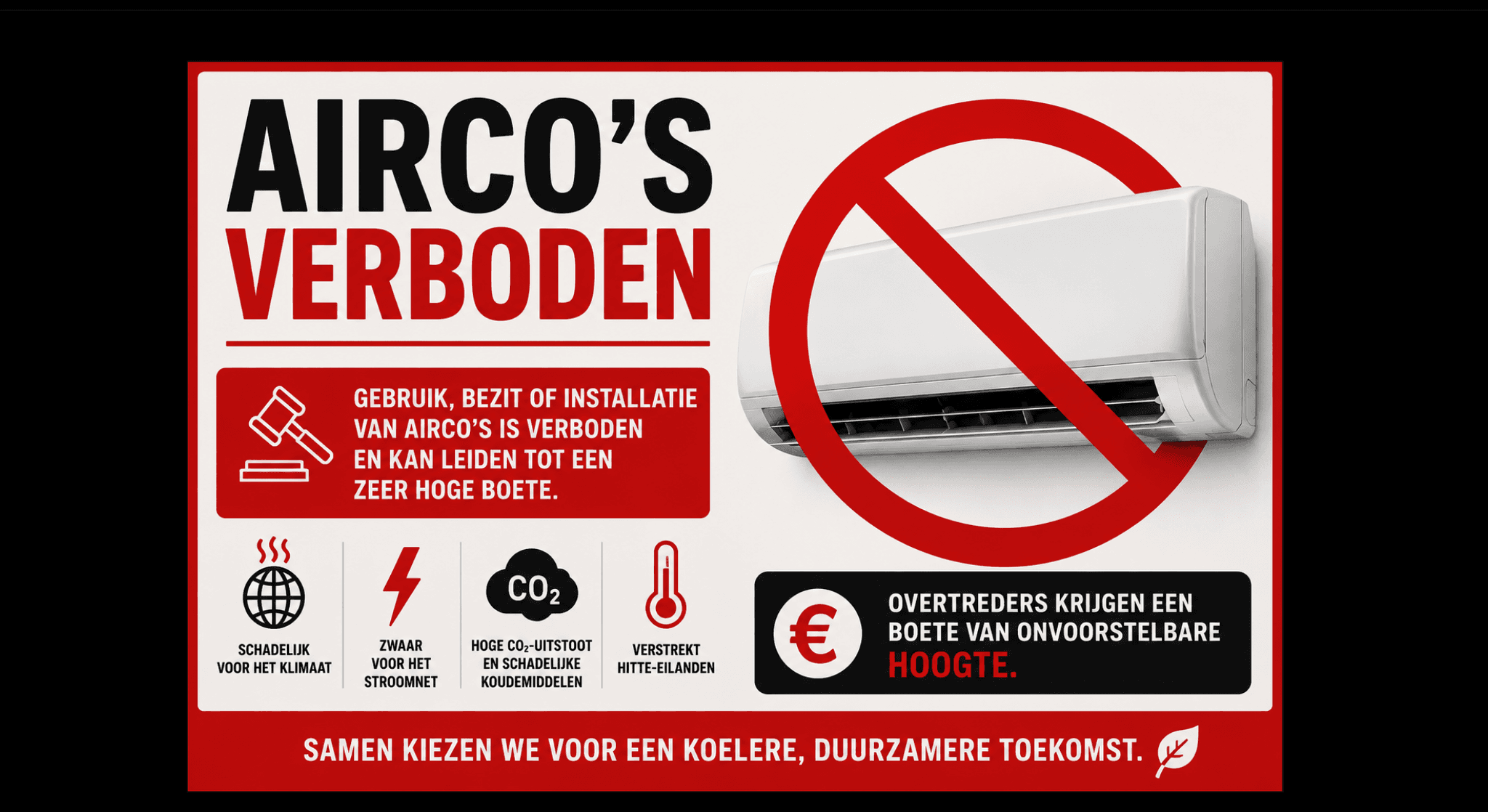
Imagine: starting tomorrow, for whatever reason, air conditioning is banned. It’s no longer available in regular stores—only on the dark web. But anyone who uses it anyway faces a fine of unimaginable proportions. What measures would you take at home to make it at least somewhat livable? And how should we adapt our cities in that case?
A livable home
There are entire experimental sites in the Netherlands dedicated to researching climate adaptation. Natural resources and the right materials determine how hot it gets in a home and/or city.
Let’s first take a look at a home. The first step is surprisingly simple: keeping heat out instead of actively cooling. That starts with insulation that works not only against the cold but also against the heat: thick walls, well-insulated roofs, and reflective materials that bounce sunlight back instead of absorbing it. Nighttime ventilation also plays a major role: homes that intelligently open up as soon as the outside temperature drops, allowing stored heat to escape naturally. Green roofs and facades have also been shown to help lower indoor temperatures through evaporation and shade. This has been practiced for decades in warm countries, and in the Netherlands, too, there is growing interest in this type of passive cooling as an alternative to energy-intensive air conditioners.
Heat islands a thing of the past
At the urban level, the focus is on breaking up heat islands, which are currently exacerbated by concrete, asphalt, and glass. Innovations focus on “cooling structures” in the city: more trees and water features that lower the ambient temperature through evaporation, and light, reflective materials that absorb less heat. In addition, wind corridors are being designed: open urban axes where natural air currents can move freely through the city and warm air is carried away. Urban density also plays a role: cities are designed so that heat isn’t trapped between tall buildings but can circulate and escape. Combined with smart water management and shade-providing infrastructure, this creates a city that cools itself passively, without relying on energy-intensive systems.
Conclusion
So the idea that we can’t do without air conditioning is nonsense. There are dozens of other cooling techniques that are much more sustainable and smarter. We just need to start applying them more seriously. A green roof like that would also look surprisingly good—and a subsidy wouldn’t be an unnecessary luxury.
Until then, something simpler will do. I’ll grab a pear popsicle from the freezer.