
You don’t learn workplace integration from a textbook
Han Rahimi (We’RHERE) is building a community that helps newcomers move from their first job to real career growth.
Published on February 3, 2026
Bart, co-founder of Media52 and Professor of Journalism oversees IO+, events, and Laio. A journalist at heart, he keeps writing as many stories as possible.
and We’RHERE sounds like a welcome, but it is also an acronym: We Are Highly Educated Refugee Employees. “Quite a mouthful,” founder Han Rahimi says with a laugh, “but at least it’s clear.” That double meaning captures the essence: people are already here and ready to work.
The platform has now existed for five years and has grown faster than Han ever dared to imagine: around 5,000 members, more than 1,000 of whom are now employed across a wide range of sectors. Every week, about 100 volunteers return to the system. “Sometimes I don’t even know my volunteers,” Han says. Not as a complaint, but almost with pride: it has grown beyond one person.
Maakkracht with Han Rahimi
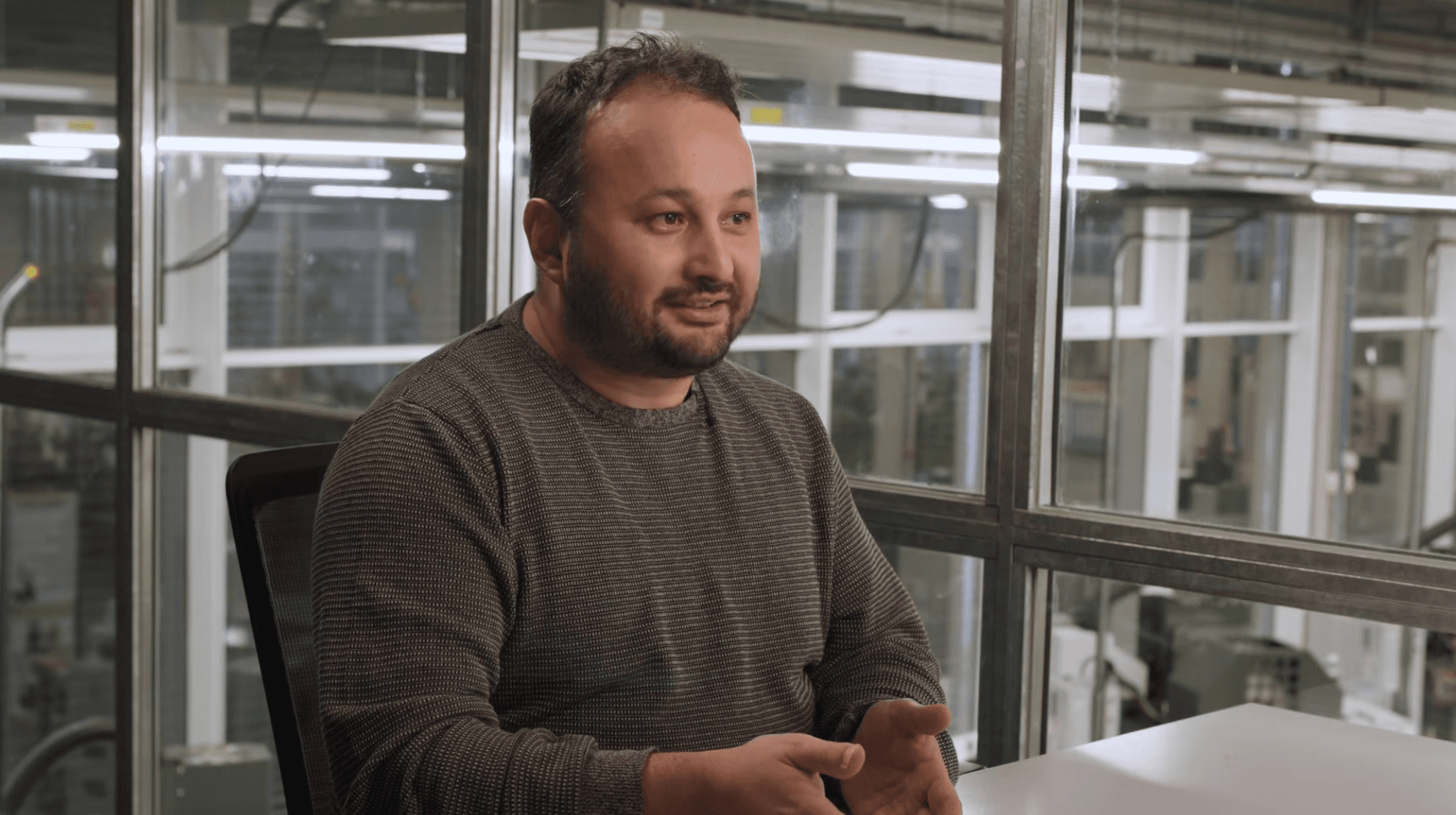
Maakkracht ("Creative Power") is the podcast in which the Leidse Instrumentenmakers School (LiS) shows just how broad - and human - the world of manufacturing really is. In this episode, Han Rahimi joins as the project leader and initiator of We’RHERE. His message: if you are new to the Netherlands, you need not only to find a job but also to learn how things work here. And that is something you don’t learn in a course, but by experiencing it. On the work floor. With people beside you. Behind Han is a setting that fits the story: the LiS workshop. Machines, metal, precision. But today the conversation is mainly about something else: culture, language, trust, and how to finally let existing talents come into their own.
We’RHERE works with 67 municipalities, now also organizes accredited training programs (including language education), and guides around 250 people per year into employment, directly and indirectly. But the most interesting aspect is not the numbers. It is the method.
Two phases: first settling in, then growing
Han explains it using a timeline that he makes strikingly concrete: 0 to 8 years after arrival. That is their playing field. Not because integration “has to” take eight years, but because that is how the system works, and We’RHERE responds to that reality.
Around year three or four, people often find their first job. Not the “dream job,” but the job in which someone learns how a Dutch workplace sounds, smells, and moves. “People’s potential and their language level often don’t align at the beginning,” Han says. That is not criticism of newcomers—it is a diagnosis of reality.
Around year seven comes the second step: a new job or advancement within the same company. That is when talent truly unfolds. “We focus not on what someone is missing, but on what someone can become,” is the underlying philosophy.
And notably, We’RHERE does not limit itself to “placements.” They stay involved. Because culture is not a checklist.
External Content
This content is from youtube. To protect your privacy, it'ts not loaded until you accept.
Peers as accelerators
Perhaps the second unique strength is the most powerful: the community trains itself. People who already have jobs return on weekends to help others: practically, professionally, and emotionally. And above all: recognizably.
Han himself arrived as a refugee in 1998 and has now lived in the Netherlands for 27 years. Precisely for that reason, he says, he is sometimes less “credible” to newcomers than someone who arrived just one or two years earlier. “Then they say: Han, come on, you’ve been here too long.”
The real accelerator is the peer: someone who is still close to the experience and can say, I went through this last year too—and look, it worked out.
This principle recurs: information alone is not enough. “Making information your own is different from simply receiving it,” Han says. Only when you see someone who resembles you does the feeling arise: I can do that too.
Manufacturing: technology, IT, and a huge hunger for people
We’RHERE focuses on four main sectors: education, finance & administration, IT, and technology—precisely the areas where the Netherlands is crying out for talent.
Han even calls We’RHERE “the largest retraining provider of status holders toward IT,” with 120 retraining programs per year. For technology, he works with a growing pool of 250–260 engineers in the network, many of whom have now been placed.
But there is also a second movement: people who already have jobs but want to switch into technology or manufacturing. According to Han, this is an overlooked opportunity. The Netherlands focuses too much on “the first job,” while the second job is often when language skills, confidence, and workplace experience come together.
Then he says something every HR manager in the industry should write down: “You have to experience Dutch work culture. It’s not just information or training. You have to live it.”
A few “aha moments,” as he calls them—meetings, informal codes, humor, feedback—the things that never appear in a handbook but determine whether someone feels at home.
Why collaborating with LiS makes sense
The conversation naturally lands on the recording location: LiS. Han sees the plans around modular education and lateral entry as an opportunity to make currently invisible talent accessible. He already visited a company day with a group of members. The effect was immediately visible: companies saw the people—and the people saw the sector.
“There is potential you don’t currently have,” Han says. Meaning: that potential already existed, but it was invisible.
According to him, the next step is twofold: preparation and workplace guidance. Not just entry, but continued support—preferably in peer groups. Language, confidence, context: factors that often make the difference between dropping out and growing further.
The real integration challenge: language (especially social language)
Han becomes sharp when discussing language education. He compares the Netherlands to Germany: four days of language school there, then targeted preparation for work. Here: “three half-days” and a long path toward B1. “I don’t know who came up with that,” he says dryly.
He also makes an important distinction: there is course language, and there is social language. You learn the latter by participating: volunteering, joining sports clubs, and engaging in activities. “Nobody asks whether you speak B2,” he says, “but everyone hears how you speak.”
Thinking in potential, not burden
If Han could express one dream, it would be a shift in perspective: seeing refugees and status holders not as a burden, but as potential. Yes, there is trauma. But there is also a need for people, and there is untapped experience.
His example is personal: his father, a businessman, was on his way to building a large company in the Netherlands within a few years. But due to a lack of information and support, he left. For Scotland. “And then we lose that potential.”
It is a painful but precise example of what We’RHERE aims to prevent: not just helping people into jobs, but preventing the Netherlands from unnecessarily pushing talent away.
What companies can do: look differently and build smarter
Han’s advice to companies is pragmatic: stop making assumptions. Too many programs focus on lower-skilled roles, while mismatches often occur among mid- and high-skilled newcomers. Don’t place people too low “because it’s easy.” Create space for growth.
Build scalable systems. Large companies can do this internally: cohorts, learning paths, career progression. SMEs can do it externally: shared talent pools, introductions to multiple companies, “shopping” for the right match. We’RHERE can help in both cases, Han says, because they offer both volume and guidance.
He adds a bonus argument the manufacturing sector should appreciate: internationalization. “If an SME is thinking about new markets, suddenly you have international people in-house who can help you.”
Community as the answer to a tight labor market
Perhaps that is the core of this episode: at a time when everyone is expected to navigate their own path individually, Han argues for community—not as a soft concept, but as a practical system. People motivate one another, show what is possible, and bring knowledge back to the group.
“Join the system,” he says. “Seeing is believing.”
And that may be the most manufacturing-worthy lesson of all: you only truly learn by doing. In the workshop. On the work floor. With people beside you.